
Work agents are examined in terms of their systems, capabilities, and optimization.
Work agents combine foundation models and runtime harnesses, covering persistence, openness, work forms, capabilities, optimization, and outcomes.
Key Takeaways
- Work agents are defined as systems that combine foundation models, runtime harnesses, and stateful workspaces to execute delegated tasks and deliver verifiable digital-work outcomes.
- The paper introduces a unified framework based on two dimensions: work persistence and work openness, plus five forms of digital work to describe task scope and structure.
- Reliable agent performance depends on five core capability families and on optimizing the foundation model, the runtime harness, or both together.
- Evaluation should shift from assessing isolated responses to measuring whether agents complete delegated work with verifiable results.
- Future research directions include sustained work delegation, adaptation to open environments, and capability improvement through ongoing execution.
Meta description: This paper presents work agents as systems combining foundation models and runtime harnesses, with two dimensions, five work forms, and outcome evaluation.
Tags: work agents, foundation models, runtime harnesses, digital work, agent evaluation
Featured image: abstract technology style with connected workflow nodes and stateful task tracks, no real people, no company logos, no text
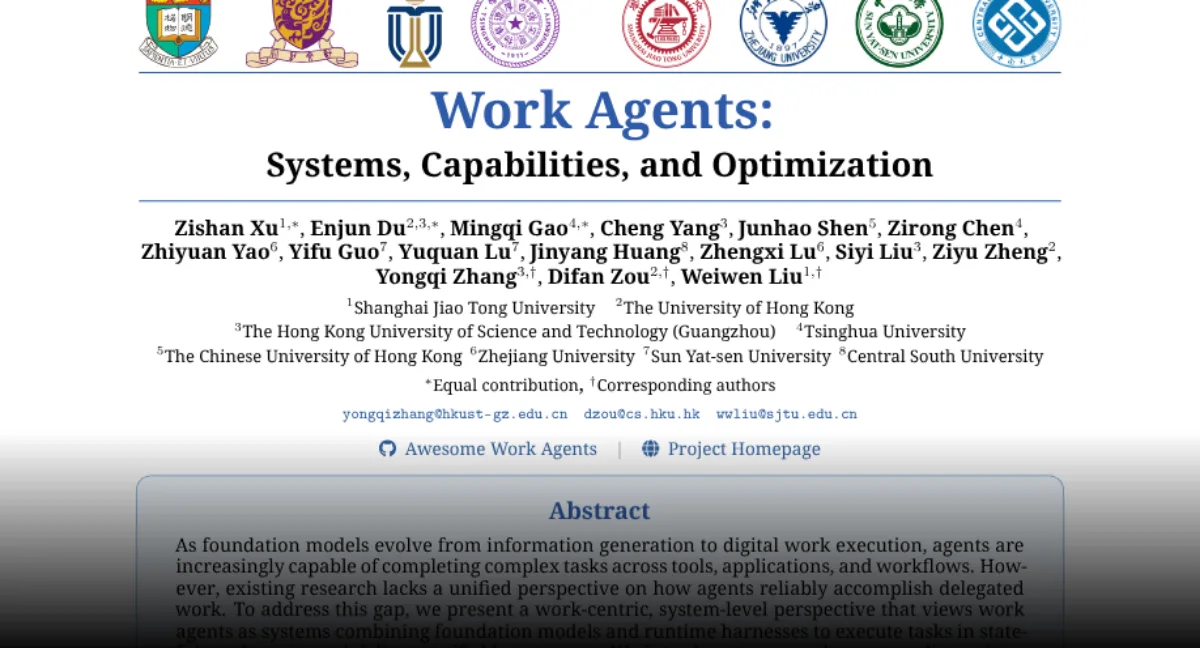
A paper introduces a unified perspective on work agents, systems that combine foundation models and runtime harnesses to execute delegated tasks in stateful workspaces and deliver verifiable outcomes. The framing matters because foundation models are moving from information generation toward digital work execution, where agents must operate across tools, applications, and workflows. Existing research, the paper says, lacks a common way to describe how agents reliably complete delegated work.
Background: From Generated Answers to Executed Work
The paper shifts attention from whether an agent can produce useful text to whether it can complete a job. A foundation model is the large model base that supports reasoning and generation, while a runtime harness is the surrounding software layer that lets the agent interact with tools and carry out steps. A stateful workspace keeps the task environment available as work progresses, which is central when tasks are long, multi-step, or dependent on earlier actions.
This perspective is useful because digital work is not just a single answer or a short chain of calls. It requires continuity, tool use, and outcomes that can be checked. The paper treats work agents as systems rather than isolated models, which makes evaluation depend on how well the whole setup completes delegated work.
Development: Two Dimensions and Five Forms of Digital Work
The framework describes working conditions through two complementary dimensions: work persistence and work openness. Work persistence refers to how much continuity a task requires across steps and time. Work openness refers to how variable or unstructured the surrounding environment may be. These dimensions help distinguish simple, bounded tasks from longer or more open-ended work.
The paper also classifies digital work into five forms according to task scope and organization. This classification connects the kind of work being delegated with the capabilities an agent needs. Instead of treating all agent tasks as one broad category, it gives researchers a way to compare systems based on the structure and demands of the work itself.
Capability and Optimization Pathways
Building on that framework, the paper identifies five core capability families required for reliable work execution. It then examines approaches to model optimization, harness optimization, and their joint optimization. Model optimization improves the foundation model itself. Harness optimization improves the runtime system that manages tools, context, and task state. Joint optimization considers both together, because the reliability of a work agent may depend on how well the model and the harness are coordinated.
This distinction matters because progress in agent systems does not come from one component alone. A stronger model may be limited by a weak runtime environment, while a better harness may not be enough if the underlying model cannot reason or act effectively. The paper's framework places both elements inside a single system view.
Evaluation and Research Directions
The paper analyzes existing evaluation methods and metrics from the perspective of work outcomes. Rather than measuring only isolated responses, this approach asks whether the agent can produce verifiable results in delegated work. It also outlines future research directions, including sustained work delegation, adaptation to open environments, and the interaction between work execution and capability improvement.
These directions point to a longer path for agent research. The focus is not only on completing a task once, but on whether agents can keep working over time, adjust when conditions change, and improve through the process of execution.
Current Stage: A Unified View for Reliable, Verifiable Work
At present, the contribution is a unified framework for understanding, optimizing, and evaluating work agents. It supports the development of systems capable of delivering reliable, verifiable, and practically valuable work outcomes. For readers, the value lies in a clearer map of what must improve when agents move from information generation to dependable digital work: persistent task execution, openness to changing environments, five forms of digital work, five capability families, and the combined optimization of models and harnesses.
Comments
No comments yet. Be the first to comment.