
Fine-Grained Embodied Interaction Within a Multi-Agent Egocentric World Model
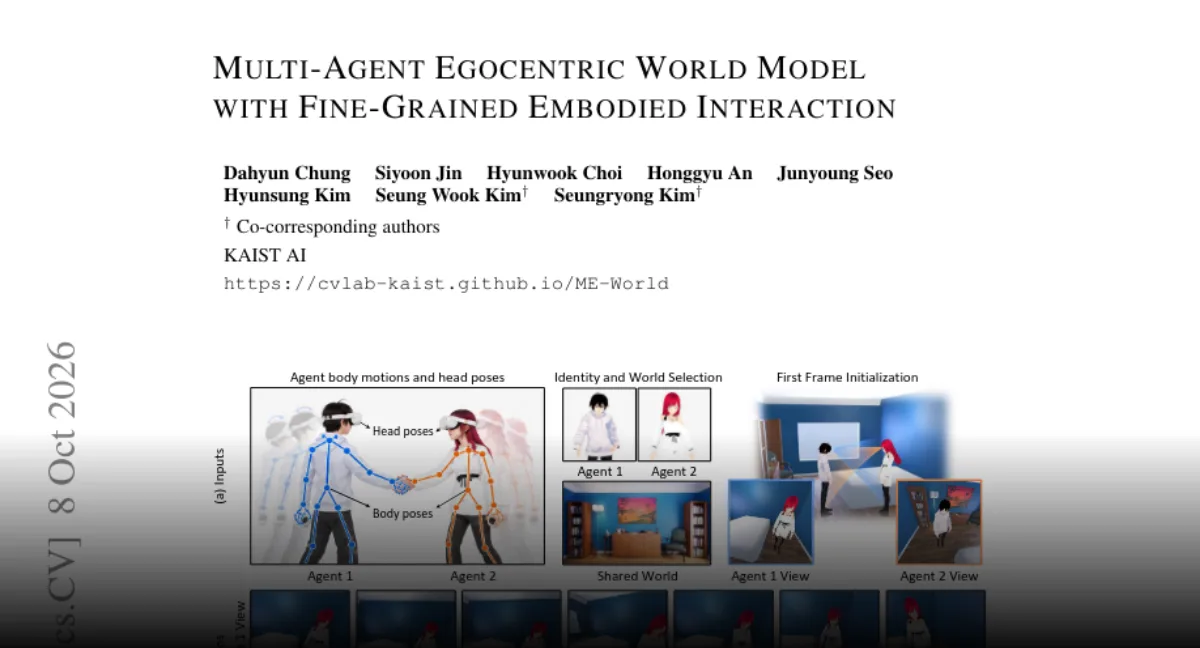
ME-World predicts first-person views for multiple agents in shared environments, using synchronized streams and consistency metrics for embodied AI.
Key Takeaways
- ME-World extends egocentric world modeling from a single agent to multiple agents sharing the same environment, addressing real embodied-AI settings where robots or humans interact around one another.
- The paper reframes first-person prediction as a coordinated problem, requiring cross-view action consistency, shared-environment consistency, and consistent propagation of interaction-induced state updates.
- Its core architecture generates synchronized ego streams through a shared token sequence, allowing each agent’s future observation to depend on both its own actions and the actions of other agents.
- The work introduces evaluation metrics for environment, update, and identity consistency, providing a testable framework for comparing multi-agent egocentric world models.
- The main contribution is the consistency framework for coordinated first-person prediction, rather than a published benchmark score table, and it points toward future testing in more complex scenes and longer interaction horizons.
Meta description: ME-World extends egocentric world modeling to multiple agents, using synchronized ego streams, action conditioning, and consistency metrics for embodied agents.
Tags: Egocentric world models, multi-agent systems, embodied AI, world modeling, ME-World
Featured image: Abstract technology style, no real people, no company logos, no text.
ME-World is a multi-agent egocentric world model that extends first-person observation prediction from a single agent to multiple agents acting in a shared environment. The change matters because egocentric prediction has long been framed around one viewer and one action stream, while real embodied systems often operate around other moving agents, robots, or humans. ME-World's contribution is not just a new model name: it reframes prediction as a coordinated problem where each agent's view must stay aligned with its own actions and with the actions of others.
Background: Egocentric world models started with one agent
Egocentric world models predict first-person observations conditioned on an agent's actions. That formulation is useful for navigation, manipulation, and planning because it ties sensory predictions to the consequences of movement. In a single-agent setting, the model can treat the world as changing mainly through that agent's choices. The camera perspective, the action sequence, and the future observation all belong to one actor.
Most egocentric world models focus on single-agent settings. The limitation is structural. If multiple agents move, the first-person view of any one agent depends on more than its own actions. Other agents may block the scene, change the layout, or create new events. A model that only conditions on one action stream can become incomplete once the environment contains several independent sources of change.
Development: Shared environments exposed three consistency problems
The move from single-agent prediction to multi-agent prediction created 3 consistency problems. ME-World's formulation turns them into explicit requirements. First, cross-view action consistency: each agent's predicted first-person observation must match the actions that agent is taking. Second, shared-environment consistency: the separate ego streams must describe one coherent world rather than several disconnected simulations. Third, consistent propagation of interaction-induced state updates: when one agent acts, the consequences must flow into the future observations of other agents, not remain isolated in a single viewpoint.
These requirements explain why multi-agent egocentric world modeling is harder than generating several independent first-person videos. The challenge is not only visual realism. It is relational consistency across viewpoints, identities, actions, and state changes.
Latest Progress: ME-World synchronizes ego streams and adds evaluation metrics
The proposed system addresses the problem by generating synchronized ego streams for multiple agents. Instead of treating each viewpoint as an independent prediction task, ME-World uses one shared token sequence to carry information across agents. Each agent's stream is conditioned on its own actions, while the shared representation lets other agents' actions affect the state. This is the core architectural shift: first-person prediction becomes a joint modeling task.
Evaluation follows the same logic. The model is trained and evaluated on 2 kinds of data: real and synthetic multi-agent data. The work also introduces shared-world consistency metrics covering environment consistency, update consistency, and identity consistency. These metrics aim to measure whether the generated streams remain aligned with each other, with agent identities, and with the state changes caused by interaction.
Reported experiments show improvements on these consistency aspects. The available summary does not provide numerical benchmark scores, so the contribution is the consistency framework itself rather than a published score table.
Current Stage: A framework for coordinated first-person prediction
The current stage is a model and evaluation framework for multi-agent egocentric world modeling. Its value is to make the transition from one viewer to many viewers testable: synchronized ego streams, shared token conditioning, and consistency metrics give researchers a concrete way to compare multi-agent prediction systems.
For readers, the takeaway is that embodied AI is shifting from asking what a robot will see if it moves, to asking what several agents will see as they move, react, and interfere. ME-World does not remove the uncertainty in real-world deployment, but it clarifies the technical requirements: each viewpoint must stay tied to actions, identities, and a shared state. The next question is whether the consistency gains hold across more complex scenes, longer horizons, and richer agent interactions.
Comments
No comments yet. Be the first to comment.