
MC-Sparse: Analyzing and Bridging the Dense–Sparse Attention Gap in Diffusion Transformers
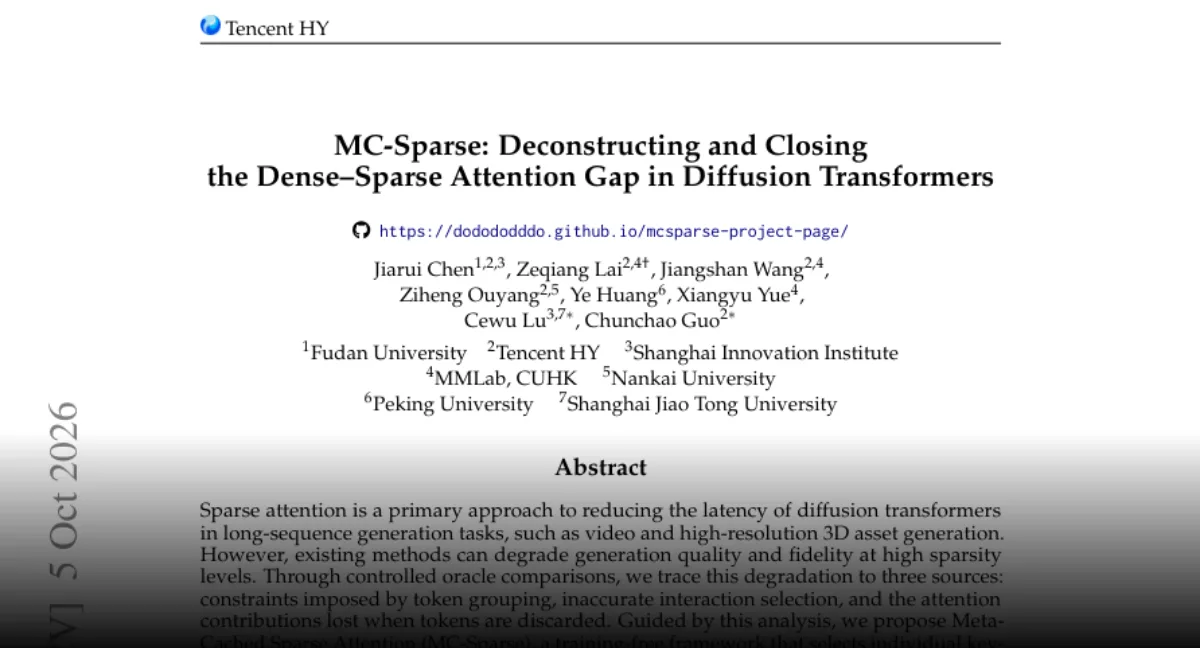
Diffusion transformers create long video and 3D outputs by repeatedly denoising token sequences, making dense attention expensive. MC-Sparse, a training-free Meta-Cached Sparse Attention framework, bridges the dense-sparse attention gap by selecting individual key-value tokens while keeping tile-aligned query groups for efficient GPU execution. It also caches metadata such as query groups and attention-derived KV indices across denoising steps. Controlled oracle analysis identifies token grouping, inaccurate interaction selection, and discarded contributions as key quality losses. MC-Sparse targets these issues, reporting 1.80x denoising speedup on Minimax-H3-Base and 2.32x on 3D asset generation with negligible fidelity loss versus dense attention.
Key Takeaways
- MC-Sparse is a training-free sparse attention framework for diffusion transformers, targeting the high latency caused by dense attention in long-sequence video and 3D generation.
- It reduces attention cost by selecting individual key-value tokens and organizing queries into tile-aligned groups, while avoiding model retraining.
- The method caches metadata such as selected KV indices and dense-versus-sparse attention residuals, then reuses them across denoising steps to avoid repeated computation.
- Reported results show 1.80x denoising speedup on Minimax-H3-Base and 2.32x on 3D asset generation, with negligible fidelity loss compared with dense attention.
- MC-Sparse addresses common sparse-attention quality issues from token grouping constraints, inaccurate token selection, and discarded attention contributions, improving both speed and output quality.
Meta description: MC-Sparse reduces diffusion transformer latency in video and 3D generation with 1.80x and 2.32x denoising speedups while preserving output fidelity.
Tags: MC-Sparse, diffusion transformers, sparse attention, Minimax-H3-Base, 3D asset generation

Diffusion transformers build long visual outputs by running repeated denoising steps, where attention over token sequences becomes a major latency source. MC-Sparse, short for Meta-Cached Sparse Attention, is a training-free sparse attention framework aimed at that bottleneck. It keeps selected interactions between queries and stored key-value (KV) tokens, then reuses cached metadata across denoising steps. The method reports a 1.80x denoising speedup on Minimax-H3-Base and a 2.32x speedup on 3D asset generation, with negligible quality loss compared with dense attention.
Background: Long Sequences Make Dense Attention Expensive
Diffusion transformers are used for long-sequence generation tasks, including video and high-resolution 3D asset generation. Dense attention means every query can look at all key-value entries. That full interaction pattern is expressive, but it makes each denoising step costly as sequences grow. Sparse attention reduces that cost by letting queries attend to a smaller subset of key-value tokens.
The trade-off has been quality. Existing sparse attention methods can degrade generation fidelity when sparsity is high. Skipping too many interactions can remove useful context and weaken output quality. The work traces this degradation to three sources: constraints imposed by token grouping, inaccurate interaction selection, and attention contributions lost when tokens are discarded.
Development: From Oracle Analysis to MC-Sparse Design
The work uses controlled oracle comparisons to isolate where standard sparse attention loses fidelity. A token grouping constraint can force queries into blocks that do not match their true attention needs. Inaccurate interaction selection can keep the wrong key-value tokens. Discarding tokens can remove attention contributions that still matter for the output.
MC-Sparse addresses those points directly. Instead of relying only on grouped interactions, it selects individual key-value tokens. It still organizes similar queries into tile-aligned groups, which helps GPU execution because GPUs work efficiently when memory access and computation align to regular tiles. The framework is training-free, so it does not require retraining the diffusion transformer model.
The other core piece is metadata caching. MC-Sparse stores query groups, the key-value indices chosen using exact attention probabilities, and residuals between dense and sparse attention outputs. These residuals capture the difference between full attention and sparse attention. During subsequent denoising steps, the cached metadata is reused, reducing the need to recompute selection information from scratch.
Latest Progress: Measured Speedups and Fidelity
Across video and 3D generation models, MC-Sparse is reported to achieve higher fidelity to dense-attention outputs than existing sparse-attention baselines. It also gives larger denoising speedups. The results are given relative to dense attention: 1.80x on Minimax-H3-Base and 2.32x on 3D asset generation.
Those numbers matter because they separate two goals that often compete: faster generation and preserved output quality. A sparse method that only speeds up a model but visibly weakens video or 3D assets may not be usable. MC-Sparse is positioned as a method that improves both sides of that trade-off, at least in the reported tests, without visible quality degradation.
Where the Work Now Stands
The current stage is a method-level result: MC-Sparse demonstrates that training-free sparse attention can be made more faithful to dense attention by refining token selection, query grouping, and cached metadata reuse. For readers watching diffusion transformer deployment, the key signal is that long-sequence generation remains a latency problem, and sparse attention is still the main practical route to reduce it. The next point to watch is whether this style of exact-probability-based KV index caching and residual reuse spreads to more video, 3D, and transformer generation pipelines without changing the model weights.
Comments
No comments yet. Be the first to comment.