
Retrieval-Oriented Deep Learning in Expanding Nonparametric Neural Networks
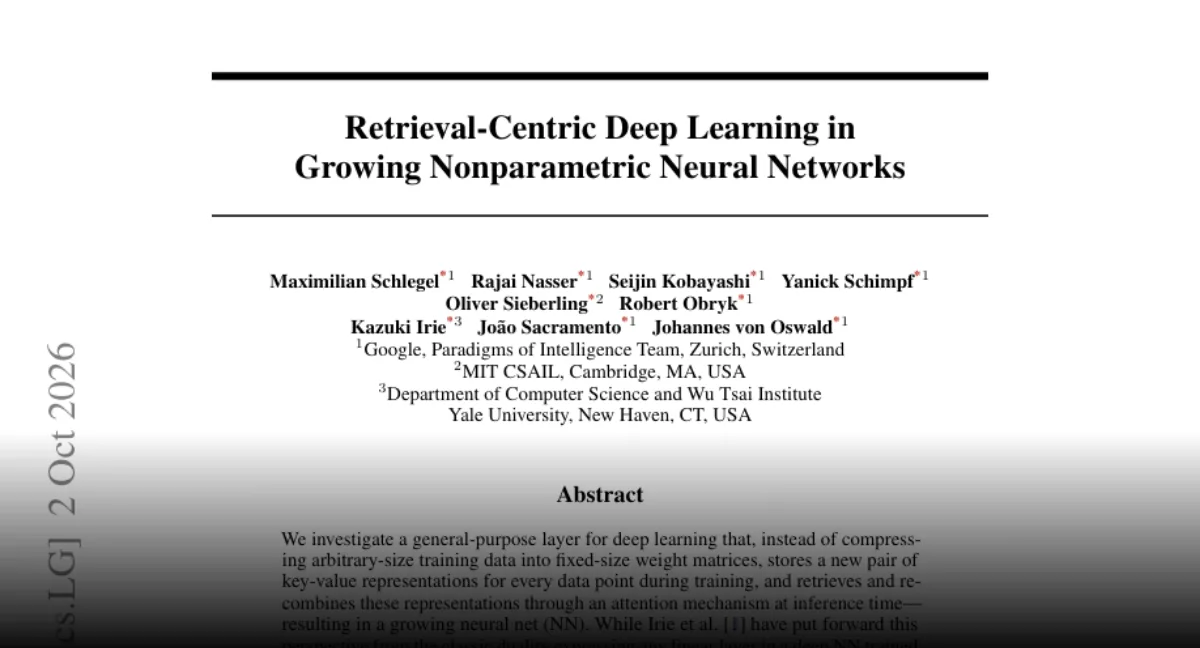
The paper reframes linear-layer training through the duality between gradient descent and linear attention, then replaces linear attention with softmax attention, DeltaNet, and Mesa layers to create retrieval-centric, growing nonparametric layers. This approach is tested on simple regression and classic CIFAR, showing strong performance and sample efficiency. The result suggests expressive attention-based retrieval can enrich neural architectures beyond fixed-weight linear layers.
Key Takeaways
- The paper proposes retrieval-oriented deep learning by building on the duality between gradient descent and linear attention, reframing linear layers as retrieval systems rather than fixed-weight modules.
- It replaces standard linear attention with more expressive mechanisms such as softmax attention, DeltaNet, and the Mesa layer to create growing nonparametric layers.
- The retrieval-centric design allows a layer’s effective capacity to expand with retrieved information, linking model performance to what the network can attend to during computation.
- Early evidence on simple regression and classic CIFAR suggests strong performance and sample efficiency, indicating that attention-like retrieval can be a richer alternative to conventional linear layers.
Meta description: A retrieval-centric deep learning paper builds on the duality between gradient descent and linear attention, using softmax, DeltaNet and Mesa layers.
Tags: Retrieval-Centric Deep Learning, Linear Attention, Gradient Descent, Softmax Attention, DeltaNet
Featured image: Abstract technology-style diagram of glowing retrieval vectors connecting data points to a growing memory layer, with no people, logos, or text.
One paper proposes retrieval-centric deep learning by building on a well-known duality that links two ideas: the training of linear layers by gradient descent, and linear attention. Instead of keeping standard linear attention as the retrieval mechanism, the paper replaces it with more expressive variants: softmax attention, DeltaNet, and the Mesa layer, to obtain growing nonparametric layers. The paper demonstrates strong performance and sample efficiency on simple regression and classic CIFAR, positioning attention-like retrieval as a richer alternative to fixed-weight linear layers.
Background: The Duality Between Gradient Descent and Linear Attention
Linear layers are basic neural network components that combine inputs through weighted sums. Gradient descent trains them by adjusting those weights in the direction of the loss gradient. The duality highlighted in the paper connects ordinary gradient-descent training of linear layers with linear attention, an attention-like mechanism often associated with efficient sequence modeling.
This connection matters because it gives linear-layer training a retrieval interpretation. Rather than viewing a layer only as a fixed matrix of learned weights, the duality suggests that the layer can be understood as attending to information that was relevant during training. In that view, linear attention becomes a bridge between optimization and representation.
Development: From Linear Layers to Retrieval-Centric Layers
The paper takes the duality as a starting point and then asks what happens if the retrieval mechanism is made more expressive. It keeps the retrieval-centric framing, but replaces standard linear attention with three named alternatives: softmax attention, DeltaNet, and the Mesa layer.
Softmax attention is the familiar attention mechanism that normalizes scores across possible values, while DeltaNet and the Mesa layer are attention-like designs named by the paper as more expressive replacements. The goal is not merely to swap one layer for another, but to create growing nonparametric layers.
Here, nonparametric is used in a capacity sense: the layer’s effective behavior can expand with the data or memory it retrieves, rather than being confined to a static set of parameters. This is where the paper’s “retrieval-centric” label becomes concrete: the model’s power is tied to what it can retrieve and attend to during computation.
Latest Progress: Evidence From Simple Regression and Classic CIFAR
The paper evaluates the proposal on simple regression and classic CIFAR. These tasks are useful because they test different kinds of learning behavior. Regression asks whether the layer can learn continuous mappings efficiently, while classic CIFAR probes image-level representation in a well-known benchmark setting.
The result described is strong performance and sample efficiency. Sample efficiency is the practical part of the claim: a retrieval-based layer may learn useful structure from fewer examples if it can lean on expressive attention patterns instead of relying only on a fixed weight matrix. No specific scores are provided, so the significance lies in the direction of the result rather than a measured number.
Current Stage: A New Layer Family, Not a Completed System
The paper is currently at the stage of a proposal with targeted evidence. It has connected a known duality between gradient descent and linear attention to a new retrieval-centric architecture, then tested softmax attention, DeltaNet, and the Mesa layer as replacements for standard linear attention.
What comes next is whether growing nonparametric layers retain their sample efficiency beyond simple regression and classic CIFAR, and whether the retrieval-based design remains practical when memory and attention patterns expand. For now, the paper’s contribution is the reframing: linear layers can be viewed as retrieval systems, and more expressive attention variants can make that view central to deep learning.
Comments
No comments yet. Be the first to comment.