
SpaceCast-Bench: Assessing Predictive Spatial Reasoning in Vision-Language Models
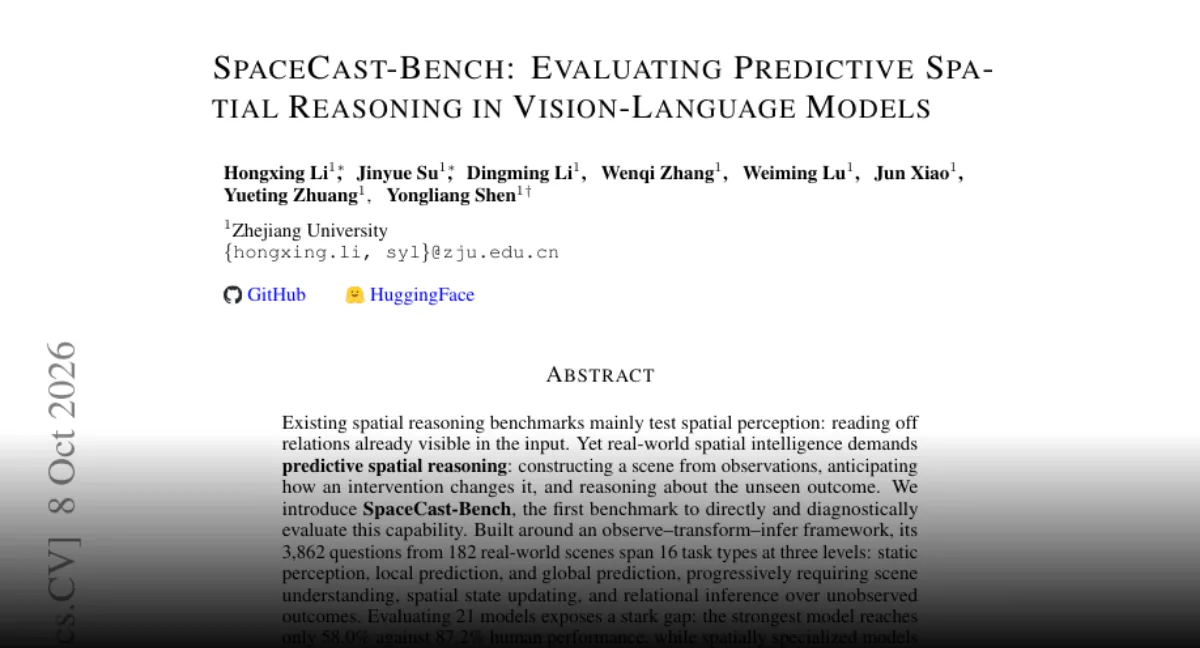
SpaceCast-Bench tests VLMs with 3,862 questions across 16 tasks, measuring static perception, local prediction, and global reasoning.
Key Takeaways
- SpaceCast-Bench is a benchmark for predictive spatial reasoning in vision-language models, testing whether models can infer unseen spatial outcomes rather than only describe visible images.
- It includes 3,862 questions across 16 task types, organized into static perception, local prediction, and global prediction.
- The benchmark separates basic visual recognition from forward-looking spatial inference, helping identify where model failures occur.
- Public code and dataset are released, enabling reproducible evaluation of multimodal spatial reasoning abilities.
Headline: SpaceCast-Bench Adds 3,862 Questions for Vision-Language Spatial Reasoning
Meta Description: SpaceCast-Bench tests vision-language models with 3,862 questions across 16 task types for static perception, local prediction, and global spatial reasoning.
Tags: Vision-Language Models, Spatial Reasoning, AI Benchmarks, Predictive Spatial Tasks, Hugging Face Dataset
Featured Image: abstract technology illustration of translucent cubes, arrows, and grid nodes transforming in a digital landscape, no people, logos, or text
SpaceCast-Bench is a benchmark for predictive spatial reasoning that asks vision-language models to go beyond describing images and infer unseen outcomes of spatial transformations. The paper introduces the benchmark with 3,862 questions spread across 16 task types, covering static perception, local prediction, and global prediction. For readers following multimodal AI, the contribution is a sharper test of whether models can connect visual evidence with spatial consequences, not just produce fluent captions.
Background: From Image Recognition to Spatial Forecasting
Vision-language models are systems that take images and text as input and generate language-based outputs. Many earlier evaluations measured whether a model could identify objects, read text in images, or answer questions about visible details. Those tasks remain useful, but they do not fully test a harder capability: using what is visible now to reason about what could happen next in a space. Predictive spatial reasoning fills that gap. It asks a model to consider movement, arrangement, occlusion, scale, or transformation and then infer an outcome that is not directly shown. This kind of reasoning is central to tools that manipulate 3D scenes, support navigation, or help a user understand how a physical layout may change.
Development Process: A Benchmark Built Around Three Reasoning Levels
The SpaceCast-Bench paper frames the problem through three broad areas. Static perception provides the base layer: a model must understand the scene as it is presented. Local prediction moves one step forward, asking the model to reason about a specific part of the scene and the result of a spatial change. Global prediction widens the scope, requiring the model to account for the whole arrangement rather than only one object or region. The benchmark contains 3,862 questions across 16 task types, giving the evaluation a structured set of prompts rather than a single vague category. The task split is important because it separates failures in basic recognition from failures in forward-looking spatial inference.
Latest Progress: Public Code and Dataset Links
The released materials include a code repository at https://github.com/ZJU-REAL/SpaceCast-Bench and a dataset at https://huggingface.co/datasets/hongxingli/SpaceCast-Bench. The code repository and dataset provide the public materials associated with the benchmark. The dataset holds the question set tied to the 16 task types. Because the benchmark is built around unseen outcomes, its practical value depends on consistent scoring and comparable model responses across static, local, and global categories.
Current Stage: A New Probe for Multimodal Spatial Ability
SpaceCast-Bench sits at the point where visual understanding and predictive reasoning meet. Its 3,862 questions and 16 task types create a common way to test whether vision-language models can forecast spatial results instead of only describing visible content. The next signal to watch is not a single headline score, but how the three reasoning areas behave under evaluation: whether a model that performs well on static perception also succeeds at local prediction, and whether global prediction reveals a separate weakness in scene-level reasoning.
Comments
No comments yet. Be the first to comment.