
Persistent Behaviors and Partial Functional Transfer of Co-evolved Communication in Evolutionary Robotics
The study examines whether a communication protocol co-evolved in a 2D simulation can work on two e-puck-type robots in 3D hardware without retraining. Using GRU controllers, it finds partial transfer: some message-driven behaviors persist, but robust joint task completion is lost. The result warns that learned signals are tightly tied to their original spatial and sensing environment.
Key Takeaways
- The study tests whether a co-evolved GRU communication protocol can transfer directly from a 2D simulation to 3D physical robots without retraining.
- The result is partial: some communication-driven behaviors persist, but robust task completion is not preserved.
- The findings show that emergent communication is not only a message pattern, but also depends on the environment in which it was learned.
- Adding explicit directional cues helps some cases but does not fully solve the transfer problem.
- The main implication is that sim-to-real communication transfer requires compatible spatial, sensor, and behavioral conditions, not just a preserved protocol.
Meta description: Paper tests a co-evolved GRU communication protocol for two e-puck-type robots from 2D simulation to 3D hardware without retraining, showing partial transfer.
Tags: Emergent communication, Sim-to-real robotics, Multi-agent AI, GRU controllers, e-puck robots
Featured image: Abstract technology style rendering of two simple robot shapes exchanging signal waves from a flat grid to a three-dimensional floor, no people, no logos, no text.
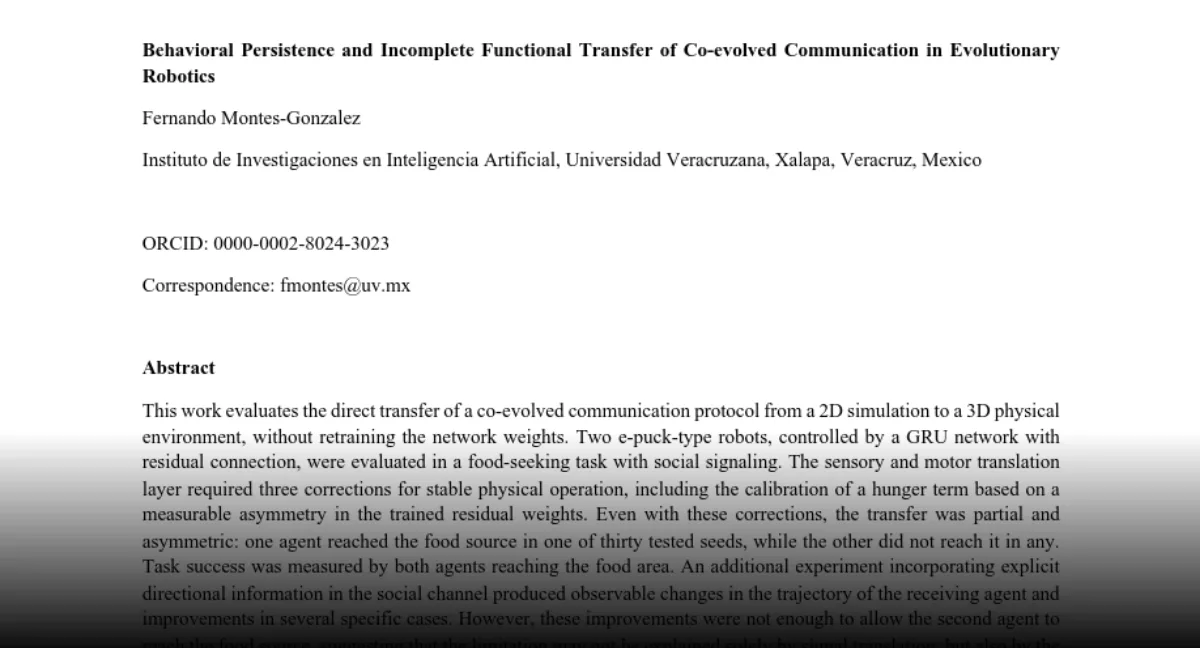
The paper evaluates whether emergent communication transfer can carry a co-evolved communication protocol directly from a 2D simulation to a 3D physical robotic environment without retraining the controller. The test involves two GRU-controlled e-puck-type robots. A GRU, or gated recurrent unit, is a recurrent neural network design that can carry information across time steps, which matters when agents must interpret short messages or recent states. The outcome is neither total failure nor clean success. Some communication-driven behaviors persisted, but robust task completion was not preserved. The result gives a concrete warning for embodied AI: a learned signal is not only a pattern of messages. It is also a pattern tied to the space in which it was learned.
Background: What a Simulated Protocol Carries Into Hardware
Emergent communication arises when agents develop signals through repeated interaction instead of receiving a fixed human-written vocabulary. In a simulation, two controllers can co-evolve a protocol: one agent emits a message, the other changes behavior, and the pair completes a task. The protocol works when the world is simple enough for the message to remain useful.
The transfer question begins there. A 2D simulation often represents movement and sensing on a plane. A 3D physical robotic environment changes the geometry, the sensor relationship to the world, and the way a robot can act. If a controller is moved directly without retraining, the test is whether the meaning of the signal travels with it.
Development: Direct Transfer Without Retraining
The study used a strict direct-transfer setup. The protocol was not relearned in the physical environment. The two GRU-controlled e-puck-type robots were expected to use the same communication structure that evolved in simulation. This choice separates two possible causes of failure: a broken message format, and a broken match between message and environment.
The findings were partial and asymmetric. Some communication-driven behaviors persisted, showing that the transfer did not erase the learned signal entirely. But robust task completion was not preserved. A robot could still respond to a message, yet the pair could fail to do what the protocol originally supported. That gap matters because a response is not the same as a reliable joint outcome.
Latest Findings: Directional Cues Help, but Do Not Close the Gap
The paper also tested explicit directional information. This added a clearer spatial signal to the agents' behavior. It modified agent behavior and improved several cases. However, transfer limitations remained. The improvement shows that the problem is partly practical: when a robot loses track of orientation or movement intent, a simple cue can restore some task function.
The result does not prove that the original protocol failed because of a single missing cue. It suggests that the evolved protocol was tightly bound to the conditions under which it formed. Successful transfer depends not only on preserving the signaling process itself, but also on maintaining the ecological and navigational conditions under which the protocol originally evolved.
What to Watch Next
The study is a narrow but useful marker in the sim-to-real conversation. It does not report a broad benchmark score or a new robot product. It tests a specific control setup with two GRU-controlled e-puck-type robots, a 2D-to-3D move, and no controller retraining.
The next question is whether a protocol can be made more transferable by training it across richer environments, adding explicit spatial cues, or grounding messages in robot-specific sensors. The practical implication is that communication is embodied. The message may survive the transfer, but the task may fail if the physical world no longer gives the message the same consequences.
Comments
No comments yet. Be the first to comment.