
Model Weights Act as Memory for Internalizing Long-Term History in Streaming Videos
MaLoW stores streaming video history in fixed Low-Rank Adaptation weights, improving video and robot tasks while keeping the backbone frozen.
Key Takeaways
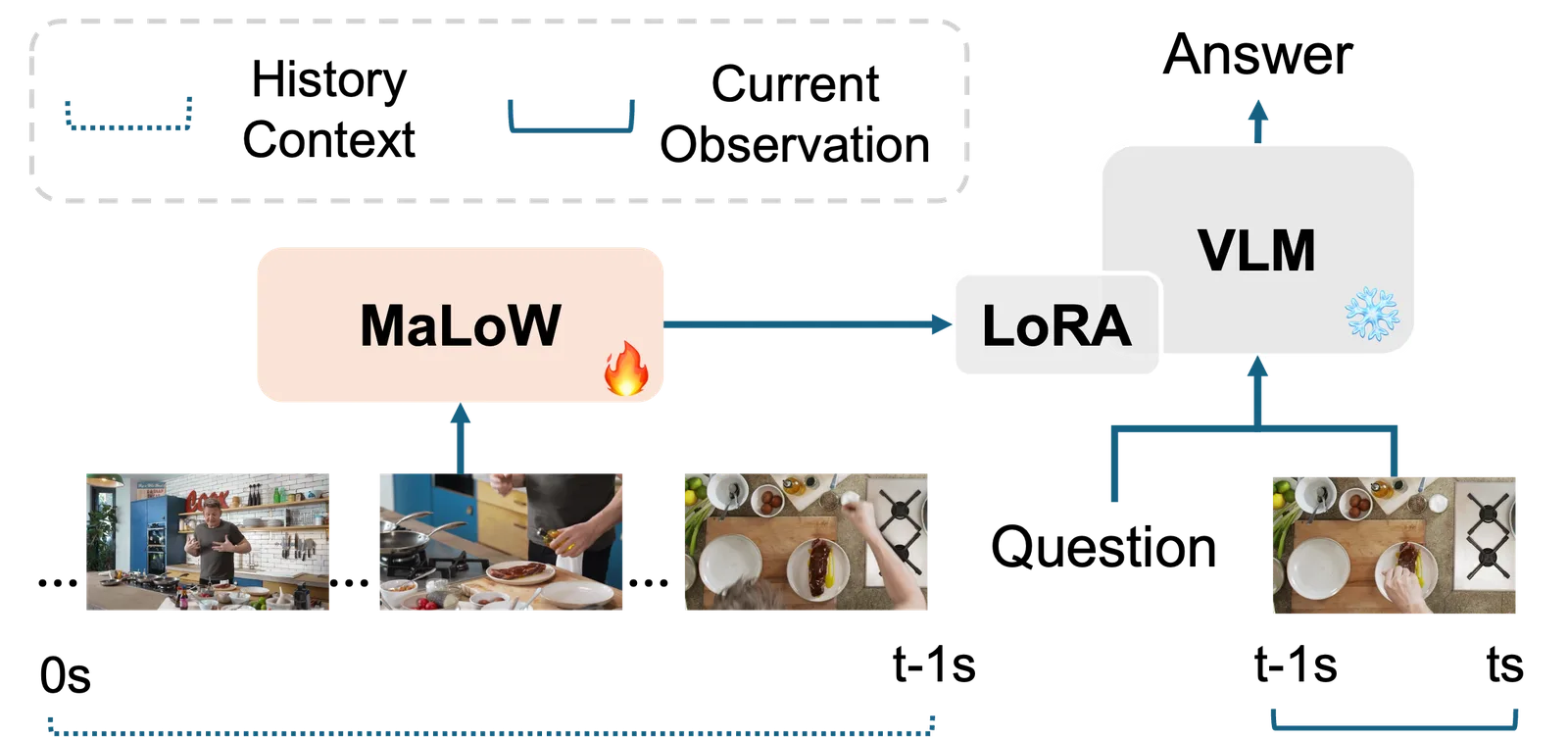
- MaLoW stores long-term streaming video history in fixed-size LoRA weights instead of an expanding context window, keeping the backbone frozen and current frames as input.
- The method separates real-time perception from recollection: past events become evolving weight state, while present frames remain visible input.
- It achieves leading reported results on video benchmarks, scoring 74.5% on OVO-Bench and 84.8% on StreamingBench, with consistent gains across 0.8B–11B base models.
- Weight-based memory also improves robot task success on Simpler WidowX from 59.4% to 68.8%, suggesting broader use for agents that rely on past observations.
- The work releases MaLoW-Instruct, a dataset with 381,000 question-answer pairs across 56,000 videos, along with paper, GitHub, project page, and Hugging Face resources.
Meta description: MaLoW encodes streaming video history into fixed-size LoRA weights, improving OVO-Bench, StreamingBench and robot tasks without retraining the frozen backbone.
Tags: Streaming Video, LoRA, Video Understanding, Multimodal AI, Robotics
Featured image: abstract neural network weights forming a fixed-size memory block beside a streaming video frame, no people, logos or text.
Background: The Streaming Video Memory Problem
MaLoW, short for Memory as LoRA Weights, is the central method in a new paper titled Memory as Weights: Internalizing Long-Term History for Streaming Videos. The work addresses a recurring challenge in streaming video understanding: systems must keep track of what happened earlier while still reacting to new frames in real time. In many models, that past is kept in a context window, which can grow as history accumulates. MaLoW asks whether long-term history can instead be stored in model weights.
This matters because memory placement affects what a system can retain, how much input it must process at each step, and whether perception and recollection stay separate. The paper proposes a design where history is not just a longer prompt, but a changing parameter state.
Development: Turning History into LoRA Weights
During streaming, the paper's method updates a compact set of LoRA weights so that earlier video content is carried forward in parameter form. LoRA, or Low-Rank Adaptation, is a technique that updates a smaller set of parameters instead of changing a whole pretrained model. In MaLoW, the weights remain fixed in size while their values evolve over time.
The pretrained backbone stays frozen, and the current frames are still supplied as input. That keeps real-time perception separate from long-term memory. The design can be summarized in two moving parts. Past video history becomes weight state. Present frames remain visible input. The model therefore does not need to carry the entire past in its input context. Instead, it updates a compact weight representation as the stream continues.
Latest Progress: Benchmarks, Robotics and Training Data
In the reported tests, variants of the method score 74.5% on OVO-Bench and 84.8% on StreamingBench, leading the methods compared in the paper. The gains are not limited to one model size: across base vision-language models ranging from 0.8 billion to 11 billion parameters, MaLoW yields consistent performance improvements.
The paper also extends the idea beyond video understanding. Incorporating memory improves robot-task success from 59.4% to 68.8% on Simpler WidowX. This result suggests that the same weight-based memory mechanism can help agents act in environments where past observations influence future decisions.
A new training resource accompanies the method. MaLoW-Instruct contains 381,000 question-answer pairs across 56,000 videos. The dataset is intended to support training and evaluation around the paper's central claim: long-term memory is not only about what to remember, but also about where to store it.
Current Stage: Resources and What Comes Next
The MaLoW project is available through an arXiv paper, a GitHub repository, a project page and a Hugging Face collection. The links are: arXiv: https://arxiv.org/abs/2610.22070, GitHub: https://github.com/dragonlzm/MaLoW, Project Page: https://dragonlzm.github.io/MaLoW, and Hugging Face: https://huggingface.co/collections/zhuomingliu/malow.
At this point, the method has been introduced as a paper contribution and demonstrated on reported video and robot tasks. The next useful question is how fixed-size memory weights hold up when streaming histories become longer, when base model families differ more widely, and when tasks require memory over many separate events. The current stage is a demonstrated internalization approach, with resources released for further testing.
Comments
No comments yet. Be the first to comment.