
Equal Character Error Rates Can Conceal Unequal Damage: A Severity-Weighted Character Error Rate for Optical Character Recognition
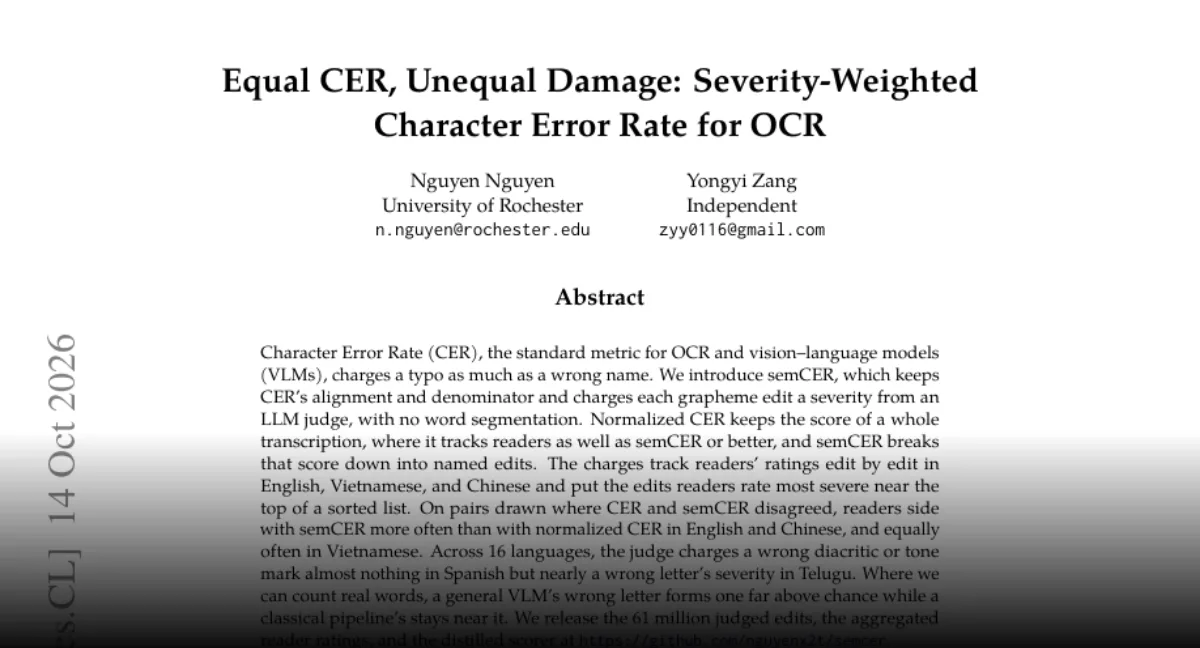
semCER weights character errors from 0 to 1, showing which recognition mistakes harm meaning across 16 languages, with open code, model, and data.
Key Points
- semCER keeps the familiar CER alignment and denominator but assigns each character error a severity score from 0 (harmless) to 1 (meaning lost), distinguishing harmless typos from damaging errors.
- Unlike CER, which charges every error the same, semCER shows that identical error types can have very different impacts across 16 languages, such as diacritic errors being minor in Spanish but severe in Telugu.
- The project positions semCER as a diagnostic breakdown alongside CER, not necessarily a replacement, because normalized CER may already track reader judgments as well or better for whole lines.
- semCER is released with open tools and data, including pip installation, GitHub code, a local 0.8B model, 61 million judged edits, and reader ratings, but its severity labels come from an LLM judge and need broader human validation beyond English, Vietnamese, and Chinese.
Meta description: semCER adds severity scores from 0 to 1 to character errors, showing which mistakes hurt meaning across 16 languages and releasing open tools and data.
Tags: semCER, CER, NLP evaluation, multilingual text quality, open models
Featured image: Abstract technology style graphic showing weighted character corrections and multilingual severity gradients, no readable words, no logos, no people.
semCER changes the way character errors are reported by adding a severity score to each correction while keeping the familiar CER frame. Character error rate, or CER, charges every character error 1, so a typo costs the same as a wrong digit in a price or a wrong name. The new measure matters because it can separate harmless slips from edits that remove meaning without discarding the standard alignment and denominator.
Background: Flat scoring in CER
The starting point is CER's single-price model. In CER, each character error receives a cost of 1, regardless of whether it is a typo, a wrong digit in a price, or a wrong name. That uniform penalty makes CER simple to compare, but it treats different mistakes as equal. For readers, however, those mistakes do not carry the same weight.
Development: Severity-weighted edits from 0 to 1
semCER keeps CER's alignment and denominator, then assigns each edit a severity from 0, meaning harmless, to 1, meaning lost. This turns the edit sequence into a weighted breakdown. The project reports that, edit by edit, the severities track human readers' ratings in English, Vietnamese and Chinese.
The multilingual result is the most concrete finding: across 16 languages, the same error type can receive very different severities. A wrong diacritic costs almost nothing in Spanish, but nearly a wrong letter's cost in Telugu. For whole lines, the project says normalized CER tracks readers as well as semCER or better. That means semCER is presented as a breakdown next to CER, not a replacement: it explains which errors hurt.
Latest Progress: Open resources and limits
The current release makes the tooling open. The code is available through pip install semcer and at https://github.com/nguyenx2t/semcer. The model is hosted at https://huggingface.co/nguyenx2t/semcer-qwen3.5-0.8b. The dataset contains 61M judged edits plus reader ratings at https://huggingface.co/datasets/nguyenx2t/semcer-judged-edits. A quickstart notebook is at https://colab.research.google.com/github/nguyenx2t/semcer/blob/main/notebooks/quickstart.ipynb.
The limits are also explicit. The severity values come from an LLM judge, DeepSeek V4 Flash, distilled into a 0.8B model that runs locally. Reader studies cover only English, Vietnamese and Chinese, and differences below about 0.1 are not reliable. The project sits at an open-release stage: severity analysis can now be run locally, but broader human validation and feedback remain the next signals to watch, especially for languages not yet checked against readers.
Comments
No comments yet. Be the first to comment.