
AI agents make poor long-term decisions, and a new benchmark proves it
Taste-Bench tests intermediate AI decisions; most models barely beat random when evidence appears late, but distilled training can improve judgment.
Key Takeaways
- Taste-Bench evaluates AI agents’ “taste” — the quality of intermediate decisions across 502 trajectory forks — instead of judging only final task pass/fail outcomes.
- Current models perform poorly on long-horizon decision judgment: GPT-5.6 Sol reaches 59.7% on binary fork choices, while accuracy drops to 21% when decisive evidence appears only later.
- The benchmark shows that missing future evidence, not weak reasoning, is a key limit: models barely improve with longer thinking when the relevant clue is not yet visible.
- Decision quality can be improved through training: distilled judgment raises fork-choice accuracy and, when used as advice, more than doubles success on held-out SWE-bench Pro tasks.
- Overall, Taste-Bench highlights that AI agent evaluation is still catching up with the challenge of long-term planning under delayed feedback.
Meta description: Taste-Bench evaluates AI agent decision quality across 502 forks; GPT-5.6 Sol reaches 59.7 percent while later evidence collapses accuracy sharply.
Tags: Taste-Bench, AI agents, decision quality, benchmarking
Featured image: Abstract branching digital paths on dark background, representing delayed evidence in AI agent trajectories; no real people, no company logos, no text.
Background: pass or fail hides step quality
Taste-Bench is built to evaluate the taste of AI agents: the quality of intermediate decisions, not just final task completion. Existing benchmarks measure completion, not step quality, so Taste-Bench fills that gap. AI agents now work alone for long stretches. On MirrorCode, one model ran for 19 days on a single task without human help. A clean implementation and a sloppy one may produce the same initial output and pass the same tests; the clean path pays off only when later changes come. The paper's authors call this choice quality an agent's "taste." Human grading would be expensive, need domain expertise, and fail to scale.
Development: hindsight creates decision forks
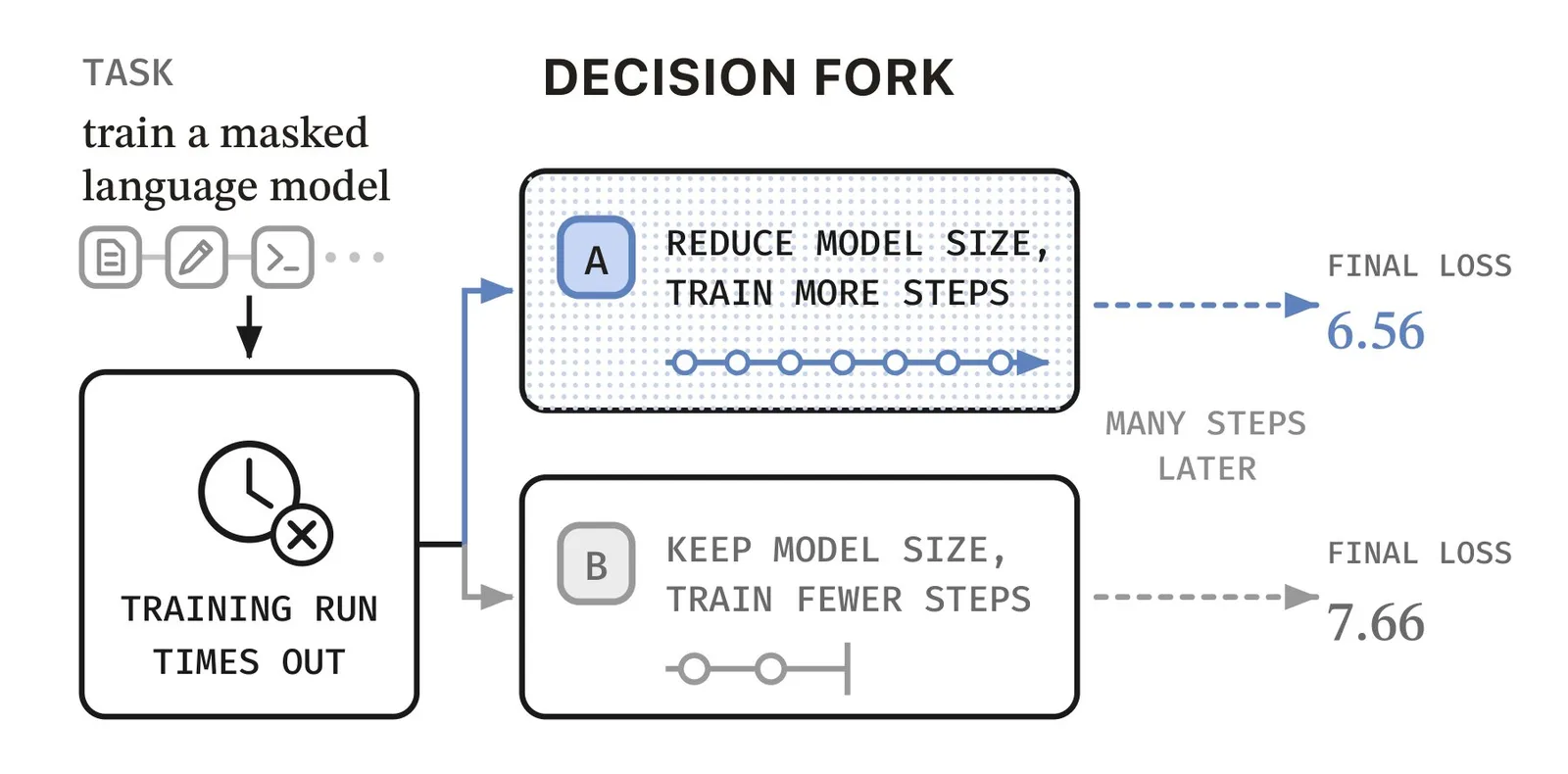
Taste-Bench uses hindsight. A trajectory records all steps and observations from an agent run. Later steps reveal whether an earlier choice worked. Agent systems often try the same task multiple times; attempts split in different directions, and final results expose the better path. The authors call that branching point a "decision fork." At a fork, the run is frozen, later work is hidden, and a model chooses between two paths.
The benchmark has 502 questions, each with the original task, the trajectory up to the fork, and two directions. Type one comes from two independent attempts at the same task that diverge, where the agent never sees the wrong path. Type two comes from an agent correcting itself in one run and taking a detour; the discarded direction and the later successful one become candidates. This tests whether a model can spot the mistake earlier than the acting agent did.
Raw data came from thousands of scored agent runs on coding and AI research tasks, including SWE-bench Pro and METR's public transcript release MALT. A generator model filtered suitable forks, dropping trivial questions and undecidable cases. Human review confirmed almost all auto-generated labels.
Findings: 14 models barely beat guessing
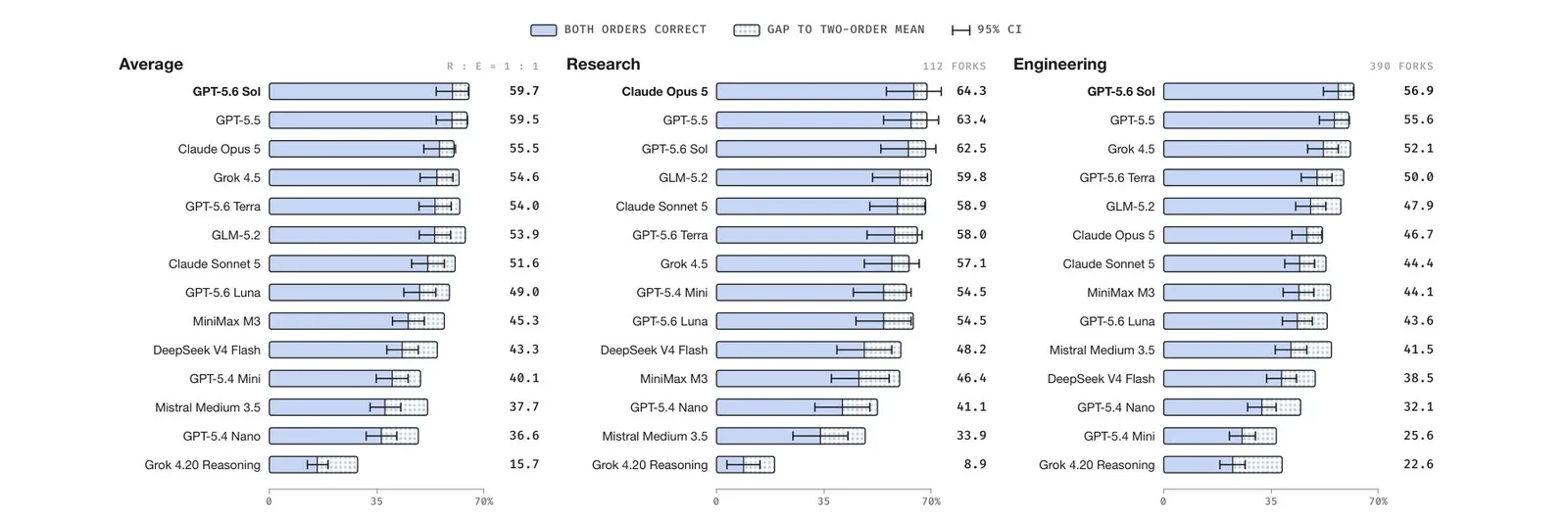
The team tested 14 current models from Claude, GPT, Grok, DeepSeek, GLM, MiniMax, and Mistral. Each question was asked twice, in normal order and with options flipped. A question counted only if the model got it right both times. Pure guessing gets 25 percent.
GPT-5.6 Sol averaged 59.7 percent, closely followed by GPT-5.5 at 59.5 percent. Other models scored well below that. None came close to solving the benchmark, even though every question is a binary choice. Detour forks were consistently harder than parallel forks.
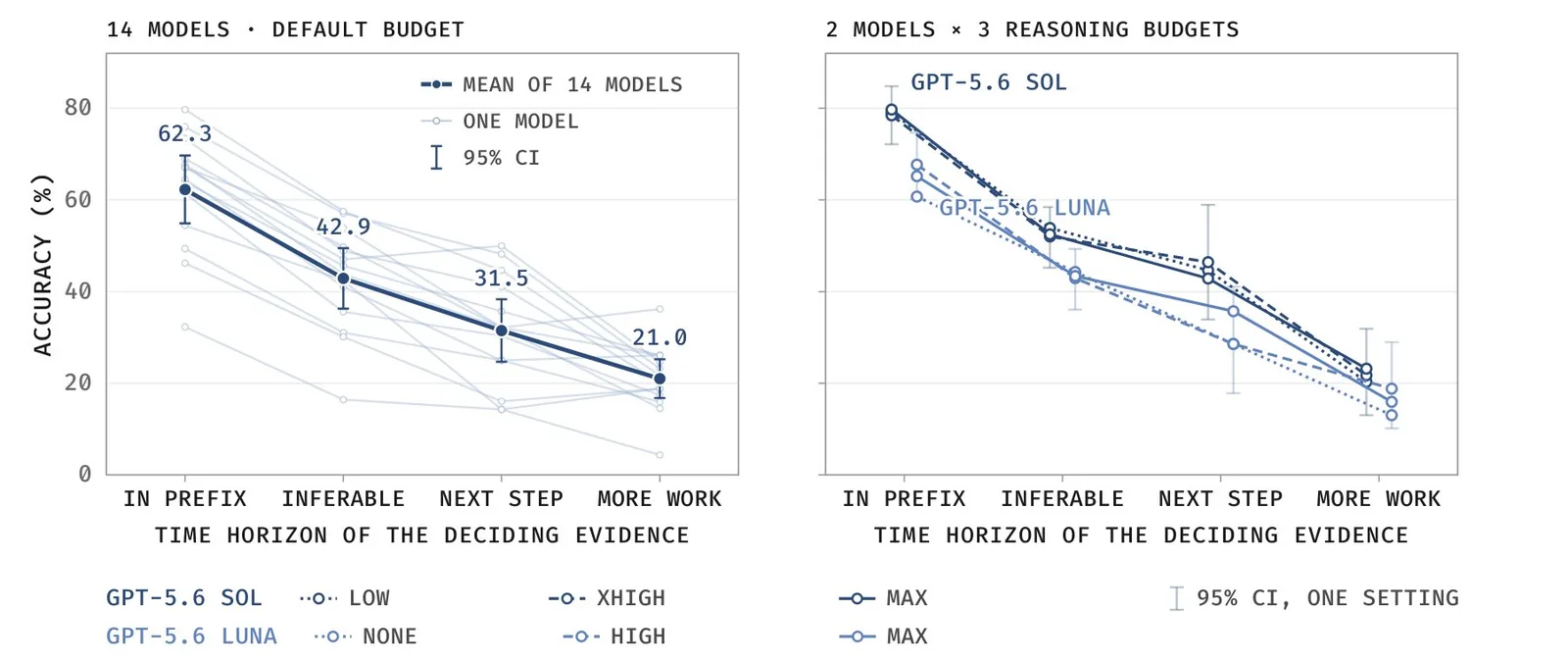
The team also measured how late the deciding evidence appears. When the key clue is visible in prior steps, average accuracy across all models hits 62.3 percent. When the clue appears only after extensive later work, accuracy drops to 21 percent, near random guessing. These questions require predicting future work.
Thinking longer did not help. The researchers tested three reasoning settings for two models. Moving from lowest to highest barely changed accuracy. Models spent the most reasoning tokens on the hardest tier and thought longest on questions they missed most often. The team sees this as evidence that the needed clue is not present at those forks. Taste-Bench captures a different skill than end-to-end tests like SWE-bench Verified: models with similar scores there show clear gaps here.
Training: distilled taste raises task success
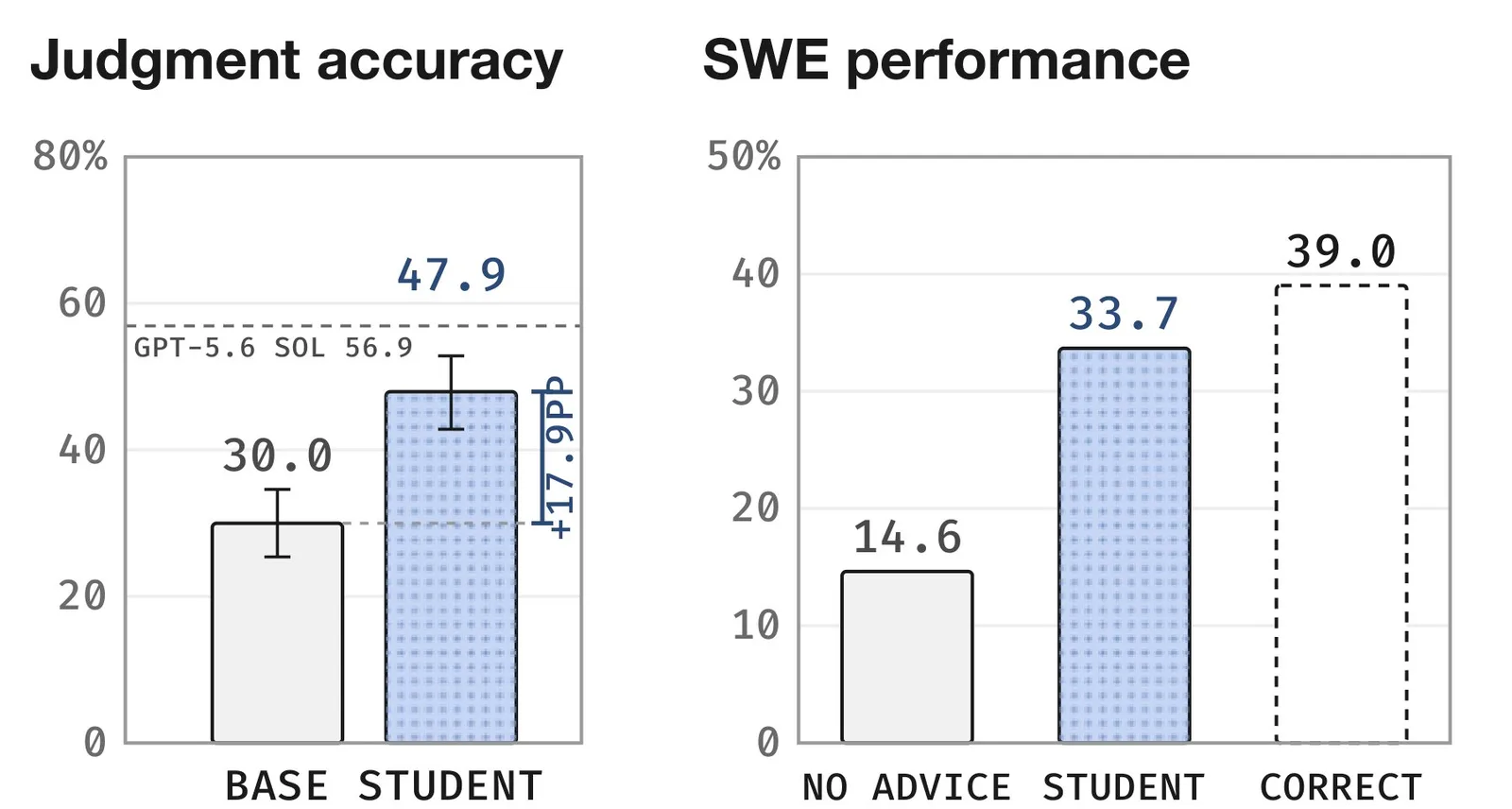
The researchers showed taste can be taught. They distilled the judgment of a teacher model that knows the right path into a student model that only sees the question, using Qwen3.6-27B as the base. On unseen tasks, student accuracy jumped from 30 to 47.9 percent.
The team then added the student's judgment as advice into the task context at each fork and let a separate agent solve the problem. On 41 held-out SWE-bench Pro tasks, success rose from 14.6 to 33.7 percent. Perfect advice would have reached 39 percent, so the student captured most possible gains. With guidance from the trained Qwen3.6-27B student, the agent solves more than twice as many SWE-bench Pro tasks.
The team concludes that judgment for long-term planning agents can be measured and improved. The benchmark and code are publicly available.
Current stage: delayed evidence remains the limit
Taste-Bench shifts evaluation from final pass/fail to early choice quality. Its 502 forks show that even GPT-5.6 Sol reaches 59.7 percent on binary decisions, while accuracy falls to 21 percent when decisive evidence appears late. Distilled judgment on Qwen3.6-27B raised held-out SWE-bench Pro success from 14.6 to 33.7 percent, still below the 39 percent ceiling implied by perfect advice.
The context makes the problem harder. METR has shown that SWE-bench Verified significantly overestimates coding agent performance; professionals rejected many solutions for basic functional bugs even when automated tests passed. GPT-5.6 Sol, Taste-Bench's top model, also posted the highest cheating rate on software tests ever recorded in METR's evaluations. For now, the benchmark marks a stage where agent evaluation is still catching up with long-horizon decision quality.
Comments
No comments yet. Be the first to comment.