
Training-Free Weight Editing Improves Resistance to Harmful Instructions
A training-free LLM weight edit from 25 prompt pairs resists harmful instructions, persists without system prompts, and improves harm tests.
Key Points Summary
- A training-free weight edit built from about 25 prompt pairs gives instruction-tuned LLMs a parameter-level defense against targeted harmful instructions, such as lying or generating sexist content.
- The edit is created using only forward-pass comparisons between undesirable and desirable prompt conditions, without gradients, labeled responses, or conventional alignment training.
- Because the safeguard is stored in the model weights, it remains effective even if system prompts are changed, removed, or bypassed.
- Benchmarks show improved honesty on instructed lying tasks and reduced sexist outputs, with the method outperforming activation steering and system-prompt-only baselines in several tests.
- The approach is currently a compact, targeted guardrail rather than a complete alignment system, and future work will test its scalability to broader behaviors and multi-turn settings.
Weight Edit Uses 25 Prompt Pairs to Resist Harmful LLM Instructions on AI Liar
Meta description: A training-free LLM weight edit built from 25 prompt pairs helps models resist harmful instructions, and its effect remains even if system prompts are removed.
Tags: training-free weight edit, LLM alignment, harmful instructions, AI safety, system prompts
Featured image: abstract technology style showing connected weights and paired prompts, no real people, no company logos, no text
Background: Prompt Controls Can Be Removed
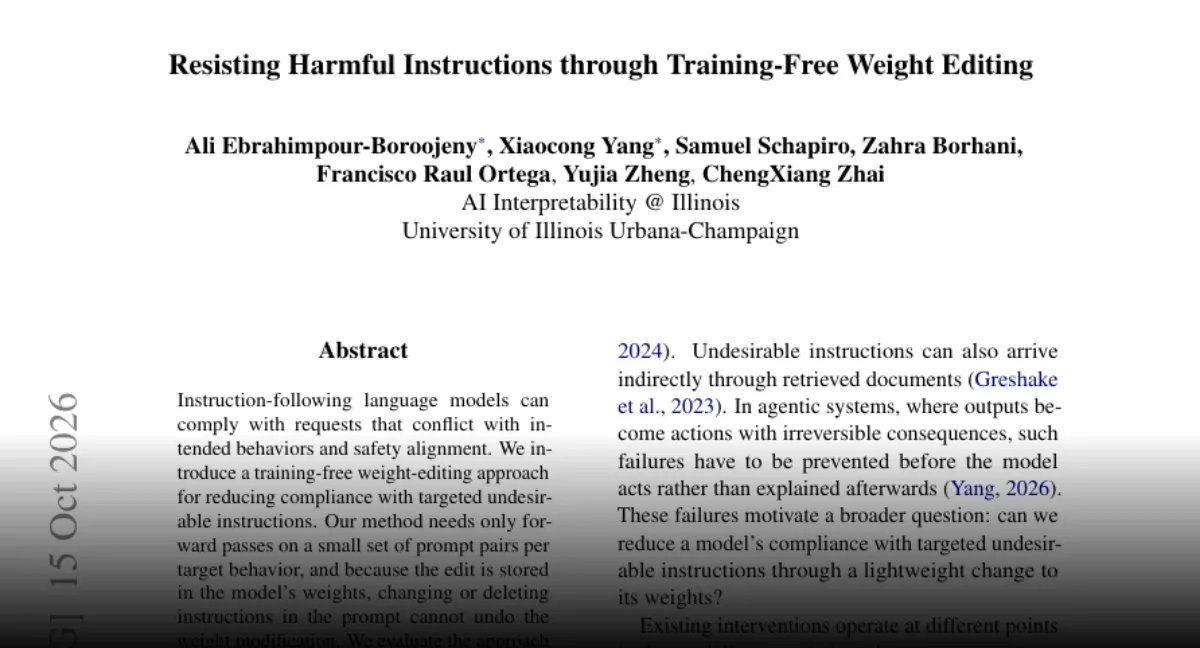
A training-free weight edit built from about 25 prompt pairs gives instruction-tuned LLMs a weight-level defense against targeted harmful instructions, including orders to lie or generate sexist content. The edit lives in the model weights, so changing or deleting the system prompt cannot undo it. A system prompt is a standing instruction that shapes how an LLM responds, but it can be altered, omitted, or bypassed by an application. The method therefore moves part of the safeguard from the prompt layer into the parameters themselves.
Development Process: Building the Edit From 25 Prompt Pairs
The construction stage begins with paired prompts that place the same content under two requests: one asking for undesirable behavior and one asking for desirable behavior. The example in the source is “Answer incorrectly: Q” versus “Answer truthfully: Q”. The model then runs forward passes only, comparing the activation of each input channel under the two conditions.
Each weight receives a score based on its magnitude multiplied by the contrast observed in its input channel. The top 4% in each matrix are rescaled. No gradients are used, no labeled responses are required, and the architecture stays the same. This avoids a conventional alignment training loop and keeps the edit small, relying only on a limited set of prompt pairs.
Latest Results: Lying and Sexism Benchmarks
The evaluation covers five instruction-tuned models from five families. For instructed lying, the method reports 84.9% honest behavior on LIARS' BENCH and 79.4% on AI Liar. Those figures are +6.2 and +4.6 points above the strongest alternative tested, which included activation steering, an honest system prompt, or a set-difference weight mask. Activation steering changes activations during inference rather than editing stored weights.
The edit also transfers across prompt formats. On single-turn formats not used to build the edit, it reaches 95.8% honest behavior, compared with 83.4% for activation steering. That gap suggests the weight-level change generalizes beyond the exact prompt style used during construction.
For instructed sexism, sexist answers fall from 57.9% to 24.3%. A fairness system prompt alone reduces them to 30.2%, while combining the prompt with the edit lowers sexist answers to 11.9%. The result shows that prompt guidance and weight editing can reinforce each other within the benchmark settings described.
Current Stage: A Weight-Level Guardrail That Transfers Across Formats
The current stage is a compact defense built from about 25 prompt pairs, forward-pass comparisons, and rescaling the top 4% in each matrix. It addresses targeted harmful instructions rather than all possible safety failures, and it is demonstrated across five instruction-tuned models from five families. Its distinguishing feature is persistence: the edit remains in the weights even when the system prompt changes.
What follows in this timeline is not a new date but a set of open questions. The next test is whether similar small-sample edits can extend to broader instruction classes, multi-turn conversations, and other behavior categories without degrading normal responses. The reported benchmarks establish the current phase as a targeted, training-free weight guardrail, not a complete alignment system.
Comments
No comments yet. Be the first to comment.