
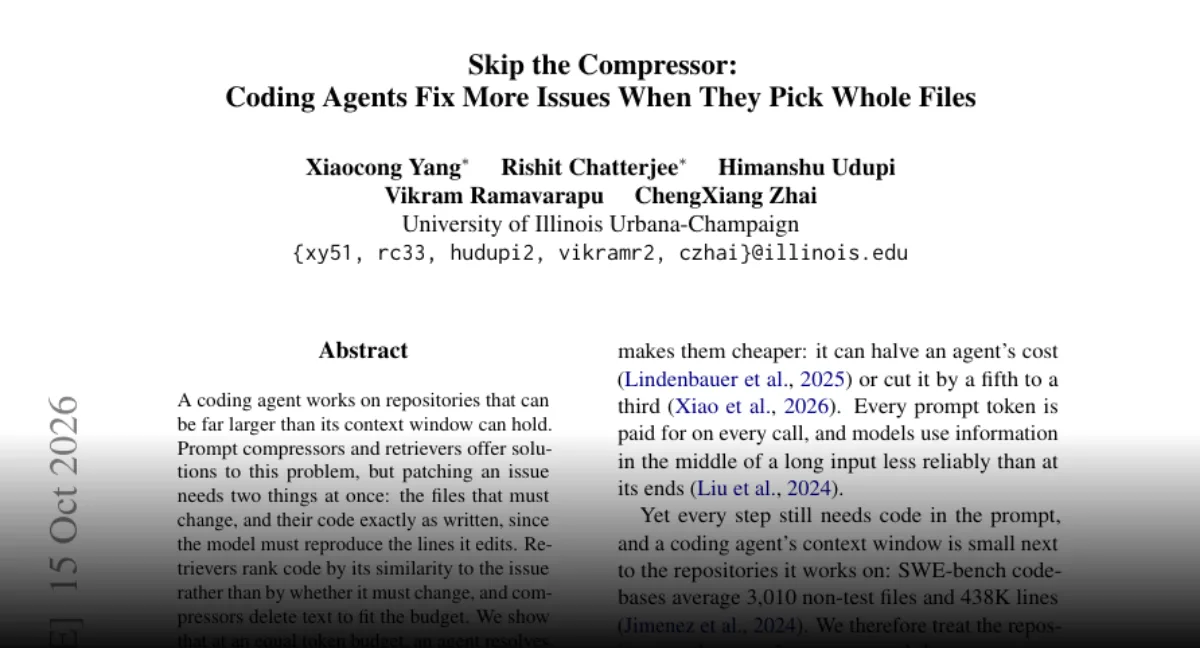
Coding Agents Fix More Issues When They Choose Whole Files Instead of Compressed Content
CQ2-CARE lets coding agents pick whole files under fixed token budgets, resolving 43.7% with GPT-5.6 and 46.7% with Claude Opus 5.
Key Takeaways
- CQ2-CARE spends fixed token budgets on whole, verbatim files chosen by the coding model, instead of using compressed or retrieved code chunks.
- On 300 SWE-rebench issues, it resolved 43.7% of problems with GPT-5.6 and 46.7% with Claude Opus 5.
- It outperformed leading prompt compressors by +6.3 points and top retrievers by +9.3 to +12.7 points under the same per-issue token budget.
- Exact text preservation is critical: removing 20% of tokens per line costs 9.7 points, while showing true gold files improves results only modestly.
- For coding agents, the practical direction is to select candidate files carefully, show them verbatim, and add targeted grep snippets only when needed.
CQ2-CARE, a simple selector for coding agents, changes how a fixed token budget should be spent: ask the model to name whole files, show them verbatim, and let the patch apply. On 300 recent SWE-rebench issues, with every context fitted to the same per-issue token budget and graded by the benchmark's tests, it resolved 43.7% of issues with GPT-5.6 and 46.7% with Claude Opus 5.
Background: why compression hurts code edits
A coding patch has to quote the lines it changes exactly. That requirement makes two common context strategies risky inside a fixed budget. Prompt compressors shorten text before a model sees it; token pruners keep the file but alter its text, so the patch no longer applies. Retrievers rank code by similarity to the issue, so they often miss the file to edit.
The practical consequence is a trade-off: spending tokens on fewer whole files can beat spending the same tokens on compressed or retrieved chunks. CQ2-CARE is positioned for that trade-off because it needs no compression model.
Development process: how CQ2-CARE works
The selector starts with the model under test. It asks the model twice, independently, which files must change, then keeps only the files both answers name. Those files are shown whole and verbatim. If the model asks for extra material, the context adds short grep spans for definitions, callers or strings.
The process is file selection first, text preservation second, and targeted search snippets third. The independent double query acts as a filter, not as a new model, because the selector needs no compression model.
Latest progress: benchmark results and comparisons
The evaluation used 300 recent SWE-rebench issues and the same per-issue token budget for every context. CQ2-CARE resolved 43.7% with GPT-5.6 and 46.7% with Claude Opus 5. That was +6.3 points over the best of three prompt compressors, LLMLingua-2, LongLLMLingua and LongCodeZip, with either model. It also exceeded the best of three retrievers, including SWE-bench's file-level retrieval scoring named Best Match 25, by +9.3 and +12.7 points in the two model settings.
The method also stayed ahead of two approaches trained for issue resolution. The gap was +2.0 and +7.3 points versus SWE-Pruner, and +0.7 and +1.7 points versus SweRank, a range the source describes as within noise. The oracle comparison narrows the room for better file selection: showing the true gold files resolves only 5.7 points more with GPT-5.6, and no more with Claude.
A controlled test added another signal: deleting 20% of the tokens on every line of the contexts used by the method costs 9.7 points. That result supports the central design rule: preserve the exact text of the selected files whenever possible.
Current stage and signals to watch
CQ2-CARE is currently presented as a simple selector that outperforms compression and retrieval under fixed token budgets. For agent builders, the tested direction is to choose candidate files well, keep them verbatim, and if something must be cut, cut whole lines. The next signals are whether the same file-consensus rule holds beyond SWE-rebench, whether grep spans need more automation, and whether whole-file contexts can scale when the chosen files are large.
Meta description: CQ2-CARE lets coding agents choose whole files to resolve 46.7% of SWE-rebench issues with Claude Opus 5, beating compressors and retrievers on token budgets.
Tags: CQ2-CARE, coding agents, SWE-rebench, GPT-5.6, Claude Opus 5
Featured image: Abstract technology style with layered code files, a fixed token budget ring, and highlighted whole-file selections; no real people, no company logos, no text.
Comments
No comments yet. Be the first to comment.