
Morphometric Imitation: Linking Morphology- and Contact-Aware Hand Retargeting with Sim-to-Real Visuomotor Policies
The article presents a claim that one human demonstration can drive a zero-shot sim-to-real visuomotor policy for multi-fingered robot hands. It emphasizes embodiment transfer, autonomous 1x-speed uncut videos, and the potential to reduce data and task-specific tuning. However, it lacks laboratory details, hardware models, success rates, baselines, and demonstration format, so quantitative validation is still needed.
Key Takeaways
- The article describes a zero-shot sim-to-real visuomotor policy for multi-fingered robot hands that can be powered by a single human demonstration.
- The key goal is embodiment transfer: enabling one learned policy to work across different multi-fingered hands without additional task-specific training or fine-tuning.
- The evidence is presented as fully autonomous, 1x-speed, continuous, uncut videos, which helps show real-time operation but does not replace quantitative success-rate reporting.
- The claim remains preliminary because the text does not specify the tested hardware, datasets, task suite, or baseline comparisons.
- Future validation will depend on public code, reproducible benchmarks, the number of hand embodiments tested, and measured success rates in real-world trials.
One Human Demonstration Powers Zero-Shot Visuomotor Policy for Multi-Fingered Hands
Meta description: One human demonstration supports a zero-shot sim-to-real visuomotor policy for multi-fingered hands, shown in autonomous 1x speed uncut videos.
Tags: robot learning, sim-to-real, visuomotor policy, multi-fingered hands, zero-shot control
Featured image: ![Abstract simulation-to-reality robot hand control visualization] (assets/abstract-robot-hand-sim-to-real.png)
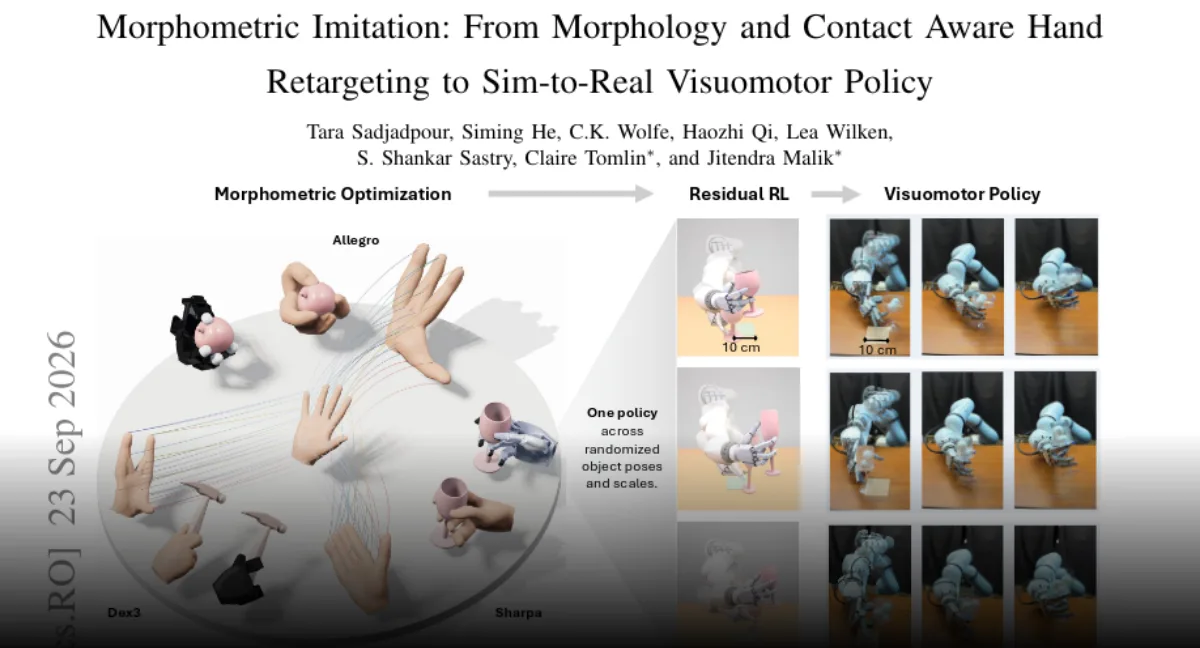
A single human demonstration is being positioned as the input to a zero-shot sim-to-real visuomotor policy for multi-fingered hands. The source summarizes the claim in three linked phrases: "One human demonstration. Any multi-fingered hand. Zero-shot sim-to-real visuomotor policy." It also says the video evidence is "1x speed fully autonomous" and includes "continuous, uncut trials." The idea matters because robot hand control usually requires large data sets, careful simulation tuning, or task-specific training; if one demonstration can cross into real hardware without additional fine-tuning, it changes how quickly a new hand can be made useful.
Background: why a hand policy is hard
Multi-fingered manipulation sits at the intersection of vision, contact, and actuator control. A policy that only works in simulation must survive camera noise, latency, friction, wear, and mismatch between virtual and real geometry. In this claim, "visuomotor" means the controller maps visual observations to motor commands, while "sim-to-real" means the learned behavior is transferred from a simulated environment to a physical robot. "Zero-shot" adds a stricter condition: the deployed system is expected to perform without extra training on the target task or embodiment.
The source does not name a laboratory, dataset, hardware model, or success rate. That absence limits how much can be inferred. Still, the framing is clear enough to place the result within a known pattern in robot learning: demonstrations are collected from humans, policies are trained in simulation, and the resulting controller is evaluated in the real world.
Development: the claim shifts adaptation to the policy
The central assertion is transferability. Instead of describing a fixed gripper or a single calibrated hand, the material says the policy applies to "Any multi-fingered hand." That wording points to an embodiment-agnostic controller, although the available text does not specify how broad that support is or what hand designs were tested.
The demonstration input is also unusually small: one human demonstration. In imitation learning, a single example can be enough for a narrow task when the policy has already learned general visual and motor structure. If the simulation stage provides that structure, the physical system may only need to align the demonstration with a hand-specific action space. The source does not say whether the demonstration is shown in simulation, recorded from a human hand, or provided through teleoperation.
Current stage: uncut autonomy is the visible proof
The evidence described is video-based, and the source states: "All videos are 1x speed fully autonomous, and we include continuous, uncut trials." The playback format is central: 1x speed means the clips are not accelerated. The phrase "fully autonomous" indicates the policy is making control decisions during recording. "Continuous, uncut trials" let the viewer see the sequence from start to finish rather than an edited highlight.
These details matter for trust. Accelerated or cut clips can hide failures, retakes, safety interventions, or periods when the robot is not acting. Full-speed, unedited autonomy reduces that ambiguity, but it still does not replace quantitative reporting. A real-world policy claim normally needs success counts across trials, camera field of view, task definitions, and comparison against baselines.
What to watch next
The current material is a demonstration-level claim, not a completed benchmark. The next useful signals would be public code, a reproducible task suite, the simulation environment, the number of target hands actually tested, and success rates for each embodiment. The claim's value will depend on whether "One human demonstration" and "Any multi-fingered hand" hold up outside the recorded videos.
Comments
No comments yet. Be the first to comment.