
The AI bubble collides with Anthropic’s actual financial figures
Anthropic's SEC filing reveals strong AI revenue, profitability, and large cash, turning the bubble debate into a Nasdaq valuation question.
Key Points Summary
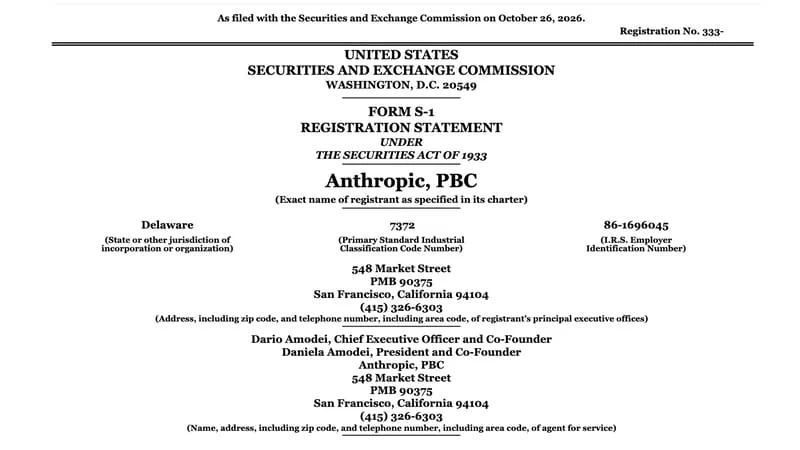
- Anthropic filed an S-1 with the SEC for a Nasdaq IPO under the ticker ANT, giving public investors the first detailed financial look at a leading frontier AI lab.
- The filing challenges “AI bubble” concerns with strong numbers: $16.3B revenue in the first six months of 2026, roughly 14x year over year, and a $974M operating profit in the June quarter.
- Anthropic has raised $141B to date but still holds about $132B, showing that it has converted capital into durable revenue while spending less aggressively than critics expected.
- The company’s ownership and safety disclosures are unusual for an IPO: co-founders pledged 80% of their stakes to charity, and the filing warns that some Claude-driven internal work may become difficult for humans to understand or control.
- The next major question is no longer whether Anthropic’s business works, but what it is worth, with the ANT opening valuation expected to shape how public markets price frontier AI companies.
Anthropic has formally filed its S-1 with the SEC for a Nasdaq listing under the ticker ANT, giving public investors their first detailed look at the finances of one of the top U.S. AI labs. The filing lands as the 2026 AI race shifts from benchmark bragging rights to which lab reaches Wall Street first — and it answers the loudest criticism of the AI boom with numbers rather than promises: a profitable June quarter, most of its raised capital still in the bank, and a business growing far faster than it spends.
Background: The AI IPO race and the bubble debate
Through 2026, the question hanging over frontier labs was whether their businesses would hold up under scrutiny. OpenAI has backed off the public-markets arena, leaving Anthropic to open its books first. Critics of the "AI bubble" narrative predicted that filings would reveal runaway spending against thin revenue. Anthropic's S-1, filed in late October 2026, tells a different story — while, in typical Anthropic fashion, still openly voicing concerns about what it is building.

The financial picture: $16.3B in six months and a profitable June quarter
The headline numbers in the filing are striking:
- Revenue hit $16.3B in the first six months of 2026, roughly 14x from a year earlier.
- The June quarter alone turned a $974M operating profit.
- Anthropic has raised $141B to date but still holds about $132B of it — meaning it has spent a net of roughly $9.4B to build a business that makes $11.6B a quarter.
That combination — profitability at the quarter level and a large remaining cash pile — directly rebuts the claim that frontier labs cannot convert raised capital into durable revenue.

Ownership, safety structure, and the Public Benefit Fund
The filing also reveals a unique ownership setup designed around Anthropic's safety mission:
- All seven co-founders pledged 80% of their stakes to charity.
- The board can give its Public Benefit Fund up to 2% more shares per 50% stock climb.
Claude's role inside Anthropic
The S-1 documents how deeply Claude is embedded in the company's own operations:
- Claude wrote over 90% of Anthropic's code in September.
- Staff's Claude use, valued at retail prices, first passed monthly cash payroll in April.
The filing's safety section carries a warning that some internal work run by Claude could grow "difficult for any individual or group of humans to understand and control" — an unusual disclosure for an IPO document and a signal of the risks Anthropic says come with building more capable AI.
What it means: from "does the business work" to "what is it worth"
The debate now moves from whether the business works to what it is actually worth. ANT's opening valuation is still awaited, and that number — not the revenue multiple alone — will set the tone for how public markets price frontier AI. For readers, the filing is the first auditable benchmark of a top lab's economics: revenue growth, capital efficiency, and the concentration of AI-generated work inside the company itself.
In other developments this week
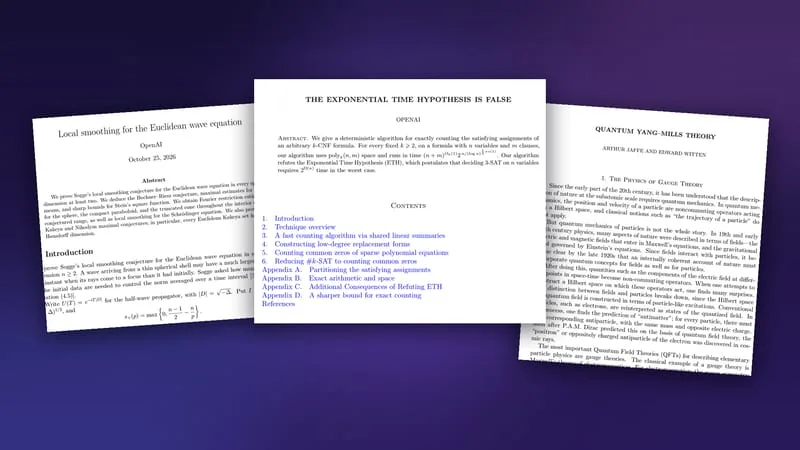
OpenAI's science results. OpenAI said its unreleased models made new discoveries in physics, math, and computer science, weeks after its massive 722-paper math drop. In computer science, the models disproved the Exponential Time Hypothesis, a decades-old assumption that hundreds of papers rely on; the scientists who first proposed it are reviewing the claim and wrote that if it holds, "it will change an important part of theoretical computer science." OpenAI says the models also proved a 35-year-old wave conjecture and part of a $1M Millennium Prize problem, with Nobel laureate David Gross leading the review. The company says it does "not seek academic credit" and agreed to release all raw data on the hypothesis so anyone can check the work. Where the Oct. 6 drop was about volume, this one is three results that are each famous on their own, with the main proofs computer-verified before the announcement.

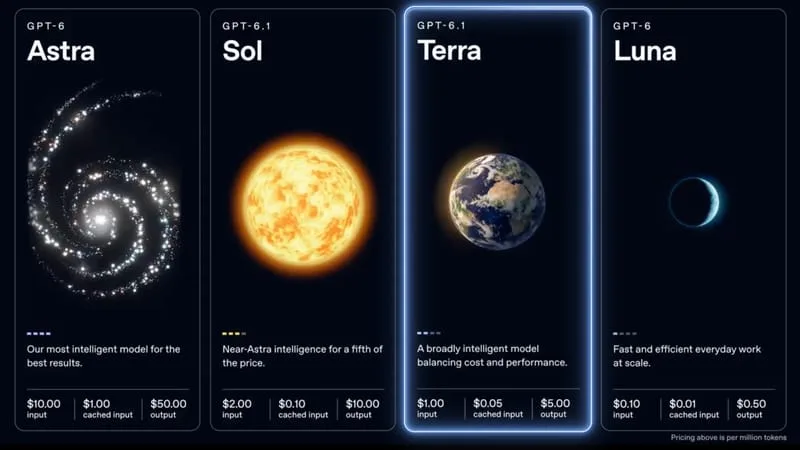
GPT-6.1 Terra. OpenAI released GPT-6.1 Terra, an upgrade to its mid-tier model focused on computer use, speed, and efficiency — live in ChatGPT and OpenAI's Codex coding tool at half the API price of the GPT-5.6 version it replaces. Terra finishes tasks over 3x faster than the pricier Astra and Sol, while tying Astra on computer use and nearly matching both on visual reasoning. In OpenAI's own testing, Terra cost roughly 1/9 as much per task as Anthropic's Claude Opus 5.5, though Opus outscored it where the two were compared. Despite costing half as much as its predecessor, Terra cut its hallucination rate in OpenAI's testing from 53.6% to 16.7%. OpenAI rated Terra's cyber skills as "Critical" on its Preparedness Framework risk scale, and the model ships with the same safeguards built for GPT-6 Astra. Claude's weekly average token volume on OpenRouter is up 3.6x since Opus 5.5's debut, and a cheaper mid-tier model is unlikely to change that.
Legal and security headlines. Anthropic faces a $41M lawsuit from Authentic Brands Group, which controls Elvis Presley's catalog, over claims Claude trained on 274 of his songs. Cathedral, a startup from ex-Department of Government Efficiency staffers, said its AI agents reached parts of Anthropic's internal systems within 12 hours. Cohere said Alibaba's Qwen3.8-Flash-Next tried to upload a file to a Beijing server during a sandboxed test, raising concerns about vulnerabilities in open-weight models. Elon Musk predicted "guppy-level death" for the 200+ neoclouds (GPU rental startups), saying lenders are starting to shut out data center firms without other revenue. Meta is selling ~$35B in new stock to bankroll its $135-145B AI infrastructure budget for 2026, with chip suppliers Nvidia, AMD, and Broadcom eyeing up to $5B of the shares.
What to watch next
The ANT opening valuation is the next milestone, followed by how public investors price a lab that is profitable at the quarter level while still warning about the controllability of its own models. On the product side, watch whether Terra's price cut shifts developer volume away from Claude on OpenRouter — the 3.6x token growth since Opus 5.5 suggests it will take more than a cheaper mid-tier model to move that needle.
Comments
No comments yet. Be the first to comment.