
Industrial intelligence represents the next growth opportunity for manufacturing.
Industrial intelligence links factory know-how, data and Physical AI to improve quality and maintenance, as shown by Toyota and Rockwell.
Key Takeaways
- Industrial intelligence turns a manufacturer’s accumulated know-how—procedures, operating practices, production data, and expert judgment—into accessible knowledge that can drive better decisions across the business.
- Physical AI connects digital intelligence to real-world operations by perceiving conditions, reasoning about them, and taking controlled actions on machines and processes.
- Data alone shows what is happening, while industrial intelligence adds context for what should happen, what constraints cannot be breached, and when human judgment is still required.
- Measured progress is emerging: Toyota Industries cut paint-defect analysis cycles from five days to under four hours and reduced relevant defects by about 25% in a pilot, while Rockwell Automation reduced new-worker troubleshooting training from nine months to three.
- The goal is not just smarter machines or more automation, but scalable learning: systems that help people act on knowledge responsibly, safely, and with clear human oversight.
Meta description: Microsoft outlines industrial intelligence, Physical AI, Toyota paint defects and Rockwell maintenance copilots turning factory know-how into measurable action.
Tags: industrial intelligence, Physical AI, Toyota Industries, Rockwell Automation, Microsoft Ignite
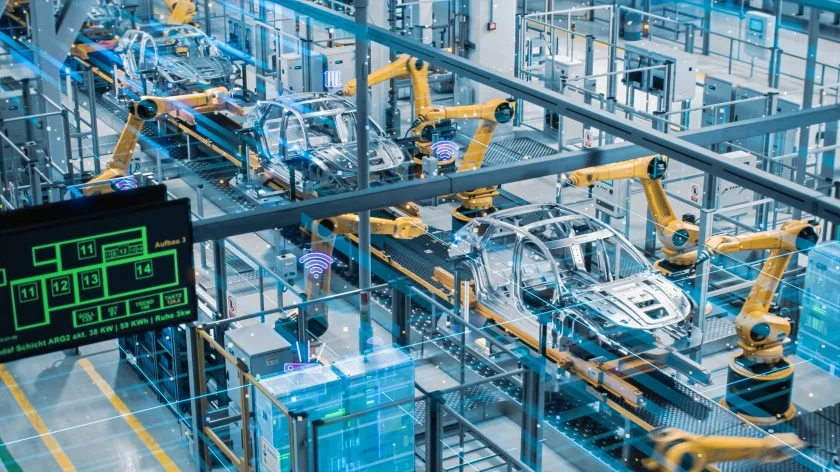
Featured image: abstract factory data network, no real people, no company logos, no text.
Background: Know-how often stayed in one place
Industrial intelligence is unique to each manufacturer and partly lives in experienced workers. It is the accumulated know-how of a manufacturer: procedures, operating practices, production data, and understanding of its own business. A line restart after a changeover depends not only on machine settings, but also on how a material behaves, what happened during the previous shift, and when a minor variation deserves closer inspection. A procedure can describe the sequence, but execution depends on judgment.
That judgment has limited reach when it stays with one person, inside one system, or within one plant. An engineer evaluating a process change needs more than a production record. They need the equipment configuration, quality requirements, and trade-offs an operator made. Connecting those elements helps people apply experience beyond the place where it originated.
When individual knowledge becomes accessible, innovation can spread to the maintenance workshop, planning office, engineering team, and production floor. More people can contribute because more people can work with what the organization knows. Manufacturing, however, remains physical and depends on materials, machines, and products.
Development Process: Connecting information to physical systems
The stated destination is not simply more agents, but using existing business intelligence to support profitable growth by making it available wherever decisions are made and connecting it to the physical world.
Physical AI describes systems that perceive conditions, reason about them, and take action within the physical world. By connecting machines and processes, manufacturers get a clearer view of what is happening. Agents can then identify patterns, predict problems, and determine the best course of action.
A robotic handling operation shows the difference between observation and response. When parts arriving at a station vary, vision can help assess position. A model informed by material and task can help determine movement. Connected controls can execute an adjustment within validated limits. The value is responding appropriately.
Data may reveal what is happening, but industrial intelligence provides context for what should happen, which constraints cannot be breached, and when uncertainty requires human judgment. Simulation lets manufacturers examine proposed actions in a digital environment before applying them to equipment. Physical validation is still needed, but simulation creates room to learn without treating the production line as the first experiment.
Latest Progress: Measured results in quality and maintenance
Toyota Industries shows the quality case. After connecting previously fragmented paint shop data, engineering and operations teams received context to understand defect drivers. The company reports analysis cycles fell from five days to under four hours, while its pilot reduced relevant paint defects by about 25%. The breakthrough was not simply identifying another signal. It was helping people understand why defects occurred and respond before the outcome was locked in.
Rockwell Automation shows the workforce case. At its Singapore plant, technicians use a maintenance copilot that combines manufacturing data, machine manuals, and knowledge captured from experienced workers. The system has reduced the time required for new workers to learn how to troubleshoot hundreds of machines from nine months to three.
Responsible use begins with operational discipline: clear authority over what systems may change, reliable connections to equipment, defined safety boundaries, and a record of decisions and actions. People must be able to recognize uncertainty, intervene, and bring equipment to a safe state. Trust rests on practical arrangements, not confidence in a model alone.
Current Stage: Learning as a scalable capability
The next challenge is not simply producing more, but growing without adding complexity at the same rate. The Microsoft-produced material describes industrial intelligence as a way to connect what a manufacturer knows: people’s experience, operational signals, and lessons accumulated over time. Physical AI gives that intelligence a way to act in the physical world, turning knowledge into decisions and decisions into action.
The aim is not to make machines smarter. It is to see what people can build when knowledge can travel and intelligence can act. This progress requires investment in equipment, but also in people: training, time to learn, and a meaningful role in shaping how systems work. Machines become more capable so people can become more capable.
The next frontier is not only smarter machines or more automated factories. It is businesses that can continuously learn, adapt, and act.
The material directs readers to a video series on how industrial customers unlock intelligence across the value chain, and to Microsoft Ignite to see what’s next for Industrial Intelligence.
This content was produced by Microsoft. It was not written by MIT Technology Review’s editorial staff.
Comments
No comments yet. Be the first to comment.