
Who actually controls Anthropic after the IPO?
Anthropic's IPO governance splits control among a public benefit company, Long-Term Benefit Trust, founder voting power, and employee checks.
Key Takeaways
- Anthropic’s pre-IPO governance distributes control among public benefit company status, a Long-Term Benefit Trust, founder-held special stock, and an employee override, limiting public shareholders’ say over major decisions.
- Seven founders jointly control 50.1% of shareholder voting power and can elect three board members, but this founder control ends 10 years after the IPO or if fewer than three founders remain.
- The Long-Term Benefit Trust can elect and remove most directors to protect the company’s AI safety mission, yet its choice of a “Specified” director can be challenged by the board’s nominating committee and decided by employee vote.
- The structure has potential tensions: if founders lose unity, common shareholders may gain more influence; if employees back the board’s committee over the Trust, employees can overrule Trust decisions on board seats.
- After founder control ends, the Trust continues unless 85% of common shareholders vote to end it or the Trust steps down with board approval; if both special classes of shareholder disappear, common shareholders ultimately gain control.
Meta description: Anthropic IPO governance timeline: public benefit status, seven founders with 50.1 percent voting power, a Long-Term Benefit Trust, and employee board votes.
Tags: Anthropic IPO governance, Long-Term Benefit Trust, founder voting power, public benefit company, employee board vote
Featured image: Abstract technology style, no real people, no company logos, no text; image credit: Tim Fernholz/TechCrunch.
As Anthropic approaches its initial public offering, the company's IPO structure shows how a frontier lab can list publicly while distributing control across several groups. Anthropic was founded in 2021 to ensure humanity can control AI and benefit from it in the long term. Its public-market governance now combines public benefit company status, a Long-Term Benefit Trust, founder-held special stock, board seats chosen through multiple channels, and an employee vote that can override a trust decision. Public shareholders have limited say over major decisions, including who sits on the board. Complex founder-control structures are not new in Silicon Valley, and founders such as Elon Musk and Mark Zuckerberg have guided public companies without owning most of them.
2021 and the Public Benefit Foundation
Anthropic began in 2021 with a stated long-term mission: keep AI under human control and make sure people benefit from it. The company is a public benefit company, a for-profit corporation legally allowed to weigh a public mission alongside profit, with the goal of promoting AI safety. That status is intended to let the board make decisions about AI safety that are not driven entirely by shareholder value, while reducing the risk of investor lawsuits over choices made to protect the mission.
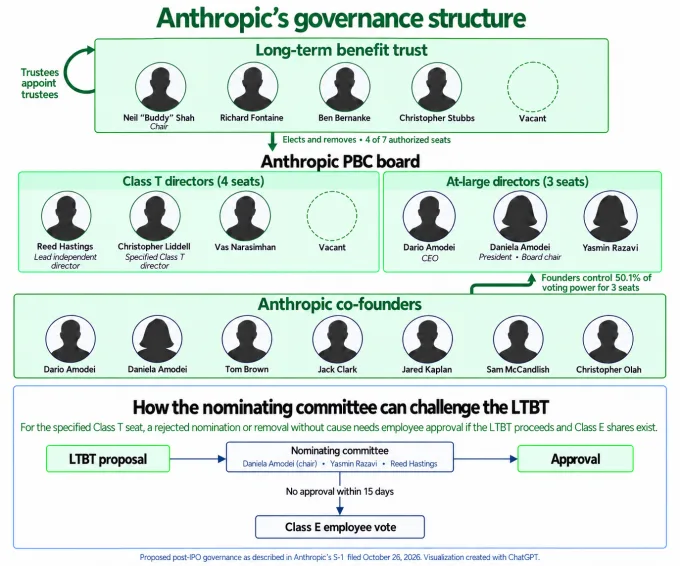
The current board is chaired by Anthropic president Daniela Amodei. Its members include CEO Dario Amodei, her brother; Netflix cofounder Reed Hastings; former Microsoft and General Motors CFO Christopher Liddell; Novartis CEO Vas Narasimhan; and Spark Capital partner Yasmin Razavi. One seat is vacant.
Before IPO: Trust, Founder Shares, and Board Checks
The second layer is a Long-Term Benefit Trust, an independent panel intended to keep the company focused on a mission that benefits humanity. The trust holds a class of stock that lets it elect and remove a majority of the board, called Class T directors. Neil Shah chairs the trust; he is a global health expert and former managing director at GiveWell, a nonprofit that ranks charities. Trust members include former Federal Reserve chair Ben Bernanke, national security expert Richard Fontaine, and Harvard physicist Christopher Stubbs. The trust also has one vacancy, and existing members choose the person to fill it.
The third layer belongs to Anthropic's seven founders. They jointly own a special class of stock that gives a majority of them 50.1 percent of shareholder voting power. That control lets the founders elect three board members. If the founders do not have a majority among themselves, their shares are voted in proportion with common shareholders.
The final check sits with the board. When the Long-Term Benefit Trust nominates a "Specified" director from among its four directors, or removes that director without cause, meaning without alleging misconduct, the board's nominating committee can decline the move. The decision then goes to company employees for a vote.
OpenAI Blip and Possible Pressure Points
The structure is complex enough that its behavior is hard to predict. A comparable episode occurred at OpenAI during its so-called blip, when the board briefly fired CEO Sam Altman over concerns that he was not being candid with them. Employees remained loyal to Altman, the board backed down, reinstated him, and a new governance structure followed. Anthropic's design appears to formalize a similar source of employee power.
The structure also has two possible points of tension. If cracks appear in the founders' unified front, common shareholders could gain more say than expected. Separately, employees can overrule the Long-Term Benefit Trust on board seats if they support the board's nominating committee rather than the trust members.
After IPO: 10 Years, 85 Percent, and Control Changes
Founder control has a time limit. Ten years after the initial public offering, the founders can choose to end their control, and it also ends automatically if fewer than three of them remain. After that point, the Long-Term Benefit Trust continues until 85 percent of common shareholders vote to end it, or until the trust decides to step down with approval from the board.
If neither special class of shareholder exists any more, common shareholders finally get control. The current stage is a pre-listing governance design: Anthropic is approaching its IPO with multiple control paths still active, one board vacancy, one trust vacancy, and several sunset conditions that could shift influence over time.
Comments
No comments yet. Be the first to comment.