
Some investors believe Google's AI search problem has finally appeared in its earnings report.
Google's third quarter earnings show slower AI search monetization, while Cloud, Gemini and spending growth keep focus on search economics.
Key Takeaways
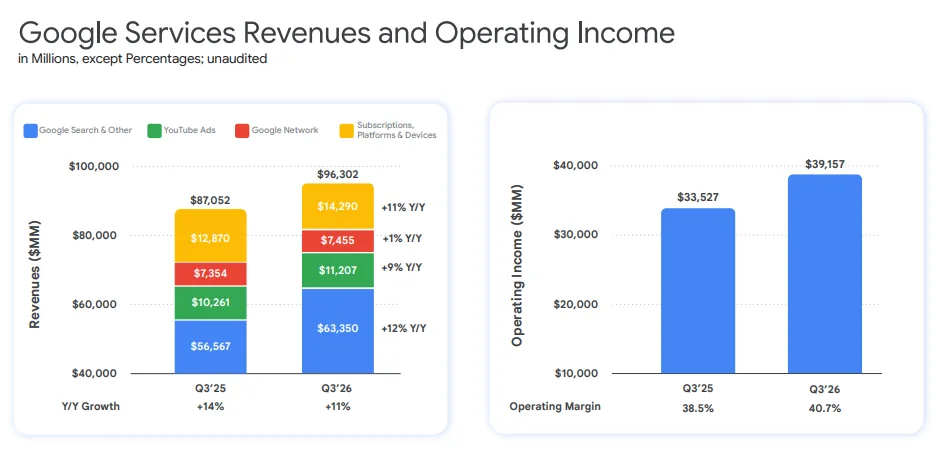
- Google’s Q3 search revenue grew 12% to $63.4 billion, below expectations, reviving investor fears that AI-powered queries may monetize less effectively than traditional search ads.
- Core advertising still expanded: Google Services revenue rose 11% to $96.3 billion, operating income reached $39.2 billion, and search query growth hit its highest annual rate in five years.
- AI adoption is scaling fast: Gemini reached 1 billion users, and model APIs processed about 32 billion tokens per minute, though part of the surge reflects reasoning and agent-driven token usage.
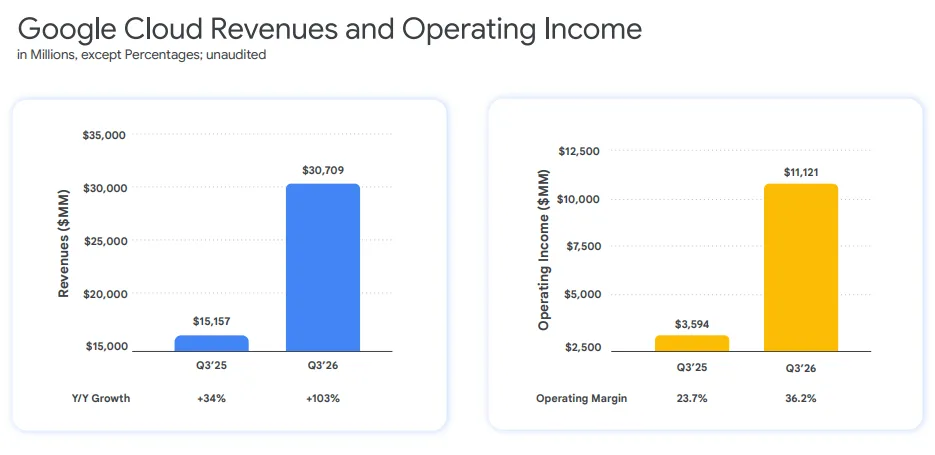
- Google Cloud became the spending spotlight, with revenue more than doubling to $30.7 billion, operating margin rising to 36.2%, and quarterly capital expenditures hitting $51.4 billion.
- The next key signals will be how quickly AI-mode monetization improves as Google expands chatbot advertising and commits to heavy infrastructure spending for agents, Carbon models, and TPU systems.
Meta Description: Google's market value dropped up to ten percent as third-quarter search revenue grew 12 percent, below 15 percent, while AI mode monetization stayed weaker.
Tags: Google, AI Search, Google Cloud, Gemini, Third Quarter Earnings
Featured Image: abstract AI search graph and cloud infrastructure nodes in blue and white, no people, no logos, no text
Background: An Old Investor Fear Reappears in Google's Search Business
For years, investors have worried that Google would become a victim of its own AI transition: users might ask questions inside an AI interface, but those interactions might not support the same advertising economics as classic search. The latest quarter sharpened that fear. Search revenue grew about 12 percent in the third quarter, short of the 15 percent analysts had expected, and Google lost up to ten percent of its market value. The shortfall could point to a tension in Google's core business. AI-powered search queries are rising quickly, yet they still generate less money than traditional search.
Executive Philipp Schindler partly confirmed the gap on the earnings call, saying that "the strong growth in AI mode queries had an impact because of the lower monetization," among other factors. Even so, the company said it was satisfied with the overall trajectory. It also reported that the annual growth rate for search queries reached its highest level in five years.
Development: Q3 Results Show Growth, But Monetization Gaps
The quarter's headline numbers showed that Google's core advertising engine still expands. Revenue from Google Services rose 11 percent in the third quarter to $96.3 billion. Search and other advertising formats increased by 12 percent to $63.4 billion. YouTube advertising grew by 9 percent to $11.2 billion. Operating income grew to $39.2 billion, and the margin rose to 40.7 percent.
Traditional search has been declared dead for years, but it keeps growing anyway. The growth rate in this quarter was slightly below expectations while remaining in line with recent years. Google is also only beginning to monetize AI mode. During the call, the company announced plans to expand its ad program for chatbots in the United States and internationally.
Latest Progress: Gemini, Tokens, and a Cloud Spending Surge
CEO Sundar Pichai said the Gemini app has reached one billion users, making it the fastest-growing product in the company's history. The result is not hard to understand: Gemini is essentially a search add-on, and search is already huge. The company's APIs for its own models process nearly 32 billion tokens per minute, more than four times as many as a year ago. Tokens are the units of text and code processed by models. Part of that jump likely reflects token inflation driven by reasoning models and agentic workflows, or automated task sequences, rather than higher usage alone.
Cloud is where the spending picture becomes most visible. Google Cloud more than doubled its revenue in the third quarter of 2026 to $30.7 billion, up 103 percent from $15.2 billion a year earlier. Operating income rose from $3.6 billion to $11.1 billion, lifting the operating margin from 23.7 to 36.2 percent. Capital expenditures hit $51.4 billion in the third quarter alone. The full-year 2026 forecast remains at $195 billion to $205 billion, with a significantly higher figure expected for 2027.
Infrastructure and Model Rollout: Carbon, Agents, and Tensor Processing Units
Cloud chief Thomas Kurian expects AI agents to drive further growth in the cloud business. His reasoning is practical: more agents in production require more compute for their tasks, more storage for agent memory, and more database capacity for reasoning. That gives Google a possible advantage on both sides, through its own consumer products and through the infrastructure other companies run on.
Pichai said the company is building smaller, distilled versions of its new Carbon model that balance quality and response speed. The plan is to serve them to billions of users through an always-on cloud runtime. The full Carbon model will initially go only to selected cybersecurity experts and the United States government.
Google also wants to sell AI infrastructure built on its proprietary tensor processing unit systems. Management did not disclose the profit margin on selling those systems to outside customers, even when asked twice.
Current Stage: Google Scales AI Infrastructure While Search Ads Catch Up
Google's position is mixed but not contradictory. Search is still growing, Gemini is spreading quickly, and cloud revenue is doubling, yet the new AI surface is monetizing less efficiently than the old one. The company now has a clearer path forward than it had at the start of the quarter: it is expanding chatbot advertising, spending heavily on infrastructure, and preparing distilled Carbon models for a much larger user base. The next signals will likely come from how AI mode monetization improves and whether the $195 billion to $205 billion capital expenditure plan for 2026 becomes a larger 2027 spending commitment.
Comments
No comments yet. Be the first to comment.