
Use enterprise context to create AI value
Most organizations use AI, but only 16% achieve transformative value, while many remain in pilots or assistant stages. The article argues that a context layer is missing infrastructure: it connects systems of record and business knowledge to AI platforms, enabling governed, machine-usable context for AI agents. By translating enterprise intelligence into AI understanding, companies can move from basic assistance toward reliable agents and operational value.
Key Takeaways
- Enterprise AI is widely adopted, but only 16% of organizations are extracting transformative value, while 23% see minimal returns or none at all.
- Most companies remain at intermediate adoption stages: 38% are piloting AI use cases and 35% are using employee-assistance tools, while only 12% have AI agents in production.
- The article frames AI deployment as a maturity ladder, moving from pilots and assistants to governed agents and eventually AI carrying most key-process work.
- A major missing infrastructure is the “context layer,” which connects business systems and data to AI platforms and translates enterprise knowledge into governed, machine-usable context.
- Future value depends on moving beyond isolated AI pilots to context-aware, governed systems that enable reliable AI agents and real business transformation.
Meta description: MIT Technology Review Insights finds only 16% of organizations extract transformative AI value, while 38% pilot use cases and 12% run AI agents.
Tags: enterprise AI, AI adoption, MIT Technology Review Insights, context layer, AI agents
Featured image: Abstract data-layer graphic showing AI models connected to business systems, no people, no logos, no text.
Background: Universal AI Use Has Not Delivered Broad Value
Enterprise AI is now present across many business systems, including AI-powered customer platforms, conversational assistants, and workflow and process automation tools. Each of these tools is sophisticated, advanced, and quick to respond. But when they are set to work, the outcomes and actions that emerge may be wrong, confused, or lacking a proper understanding of the business. Many organizations find themselves in this situation, and it could be one of the key reasons they struggle to extract returns on their AI investments.
An MIT Technology Review Insights poll gives that experience a distribution. While every organization surveyed is using AI today to some degree, fewer than one in five, or 16%, are extracting transformative value from their deployments. The largest percentage of respondents, 40%, say they are seeing moderate gains in specific tasks or teams. A smaller group, 21%, report meaningful gains, while 23% are seeing minimal returns or none at all.
Development: Adoption Stages Show a Maturity Ladder
The survey separates how companies are using AI from how much value they are getting. Companies are mostly still piloting AI use cases, according to 38% of respondents, or using it to assist employees’ work with tools like co-pilots or chat assistants, according to 35%. Those are intermediate stages: the technology is active, but it is not yet embedded as the main engine of key processes.
The more advanced share is much smaller. Just 12% of enterprises have AI agents in production, and 3% say they are using AI to do most of the work in key processes. The numbers outline a ladder. A business may start with pilots, move to employee assistance tools, then deploy AI agents, and finally let AI carry the majority of work in a critical process. Most respondents are still on the lower rungs.
Latest Progress: Context Layer Framed as the Missing Infrastructure
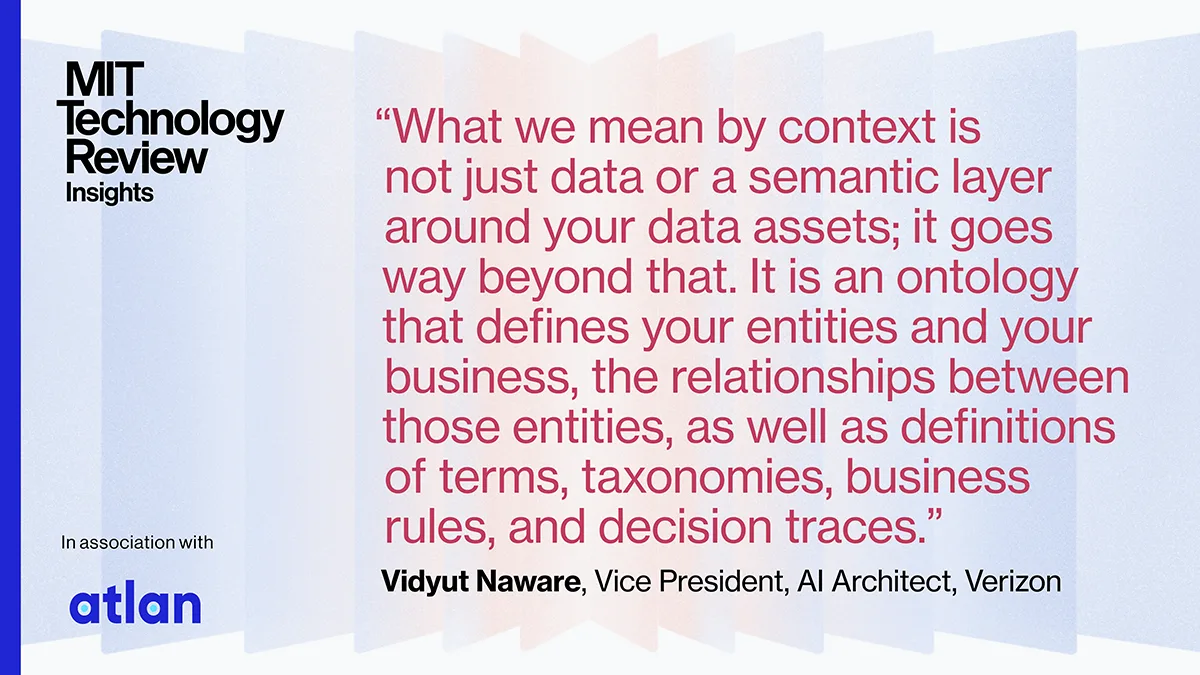
The material identifies a missing layer: context, or how well AI understands a business. A context layer is the architectural infrastructure that sits between an organization’s business systems, for example systems of record and data, and its AI platforms. It translates enterprise intelligence into governed, machine-usable context for AI agents or models and helps knowledge compound.
“There’s a big gap between what the models are capable of and how the models are actually being useful inside organizations,” says Prukalpa Sankar, co-founder of Atlan. “For every real-life intent and purpose, artificial general intelligence is already here. It’s just not really useful in most companies today.”
The missing layer is the translation mechanism that lets AI systems understand the business context they need to act usefully. “Without a context layer for AI, it’s almost like you’re hiring the smartest intern in the world, blindfolding them, and throwing them into your organization,” Sankar says.
Current Stage: From Assistants Toward Governed Agents
The poll places enterprise AI in a transition state. The broad use of AI is no longer the question; every surveyed organization is using it in some form. The harder question is whether deployments are becoming valuable enough to transform operations. At present, 16% are extracting transformative value, while 40% are getting moderate gains in specific tasks or teams, 21% are seeing meaningful gains, and 23% are seeing minimal returns or none at all.
The deployment pattern shows the same transition. Pilots account for 38% of respondents, employee assistance tools such as co-pilots or chat assistants account for 35%, AI agents in production account for 12%, and AI doing most of the work in key processes accounts for 3%. What comes next is whether organizations can move from isolated pilots and assistants to governed, context-aware systems that support agents and key processes.
This content was produced by Insights, MIT Technology Review’s custom content arm, not its editorial staff. It was researched and written by humans, with any AI tools that may have been used limited to production processes under human oversight.
Comments
No comments yet. Be the first to comment.