
Quest Diagnostics Shares Two Use Cases for AI
Quest Diagnostics uses AI in digital cytology and contact centers to raise lab productivity and manage wage inflation.
Key Takeaways
- Quest Diagnostics is using AI as part of its Invigorate cost program to manage very large-scale lab and customer service workloads, including $11 billion in 2025 net revenues and about 244 million test requisitions.
- In digital cytology, the Hologic Genius system can improve detection of high-grade lesions compared with manual review, but it may also lower specificity; early workflow data suggest higher cases per cytologist and faster turnaround, though measured productivity gains are still not confirmed.
- Quest has also used AI and automation in microbiology to simplify workflows, improve turnaround time for negative cultures, and reduce staffing needs, with lab automation accounting for a large share of its AI efforts.
- Customer service AI tools include a virtual agent, email triage, and answer-search support; reported benefits such as fewer routine calls and higher agent productivity are self-reported and lack disclosed methodology, vendors, or proof of scale.
- Future impact depends on broader rollouts and measurable results, with Quest also expanding partnerships such as PathAI assets and Google Cloud for further AI and data analytics use.
Quest Diagnostics reported $11 billion in net revenues for 2025 and processed about 244 million test requisitions, serving roughly one in three U.S. adults and about half of U.S. physicians and hospitals each year. At that scale, small workflow gains translate into large volumes of work, and the company has pointed to AI as one lever inside its broader Invigorate cost program.
Background: Why Specialist Time and Contact Volume Matter
Pap test review depends on cytologists and pathologists, so specialist staffing limits how many slides a lab can read. The American Society for Clinical Pathology's 2024 vacancy survey found the U.S. cytology vacancy rate fell from 13.2% in 2022 to 11.6% in 2024; in the 2022 survey, respondents said filling cytology positions took more than 12 months. For labs, the question is whether existing staff can review more slides and return results sooner without hurting screening performance.
On the customer service side, Quest's contact centers handled 13.2 million interactions in 2024, up from 12.2 million in 2023, with phone calls at 71% of interactions in 2024. Calls per 100 requisitions fell from 6.2 in 2022 to 5.5 in 2023 and held at 5.5 in 2024, an 11% reduction from the 2022 baseline. On the Q3 2026 earnings call, CEO Jim Davis estimated wage inflation would be 3% to 4% in 2026, putting at least $120 million in annual cost pressure on the company, which Invigorate is meant to offset.
Development: Digital Cytology Moves From Pilot to Rollout
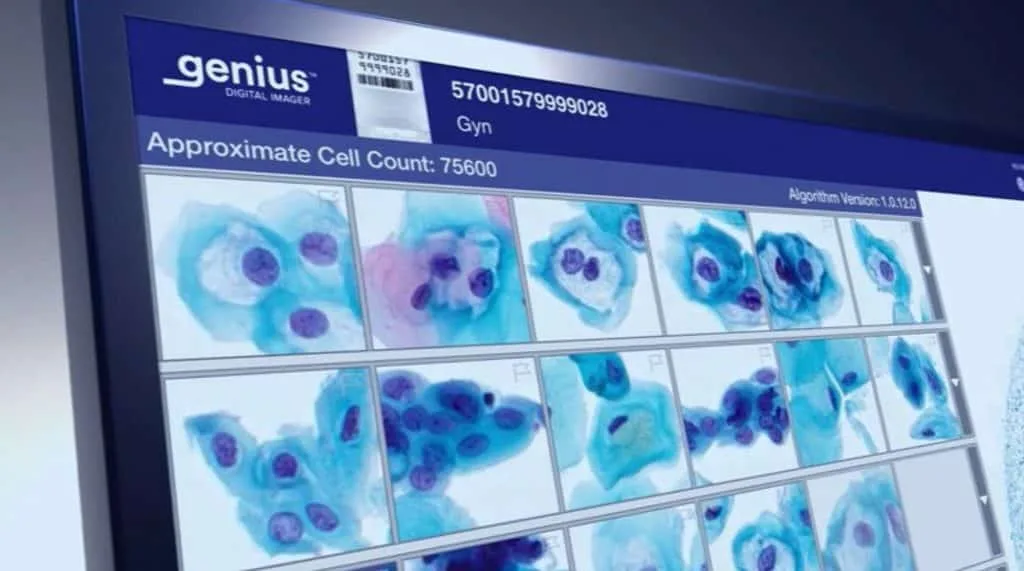
Quest uses the Hologic Genius Digital Diagnostics System in cervical cancer screening. Per the FDA's review, it works in three connected steps: a digital imager scans each stained slide; a deep learning model selects images of cells and cell clusters for a review gallery and provides a cell count to help assess sample adequacy; cytologists and pathologists then review the full gallery and remain responsible for the diagnosis. Hologic also describes secure remote case sharing, a capability of the imaging infrastructure rather than the AI itself.
In a four-site study of 1,960 evaluable slides, sensitivity for high-grade lesions or worse was 81.5% with Genius versus 74.0% for manual review. At the same threshold, specificity fell from 97.2% manually to 94.8% with Genius, a statistically significant difference—more high-grade abnormalities detected, but also more slides without them flagged for further review.
A retrospective study at ProPath, a Dallas pathology laboratory, compared workflows before and after adoption. Average daily review volumes were similar, while cases reviewed per cytologist per day rose from 74.5 to 94.7 and the average number of cytologists working per day fell from 10.4 to 8.1; time from specimen accession to final sign-out also fell across diagnostic categories. Hologic funded the study and employed one co-author; it covered one lab with about eight months of post-implementation data, did not use biopsy data to confirm the detection increase, and could not isolate AI's contribution.
On the April 2026 earnings call, Davis estimated 60% to 70% of Quest's AI and automation efforts were focused on its labs. In February prepared remarks, Quest said it had implemented Genius at two laboratories and planned to expand to several more that year; on the July call, Davis said it had recently installed the system at two more locations, following implementations at about half a dozen sites over the previous year. At its 2025 Investor Day, Quest projected the system would improve resource productivity by more than 40%; the rollout updates gave no measured productivity result.
Quest has also applied AI and automation to microbiology. In its 2023 Investor Day presentation, it reported reducing the microbiology workflow from eight steps to two, improving turnaround time for negative cultures by 40%, and cutting full-time staffing for the workflow by about 40%—combined effects of automation and AI. Its 2024 annual report described using AI to separate specimens with no evidence of microbial growth so medical scientists can focus on specimens more likely to indicate disease.
Latest: A Virtual Agent and Email Triage in Customer Service
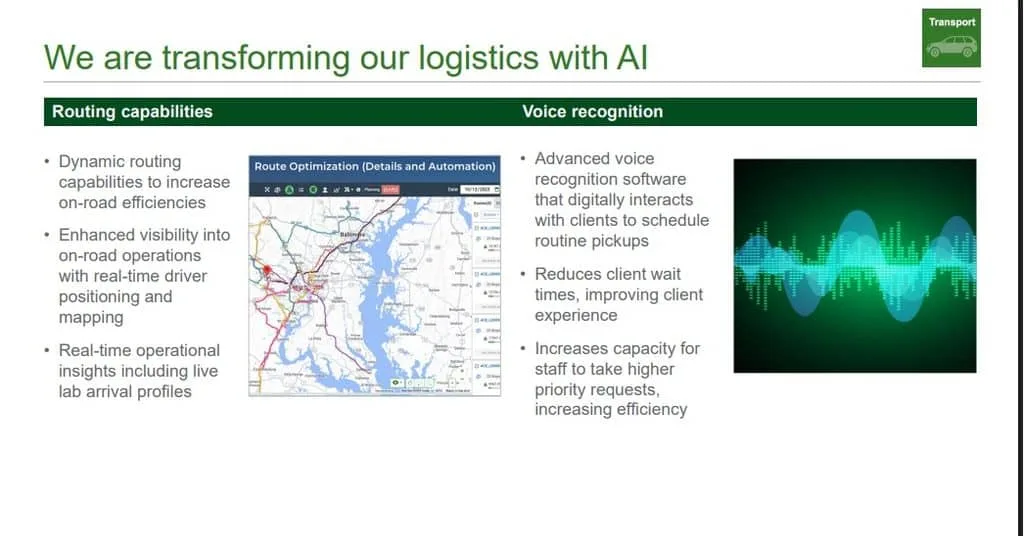
Quest has described three AI applications in customer service. A virtual agent handles routine logistics calls; Quest's 2025 Investor Day describes voice recognition software that interacts with clients to schedule routine pickups, reducing wait times and freeing staff for higher-priority requests, though Quest has not said whether this is the same tool as the virtual agent. AI triages and routes incoming customer service emails, and representatives use AI to find answers more quickly—the 2024 annual report said Quest is broadening AI use so representatives can access answers faster.
Two headline impact figures are self-reported. Davis said the virtual agent reduced routine logistics calls by "up to" 50%, a best case rather than an average, and reported a 40% productivity gain in Q1 2026 among agents who used AI to triage emails, without a published methodology or comparison group. Quest has not named the vendors or models behind these tools or disclosed which call types the agent covers, adoption levels, volumes, costs, or AI's share of Invigorate savings. Customer service AI has appeared in its reporting from 2023 through 2026—sustained attention rather than proven scale.
What to Watch
The Invigorate program met its 3% annual cost savings and productivity improvement target in 2025, reflecting combined initiatives including AI and automation. Quest's June 2024 acquisition of select PathAI Diagnostics lab assets and its March 2025 collaboration with Google Cloud—covering data analytics and exploration of generative AI across research, customer experience, and operations, with several applications still under exploration—signal where further deployments could come from. The open questions are measured results: whether Genius delivers the projected productivity gain across more sites, and whether the contact center figures hold up against defined baselines and comparison groups.
Comments
No comments yet. Be the first to comment.