
K2-Horizon is a cutting-edge fleet of open-source language models.
K2-Horizon offers six open language models, MoVA, Uno decoding, 10T synthetic tokens, and full training artifacts, showing efficiency at scale.
Key Takeaways
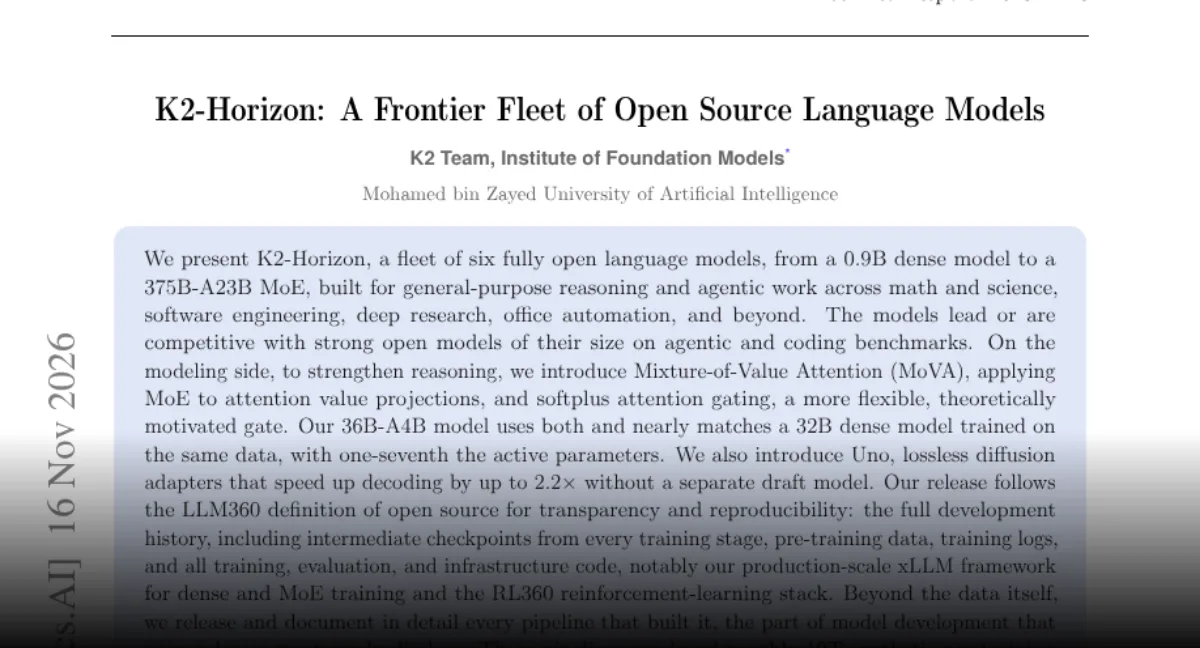
- K2-Horizon releases six fully open language models, from a 0.9B dense model to a 375B-A23B MoE, for reasoning, agentic work, coding, math/science, research, and office automation.
- It introduces MoVA and softplus attention gating; the 36B-A4B model nearly matches a 32B dense model while using only one-seventh the active parameters.
- Uno lossless diffusion adapters speed up decoding by up to 2.2× without requiring a separate draft model.
- The project follows LLM360 open-source standards by releasing full training artifacts, including intermediate checkpoints, pre-training data, logs, code, xLLM, and RL360.
- Its data pipelines produced about 10T synthetic pre-training tokens, and four models share a 22T-token corpus, enabling reproducible studies of scale and sparsity.
Meta description: K2-Horizon releases six open language models, from 0.9B to 375B-A23B, adding MoVA, softplus gating, Uno decoding, and full training artifacts at ifm.ai.
Tags: K2-Horizon, open language models, MoE, synthetic data, xLLM
Featured image: abstract gradient network of glowing nodes and layered data streams, no people, logos, or text.
K2-Horizon is a fleet of six fully open language models, ranging from a 0.9B dense model to a 375B-A23B MoE, a Mixture-of-Experts model. Its stated use cases span general-purpose reasoning and agentic work in math and science, software engineering, deep research, office automation, and other areas. The release matters because it presents a complete open development bundle, not only final model weights, so the training path, infrastructure, and data pipelines can be examined directly.
Background: Open Models Compete on Reasoning and Agentic Work
The models are positioned ahead of, or in line with, strong open peers of comparable size on agentic and coding benchmarks. That places the release in a practical comparison area where reasoning, coding, and task-oriented model use are evaluated against open models of similar scale. The stated task range also covers math and science, deep research, and office automation, broadening the fleet beyond chat-style language generation.
Development: MoVA, Softplus Gating, and the 36B-A4B Checkpoint
On the modeling side, to strengthen reasoning, K2-Horizon introduces Mixture-of-Value Attention, or MoVA, which applies MoE to attention value projections. It also introduces softplus attention gating, described as a more flexible, theoretically motivated gate. The 36B-A4B model uses both techniques and nearly matches a 32B dense model trained on the same data, while using one-seventh the active parameters. That result is the clearest architecture signal in the release: MoVA and softplus gating are tied to a concrete efficiency comparison between a sparse-active model and a dense model.
Latest Release: Uno, Synthetic Data, and Full Artifacts
The release also introduces Uno, lossless diffusion adapters that speed up decoding by up to 2.2× without a separate draft model. This adds an inference-side element to the fleet, alongside the training architecture.
The project follows the LLM360 definition of open source for transparency and reproducibility. The published package includes the complete development history, intermediate checkpoints from every training stage, pre-training data, training logs, and all code for training, evaluation, and infrastructure. It also includes the production-scale xLLM framework for dense and MoE training and the RL360 reinforcement-learning stack.
Beyond the data, the release documents every pipeline used to build it, a component that open model releases rarely expose. These pipelines produced roughly 10T synthetic pre-training tokens, showing that synthetic data can be a major ingredient of pre-training at scale. Four models share one 22T-token pre-training corpus and recipe, indicating consistent scaling behavior and enabling controlled studies of scale and sparsity.
Current Stage: A Fully Documented Open Fleet
All artifacts are available at https://ifm.ai/k2/. K2-Horizon is now at a stage where its model range, architecture choices, decoding adapters, training stack, and data pipelines are published together. The shared 22T-token corpus, the 10T synthetic token pipeline, and the 36B-A4B efficiency result form the main evidence trail for readers assessing how this open fleet behaves across agentic, coding, math, science, research, and office automation tasks.
Comments
No comments yet. Be the first to comment.