
Researchers identify six patterns that make AI text so draining to read
NYU and UT Austin tested 14 LLMs and found six AI text patterns make model writing hard to read; training rewards dense, correct output over clarity.
Key Takeaways
- A NYU and UT Austin study of 14 language models found that AI text often feels harder to read than human writing because it overuses six specific linguistic patterns.
- These patterns include unusual word combinations, separated sentence parts, omitted connectors, stacked nouns, noun-to-verb usage, and animate verbs applied to inanimate subjects.
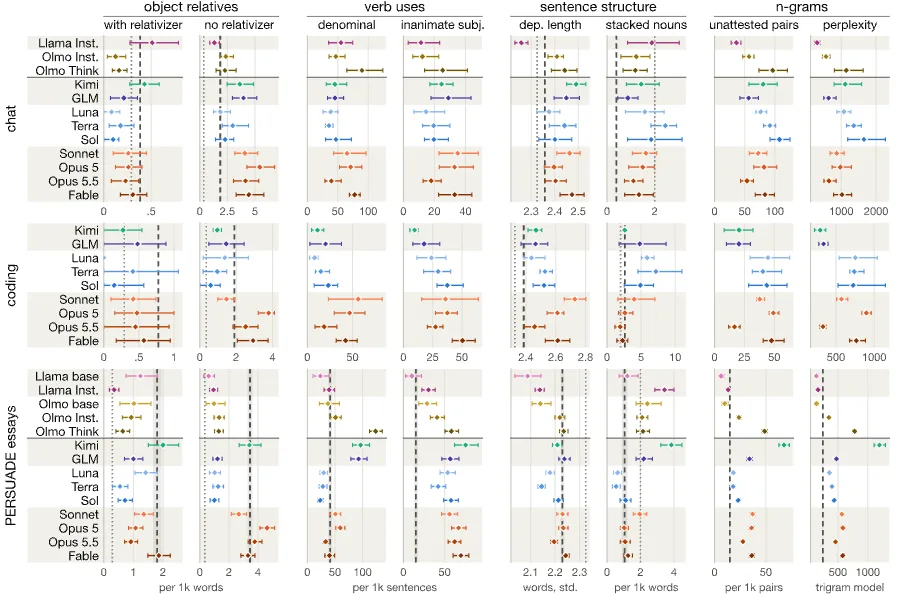
- Model comparisons suggest post-training is a major cause of reduced readability: Llama and Olmo base models stayed closest to human text, while instruct and reasoning variants became denser.
- The study argues that modern AI training increasingly rewards compact, correct output in math, code, and logic, while giving less weight to human-friendly clarity.
- Targeted finetuning can improve readability without sacrificing capability, as seen in Claude Opus 5.5’s stronger performance against Opus 5, but the broader question is whether more models will treat clarity as an explicit training goal.
Meta description: An AI readability study by NYU and UT Austin tested 14 language models, including Claude, GPT-5.6, GLM-5, Kimi K2.5, Llama and Olmo, for hard-to-read patterns.
Tags: AI readability, Claude, language models, LLM training, text clarity
Featured image: Abstract technology style image with translucent network nodes, flowing data streams, and readability gauges; no real people, company logos, or text.
Background: Testing 14 language models against human writing
An AI readability study by researchers at New York University and the University of Texas at Austin asked whether model-written text feels harder to process than human-written text. The study, credited to Clark, Martin & Mahowald (2026), had 14 language models generate text in casual conversation, coding sessions, and argumentative essays. The tested lineup included Claude, GPT-5.6, GLM-5, Kimi K2.5, and smaller open-source models such as Llama and Olmo. The researchers analyzed 120 conversations, 45 coding sessions, and 980 essays, then compared the model outputs with human writing drawn from movie subtitles, StackExchange, and student essays.
Development: Six patterns that make AI text a chore to read
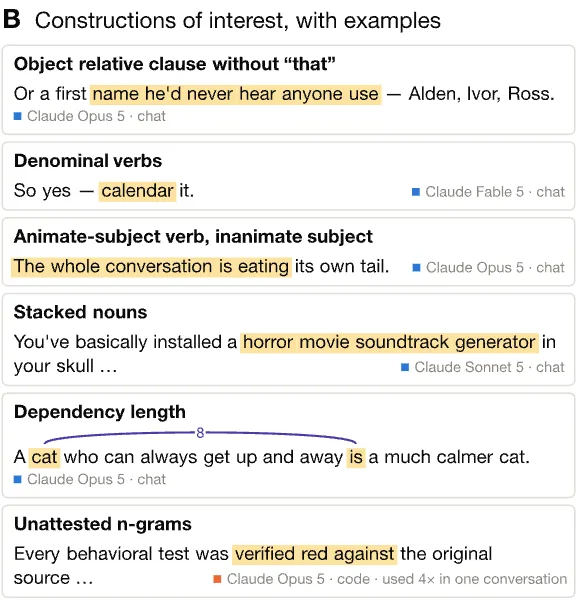
The study identified six linguistic constructions that appear too often in model-generated writing. One is an unusual word combination that rarely occurs in human text, such as "reader-patience budget." Another is placing related sentence parts far apart, which taxes working memory. Claude Opus 5 produced, "A cat who can always get up and away is a much calmer cat," separating the subject from the main predicate with a long clause.
A third pattern is a shortened reference with a dropped connector. Instead of writing "the book that the professor wrote," a model may write "the book the professor wrote." That saves one word but can briefly confuse how the clause parts fit together. A fourth pattern is stacked nouns, such as "horror movie soundtrack generator," which forces readers to infer which word modifies which.
The fifth pattern turns nouns into verbs where a human would likely use a fuller phrase. Claude Fable 5 wrote "calendar it," while a human would more naturally say "put it in the calendar." The sixth pattern applies animate verbs to inanimate subjects. Claude Opus 5 wrote, "The whole conversation is eating its own tail," even though a conversation has no tail and cannot eat. Readers may still infer the meaning, but the sentence requires an extra beat.
The study also found differences across model families. Llama and the Olmo base model came closest to human text. Within the Olmo family, scores rose steadily from the base model through the instruct variant to the reasoning model Olmo Think, which reached frontier-level numbers. That pattern pointed to post-training as the likely cause of the divergence. Claude Opus 5.5 beat its predecessor Opus 5 in 19 out of 21 comparisons, suggesting that targeted finetuning can improve readability.
Latest progress: Training rewards density more than clarity
The researchers argued that human language balances ease of production with ease of understanding, while modern language models are trained increasingly on tasks such as math, code, and logical reasoning. In those settings, correctness is rewarded and clarity is not. The shift from RLHF (Reinforcement Learning from Human Feedback) to RLVR (Reinforcement Learning with Verifiable Rewards) removes humans from the feedback loop entirely, they say, and models develop a kind of dialect that compresses information and helps solve complex problems but reads poorly for humans.
As a proof of concept, the researchers trained a smaller language model with a penalty term that rewarded shorter answers. Under certain training conditions, the model favored shorter phrasings almost without exception, regardless of context. It even generalized that preference to sentence patterns it had never encountered during training. Humans, by contrast, chose between shorter and longer variants depending on the situation.
A similar explanation came from inside the industry. Anthropic employee Jackson Kernion, who works on Claude fine-tuning, recently explained why Opus 4.6 was the last good writing model from Anthropic. He said optimizing newer models for math, code, and technical explanations aimed at other AI models pushed Claude toward a style that works well for AI but reads as too dense and unnatural for humans. Kernion called it an adaptation to "LLM psychology." With Opus 5.5, Anthropic pushed back for the first time, addressing sentence clarity and overloaded blocks of information, and the study suggests the correction worked.
What to watch next
The sequence runs from data collection across 120 conversations, 45 coding sessions, and 980 essays to a clearer account of why model text can feel effortful. The current stage is a split between models that stay close to human patterns, such as Llama and Olmo base, and post-trained variants that become denser through later tuning. The Claude Opus 5.5 result, winning 19 out of 21 comparisons against Opus 5, shows that readability can be improved without abandoning capability, but the broader question is whether more model families will treat clarity as a training signal rather than a byproduct.
Comments
No comments yet. Be the first to comment.