
Meituan has released a 1.6 trillion-parameter agent model that never used an Nvidia GPU.
Meituan's LongCat-2.5 is a 1.6-trillion multimodal AI agent trained on Huawei Ascend chips, MIT licensed, with low API pricing and agent benchmarks.
Key Takeaways
- Meituan released LongCat-2.5, a 1.6-trillion-parameter mixture-of-experts model that activates about 48 billion parameters per token and is deployed on Huawei Ascend accelerators without using Nvidia GPUs.
- The model is natively multimodal, understanding text, images, and video by processing visual content as discrete tokens, and supports 1 million input tokens with responses up to 128,000 tokens.
- LongCat-2.5 was trained with reinforcement learning on real GitHub tasks and optimized using 4-bit quantization, improving throughput while maintaining accuracy on Chinese AI chips.
- Benchmark results show strong agent and web-search performance, with competitive but mixed scores against leading models such as Claude Opus 5 and GPT-5.6 Sol.
- The model is open-weighted under MIT license with low promotional API pricing, signaling growing competitiveness of open models optimized for Chinese AI hardware.
Meituan has released LongCat-2.5, a mixture-of-experts model that activates roughly 48 billion of its 1.6 trillion total parameters per token and runs its reference deployment on 194 Huawei Ascend accelerators. The release matters because it pairs frontier-scale agent performance with a hardware stack that avoids Nvidia GPUs entirely, and it ships under the MIT license with promotional API pricing of about €0.27 per million input tokens and €1.07 per million output tokens.
Background: From LongCat-2.0 to a Natively Multimodal Model
LongCat-2.5 builds on LongCat-2.0, which Meituan says it trained in late June entirely on a cluster of more than 50,000 Chinese AI chips. Before that model's identity was disclosed, it ran anonymously as "Owl Alpha" on OpenRouter.
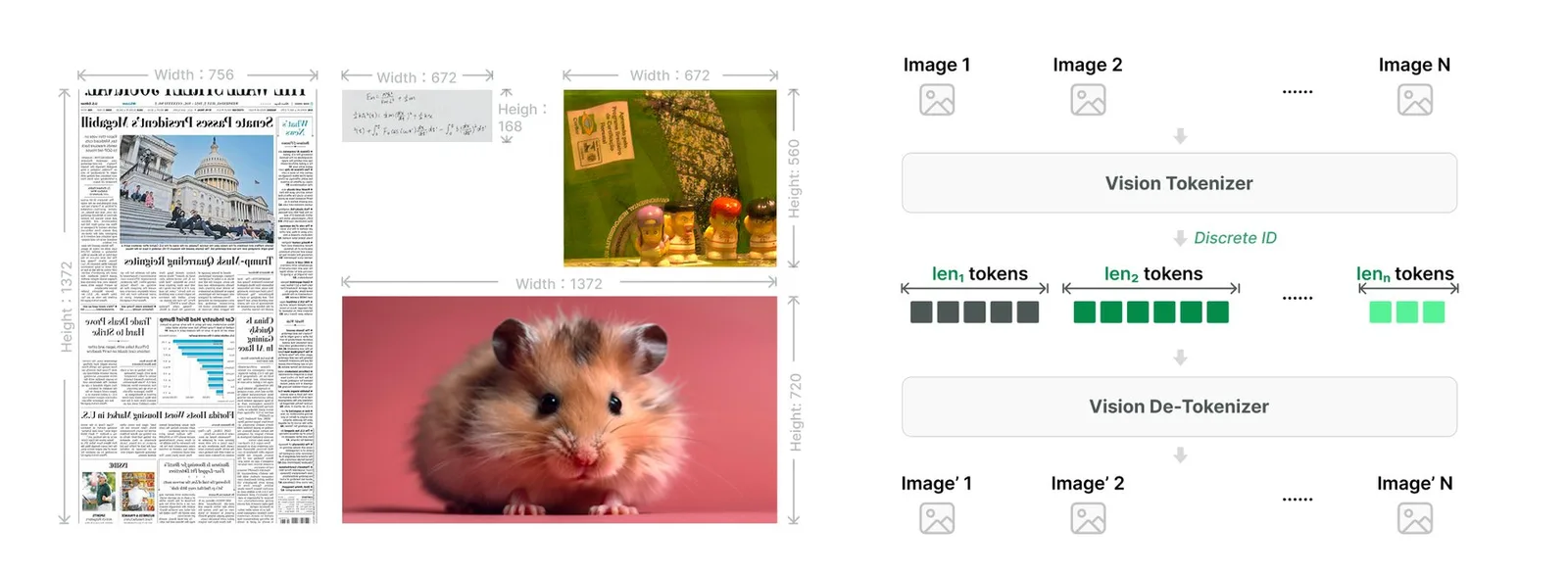
The new version adds image understanding, but not by bolting a separate image encoder onto a text model after the fact. Instead, LongCat-2.5 breaks images down at their native resolution into discrete tokens that the model processes alongside text, the same pattern today's LLMs use for language. The approach draws on the research model LongCat-Next and targets visual coding, design, and 3D tasks.
Capability-wise, the API accepts up to one million tokens at once and generates responses up to 128,000 tokens long. It understands text, images, and video, responds in text, and lets users toggle reasoning on and off.
Development: Reinforcement Learning on Real GitHub Work
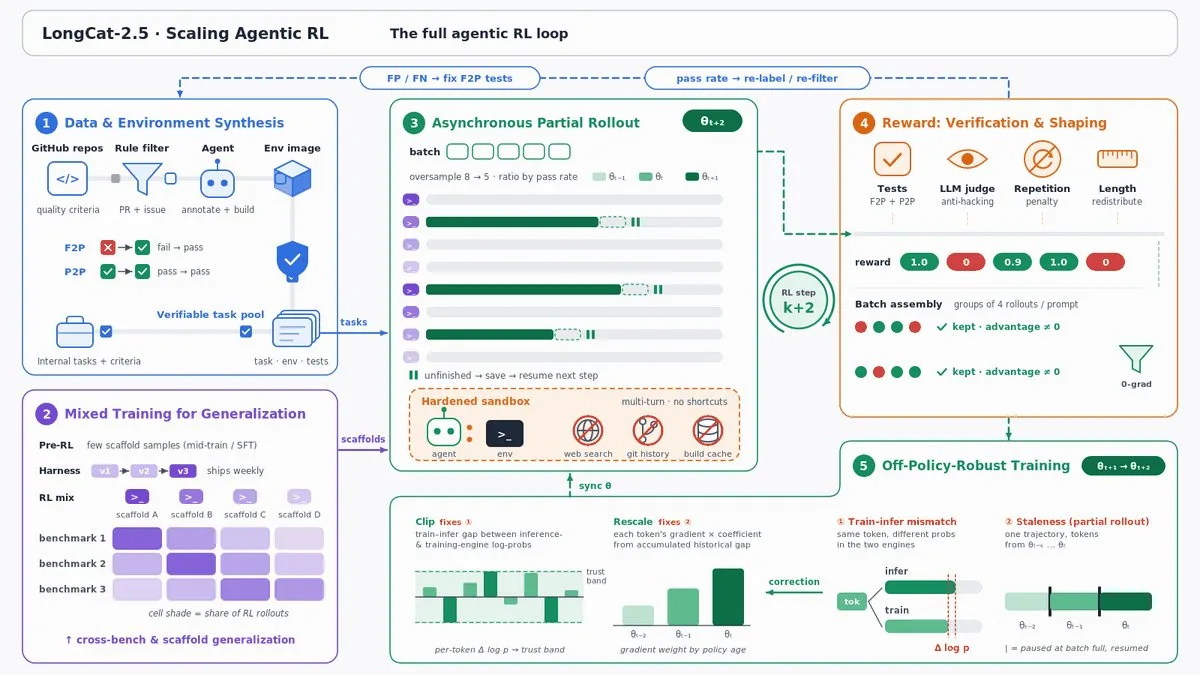
For reinforcement learning, the team pulled real software tasks from GitHub pull requests and recreated agent failures. To confirm the model actually solved tasks rather than exploiting shortcuts, developers blocked internet access in the training environments, removed Git history and cached files, and used a language model to check solutions for tricks. Meituan also distilled the capabilities of several specialized teacher models for agent work, reasoning, and dialog into LongCat-2.5.
The efficiency story sits on quantization. Meituan quantizes the experts' weights and activations to 4-bit precision, which Chinese chips process natively. In the company's load tests, throughput rose 43.3 percent for prompt processing and 42.77 percent for response generation compared with an 8-bit version, while accuracy stayed on par with the uncompressed model, according to Meituan.
Latest: Benchmark Scores and the 194-Chip Deployment
The self-hosting guide, available in a separate repository, describes a cluster of 194 Huawei Ascend accelerators from the Atlas A2 series: two handle image processing, 64 handle prompt ingestion, and 128 handle response generation. There is no guidance for Nvidia GPUs.
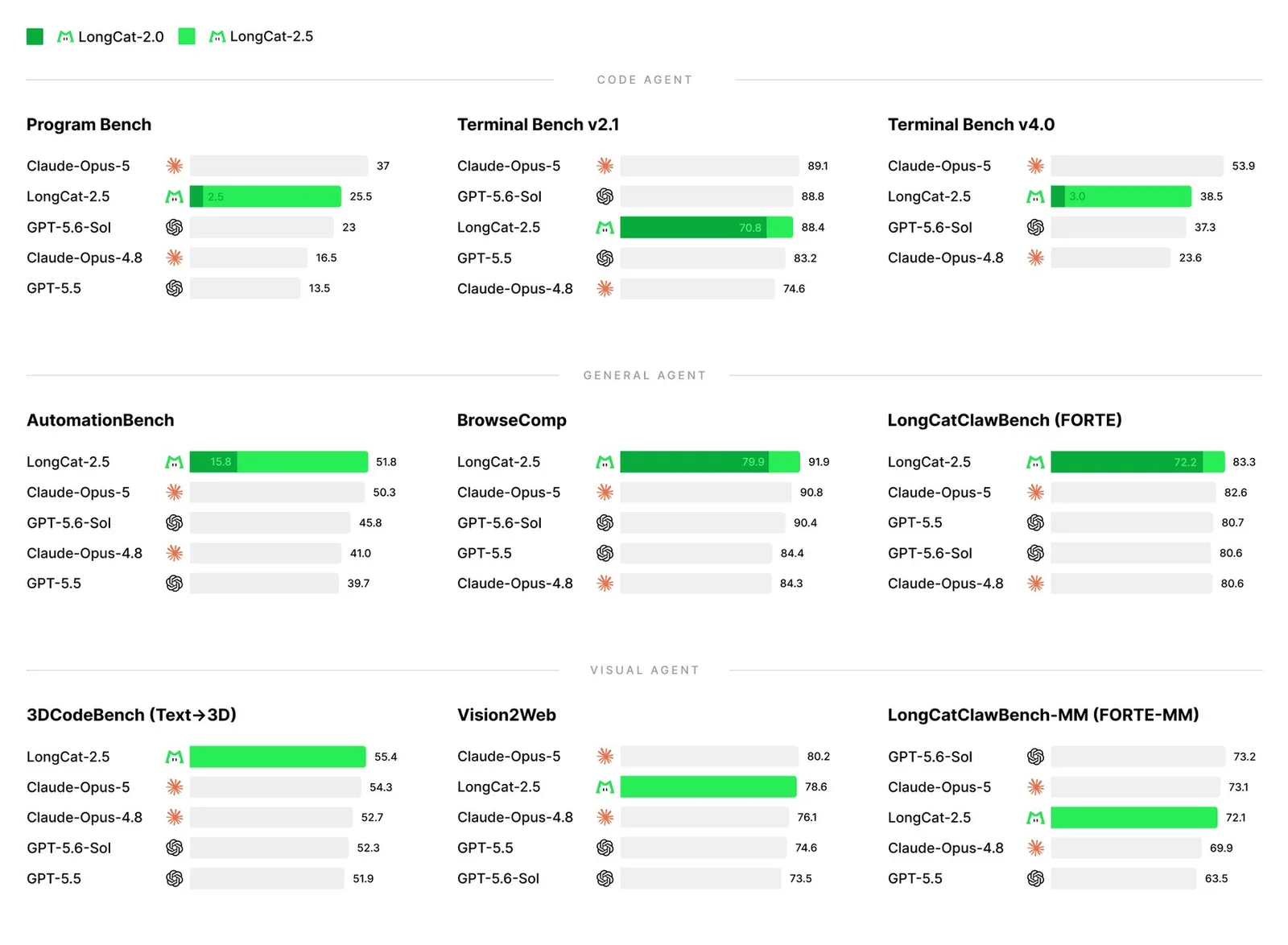
On Terminal Bench v2.1, which measures how well agents solve command-line tasks, LongCat-2.5 reports 88.4 points. Meituan lists Claude Opus 5 at 89.1, GPT-5.6 Sol at 88.8, and Deepseek-V4.1-Flash atop the table at 90.6. On the harder Terminal Bench v4.0, LongCat-2.5 scores 38.5, slightly above GPT-5.6 Sol's 37.3 but well below Opus 5's 53.9.
DeepSWE, which tests bug fixes in real code repositories, shows the largest jump: LongCat-2.5 rises from 9.7 to 64.6 points. That places it behind every other model in the table except Claude Opus 4.8, with Deepseek-V4.1-Flash leading at 74.2 and GPT-5.6 Sol at 72.7. The newer Claude Opus 5.5 and GPT-6.1 Sol are not included in the table.
LongCat-2.5 also posts 91.9 on the web search benchmark BrowseComp, the highest score in the table, though Meituan ran that test in its own environment.
What to Watch
The weights are available under the MIT license, permitting commercial use, modification, and redistribution. Users can try the model through a chat interface at https://longcat.ai/, and the API supports both the OpenAI and Anthropic formats, plugging into agent harnesses such as Claude Code, Codex, and Hermes.
The broader signal is that open-weight models optimized for Chinese chips from the start make that hardware more attractive outside China too. Chinese open-weight models like Kimi K3.1 and GLM-5.3 have largely caught up with top US models on common benchmarks. Meituan is also working beyond multimodal agent models: it previously released LongCat-Image, an open-source text-to-image model with just 6 billion parameters that prioritizes efficiency over sheer model size.
Comments
No comments yet. Be the first to comment.