
Nvidia's open Nemotron 3.5 Transcribe unifies transcription, translation, and speaker recognition in one model.
Nvidia's open Nemotron 3.5 Transcribe transcribes 40 languages, translates, identifies speakers on one GPU, leads benchmarks, and ships Granary v2.
Key Takeaways
- Nvidia Nemotron 3.5 Transcribe is an open speech model that unifies transcription, translation, speaker labeling, summaries, and audio Q&A in one system, supporting 40 languages.
- It leads several open speech benchmarks, including top open-weight performance on English ASR and stronger speaker recognition than many competitors, while using relatively efficient compute.
- The model’s 30B-parameter design activates only about 4B parameters per step, allowing it to run on a single GPU and process large audio batches quickly.
- Nvidia also released Granary v2, a much larger multilingual speech dataset with multiple transcription styles, plus tools and guides for fine-tuning specialized domains such as medical speech.
- Key limitations include support for recorded audio only, no real-time processing, language-dependent features, and the need to spot-check results, especially after domain-specific fine-tuning.
Title: Nvidia Nemotron 3.5 Transcribe leads open speech benchmarks on one GPU
Meta description: Nvidia Nemotron 3.5 Transcribe leads open speech and speaker-recognition benchmarks, transcribes 40 languages, runs on one GPU, and ships with Granary v2.
Tags: Nemotron 3.5 Transcribe, Nvidia, speech recognition, speaker identification, Granary v2
Featured image: abstract waveform grid on dark background with soft blue and green gradients, no people, no logos, no text.
Nvidia Nemotron 3.5 Transcribe is an open speech recognition model that can follow text instructions to turn recordings into transcripts, translations, speaker-labeled records, or summaries, and it can also answer questions about a recording's content. Nvidia says it leads several benchmarks, and the release includes the Granary v2 dataset plus tools for adapting the model to specialized fields. For teams working with recorded speech, the model matters because it combines several tasks that usually require separate systems while remaining small enough to run on a single GPU.
Background: Nvidia builds on diarization and dataset work
Before this release, a plain transcript often failed to show who spoke, translate content, or spell technical terms correctly. Nvidia had already used the Granary dataset for its multimodal Nemotron 3 Nano Omni model. Only recently, in September, Nvidia introduced Nemotron 3 Diarization, a dedicated speaker recognition model that can tell apart up to eight speakers, even in live conversations. That diarization step still required a separate model, such as Nvidia's Parakeet, for actual transcription. Nemotron 3.5 Transcribe combines those jobs and adds translation and audio understanding, though Nvidia says it does not support real-time processing.
Development: one model transcribes, translates, and labels speakers
Nvidia says the model transcribes 40 languages, translates 31 of them to or from English, and identifies speakers in 13 languages. It can handle recordings up to one hour long with as many as eight speakers. Users control it with simple instructions. The same meeting recording can become a transcript with speaker labels, an English translation, or a summary of decisions made. Users can also provide technical terms, such as drug names, as hints; Nvidia says the model should use them only when they actually appear in the recording.
Architecturally, the model has 30 billion parameters but activates only about 4 billion per processing step. That design lets it run on a single Nvidia GPU, from compact DGX Spark systems to data center hardware. Nvidia says it processes 100 hours of audio in under three minutes on an RTX PRO 6000 Blackwell Server Edition at NVFP4 precision.
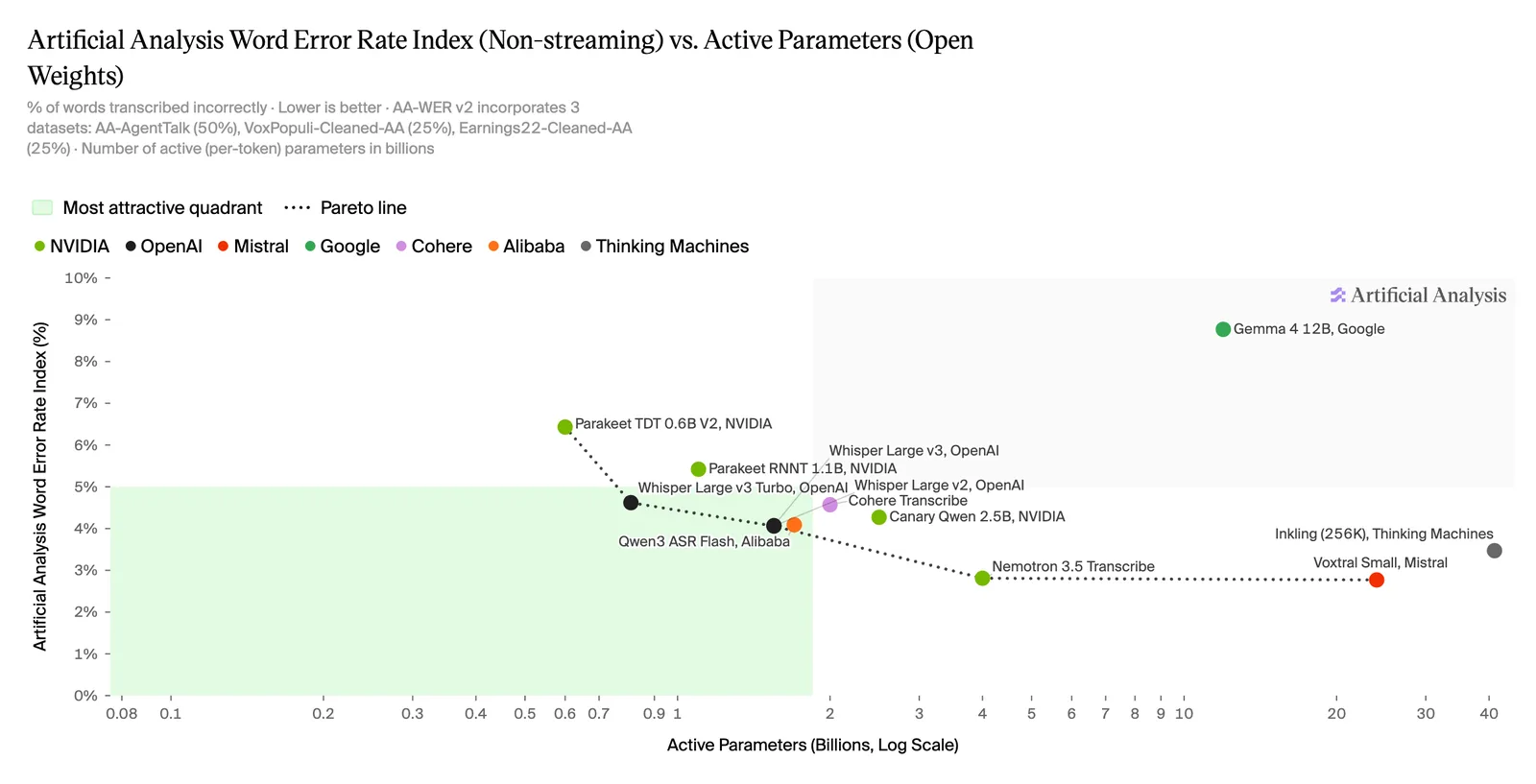
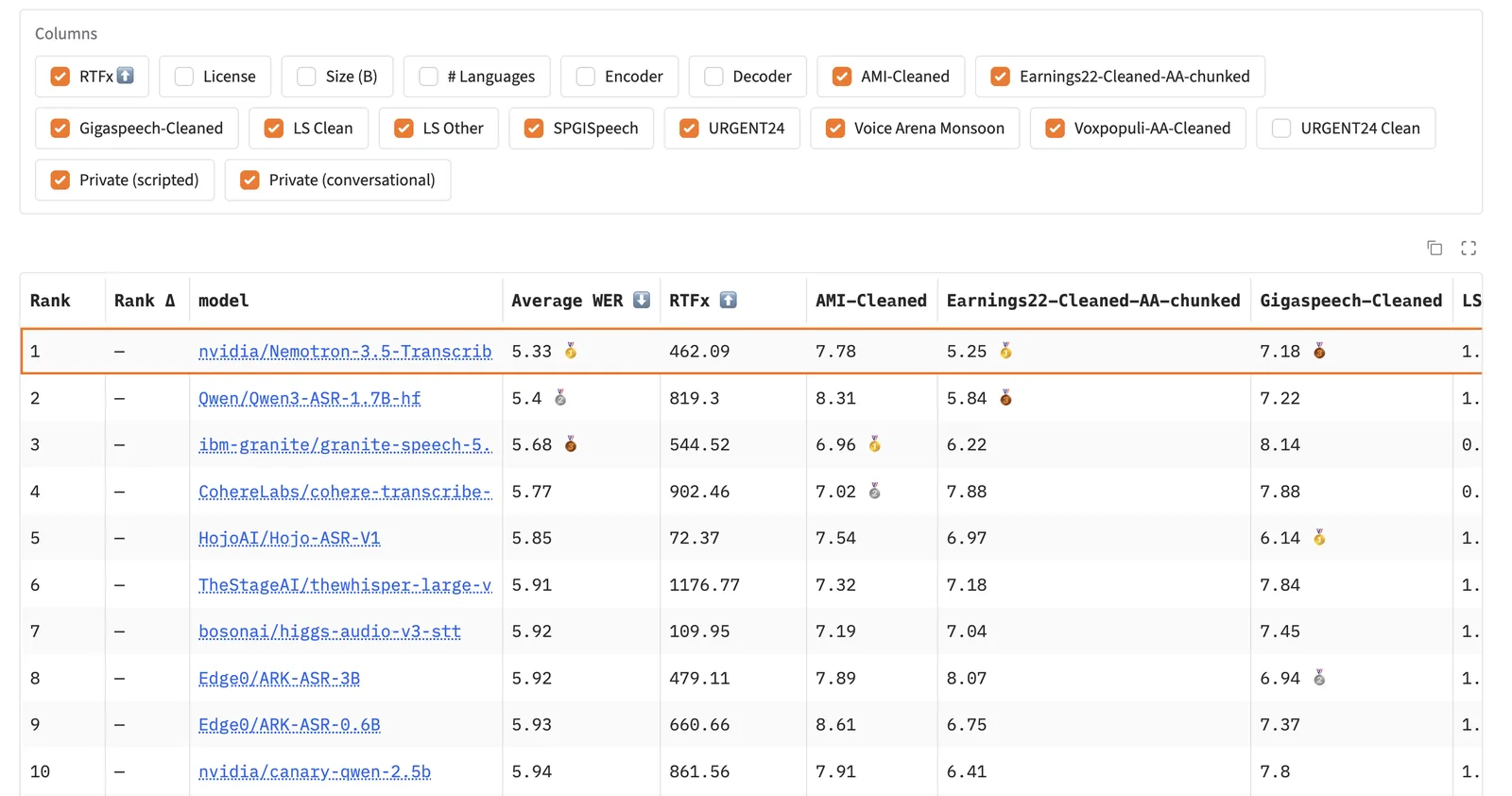
Benchmark results are central to the release. On Hugging Face's English Open ASR (automatic speech recognition) Leaderboard, Transcribe ranks first among open-weight models with an average word error rate of 5.33 percent. In Artificial Analysis' comparison, it makes barely more errors than Mistral's much larger Voxtral Small while using a fraction of the compute. It scores 2.81 percent, close to the best open model, Voxtral Small, at 2.77 percent, while Transcribe uses only about a sixth of the active parameters. Nvidia says several widely used commercial speech services trail behind. On Hugging Face's Open ASR Leaderboard, Nemotron 3.5 Transcribe edges out open models from Alibaba and IBM.
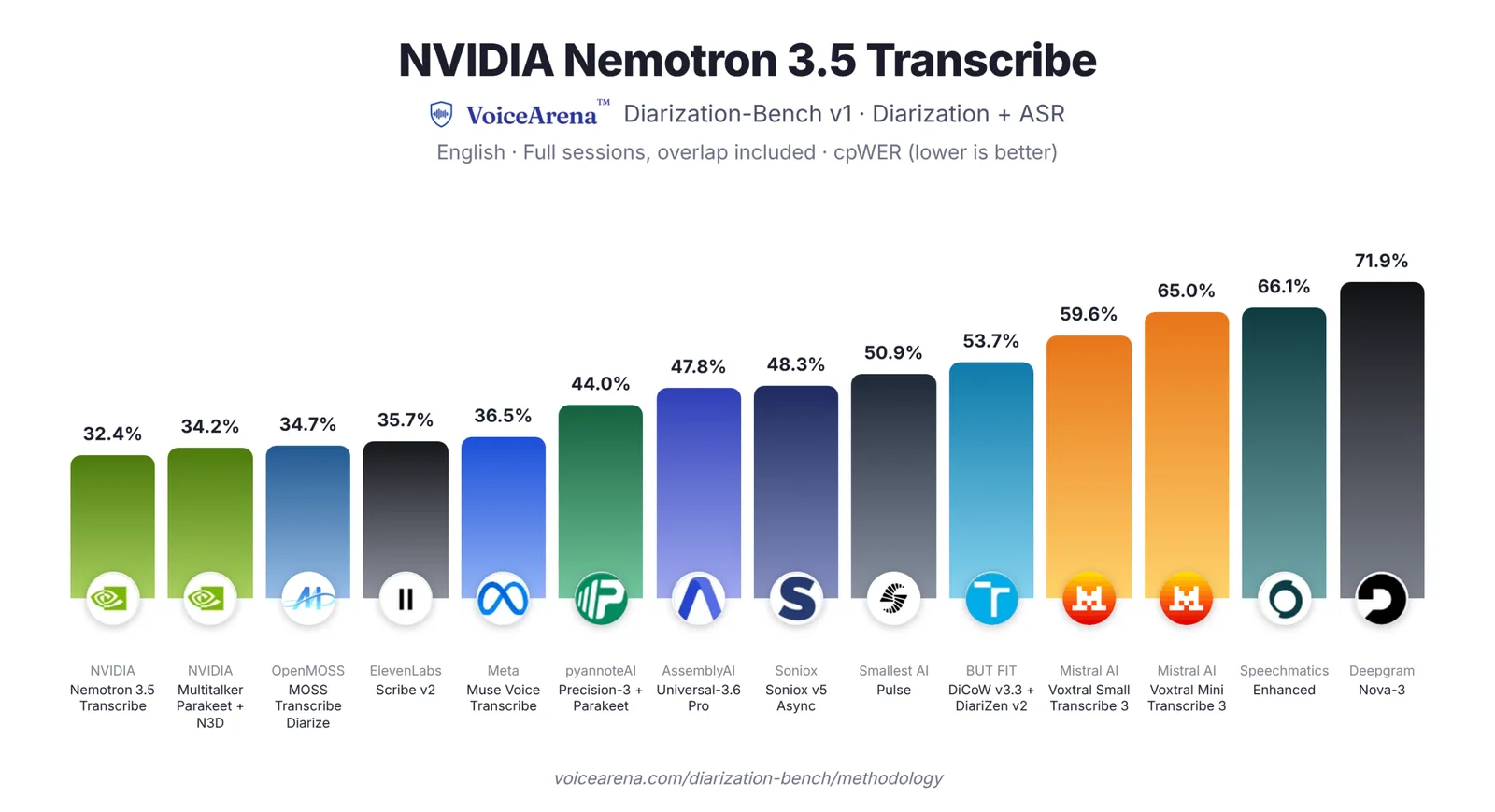
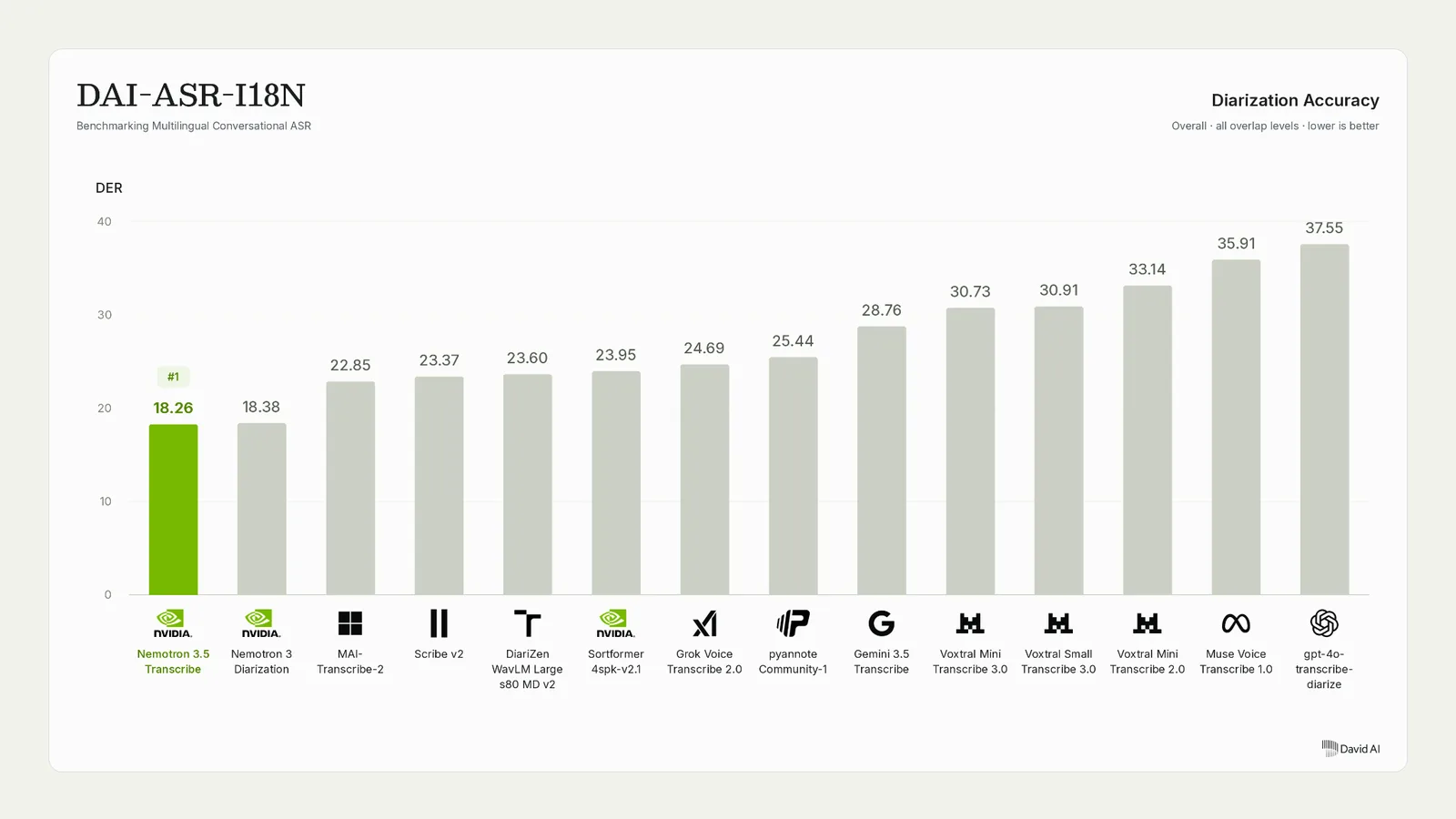
The speaker-recognition lead is larger. VoiceArena tested 14 systems on English conversations where speakers interrupt or talk over each other, and Transcribe took first place. It dropped the fewest words, missing 8.32 percent against a median of about 31 percent. On David AI's benchmark, which measures speaker attribution across 21 languages, it was the most reliable at identifying the current speaker. It posted the lowest error rate and finished just ahead of Nvidia's own dedicated model for the task.
Latest progress: Granary v2, fine-tuning, limits, and rivals
Alongside the model, Nvidia released Granary v2. The dataset contains about 844,000 hours of speech in 48 languages, up from roughly 643,000 hours in 25 languages in the previous version. Each recording has multiple transcription styles: one verbatim version keeps filler words such as "uh" and spelled-out numbers, while another cleaned-up version removes fillers and uses digits instead of words. Nvidia is also sharing the dataset-building tools so developers can apply them to their own recordings. The company says the dataset does not fully match the model's training data.
To test specialization, Nvidia targeted fine-tuning on recordings of Indian doctors and medical students. On the full benchmark, a more precise prompt cut the error rate from 30.8 to 23.8 percent. After fine-tuning, the rate fell to 11.8 percent. The training data was mostly synthetic speech. For speakers the model had not heard before, Nvidia separately reports a drop from 22.44 to 12.17 percent, a relative improvement of 45.8 percent. That result put the adapted model ahead of an open medical speech model scored at 13.79 percent. Nvidia says the full process took about 14 GPU hours on a single Nvidia GB300.
The specialization has costs. The error rate rose slightly on general English speech, and the medical model stayed more accurate on brand-name drugs. Nvidia recommends setting aside at least 100 real, verified recordings for testing when building custom versions. The base model also has limits: features vary by language, and the audio question-answering feature was trained in English. It is built only for recorded audio, so Nvidia says users should spot-check names, speaker changes, and answers.
The model and dataset are available on Hugging Face, along with a demo. For fine-tuning, Nvidia offers guides and an extension that lets an AI coding assistant run the training workflow. Competitors are choosing different priorities. Mistral's Voxtral family also combines transcription and audio understanding, but with the recently announced Voxtral 3, Mistral is focusing on real-time voice agents. The next test will be how quickly teams adopt Nemotron 3.5 Transcribe's recorded-audio, instruction-driven design in open speech workflows.
Comments
No comments yet. Be the first to comment.