
OmniSpectra provides a unified foundation model for learning universal spectra representations.
OmniSpectra is a compact wavelength-native masked autoencoder for spectra. It avoids resampling, preserves narrow lines, and transfers across surveys.
Key Takeaways
- OmniSpectra is a compact, wavelength-native masked autoencoder that anchors spectral tokens to physical wavelength rather than detector pixel position.
- It avoids resampling onto a shared grid, reducing blur in narrow spectral lines while handling instrument grids up to 25 times apart.
- Pretrained on 6.4M spectra from eight surveys with only 12.2M parameters, it achieves strong results and outperforms larger models, especially when labels are scarce.
- Its resolution-gated Fourier decoder reconstructs flux at each instrument’s native wavelengths and suppresses details the instrument cannot resolve.
- The model transfers well across instruments, including from SDSS to APOGEE near-infrared wavelengths unseen during pretraining.
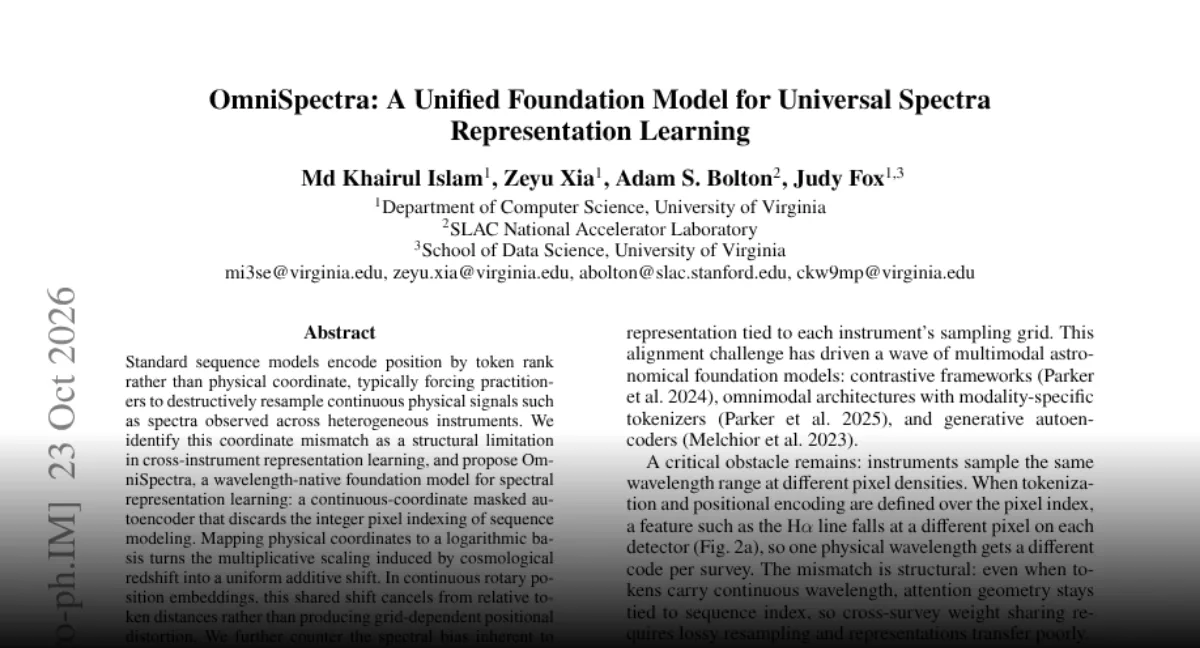
In astronomical spectroscopy, a spectrum records how much light an object emits or absorbs at different wavelengths. The difficulty arises when different instruments sample the same physical wavelengths on very different pixel grids. In the training corpus described here, those grids can be up to 25 times apart. OmniSpectra responds by anchoring tokens to wavelength itself, not to detector position. It is a wavelength-native masked autoencoder trained on 6.4M spectra from eight surveys, and it uses only 12.2M parameters. The significance is not just the small size; it is that the model reaches strong results without the resampling step that can blur narrow lines.
A masked autoencoder learns by reconstructing parts of its input that have been hidden, so the way it represents position strongly affects how well it can generalize across instruments.
Background: The Pixel-Grid Problem
Standard sequence models often position spectral tokens by pixel index. In the described training corpus, instruments can sample the same wavelengths on grids up to 25 times apart. Because of that, a line such as Hα can receive a different positional code on every instrument.
The usual fix is to resample everything onto a common grid. That makes token positions comparable, but it also blurs narrow lines. For astronomical spectra, that is a central tension: a model needs a shared representation, while the science often depends on preserving sharp, narrow features.
Development: A Wavelength-Native Representation
OmniSpectra changes the positional system. Instead of using pixel index, it uses log lambda, anchoring each token to a physical wavelength. In logarithmic wavelength space, a cosmological redshift becomes one uniform shift. Because that shift cancels inside continuous rotary position embeddings, attention depends on physical wavelength ratios rather than the detector grid.
The model also includes a resolution-gated Fourier decoder. It reconstructs flux at each instrument's native wavelengths. The gate is set by the instrument's line-spread function, which describes how sharply an instrument can resolve spectral detail. If a spectrograph cannot actually resolve a feature, the model suppresses that detail rather than inventing it.
The design is presented as one set of weights with no resampling.
Latest Results: Compact Parameters, Broad Survey Coverage
OmniSpectra is pretrained on 6.4M spectra from SDSS, BOSS, eBOSS, SEGUE-1/2, DESI, APOGEE, and GALAH, described as eight surveys. With only 12.2M parameters, it reaches state-of-the-art results across stellar parameters, galaxy properties, source classification and redshift, and outperforms much larger models such as AstroCLIP and AION-1.
The advantage is especially strong when labels are scarce. That is an important distinction for astronomical datasets, where high-quality labels are often much harder to obtain than raw spectra.
Transfer results add another signal. When pretrained on SDSS alone, OmniSpectra still transfers to APOGEE, whose near-infrared range it never saw during pretraining, with little degradation. That suggests the wavelength-native representation can cross instrument boundaries even when part of the physical range is new to the model.
Current Stage: What the Numbers Suggest
The work presents OmniSpectra as a compact, wavelength-first alternative to resampling-based spectral models. The key numbers are a pixel-grid mismatch of up to 25 times, 6.4M training spectra, eight surveys, and 12.2M parameters.
The main claim is that physical wavelength anchoring can reduce the need for resampling while preserving narrow spectral features. The SDSS-to-APOGEE transfer result points to a model that can extend beyond the wavelength range it saw during pretraining. What to watch next is whether this one-weight, no-resampling design keeps its advantage as more instruments, narrower line regions, and scarcer labels are tested.
Meta description: OmniSpectra trains on 6.4M spectra from eight surveys with 12.2M parameters and uses wavelength tokens instead of resampling across instruments.
Tags: OmniSpectra, Astronomy, Machine Learning, Spectroscopy, AI
Featured image: abstract technology style visualization of wavelength-aligned spectral data, no real people, no company logos, no text
Comments
No comments yet. Be the first to comment.