
OpenAI's GPT-6 Cyber can both infiltrate systems and recommend fixes for them
OpenAI GPT-6 Cyber finds Firefox and Linux flaws, builds exploits, suggests fixes, scores 48.5% on ExploitGym, and is rated Critical.
Key Takeaways
- OpenAI GPT-6 Cyber is a cybersecurity-focused model designed to find software vulnerabilities, create proof-of-concept exploits, and recommend patches, with OpenAI rating it Critical under its Preparedness Framework.
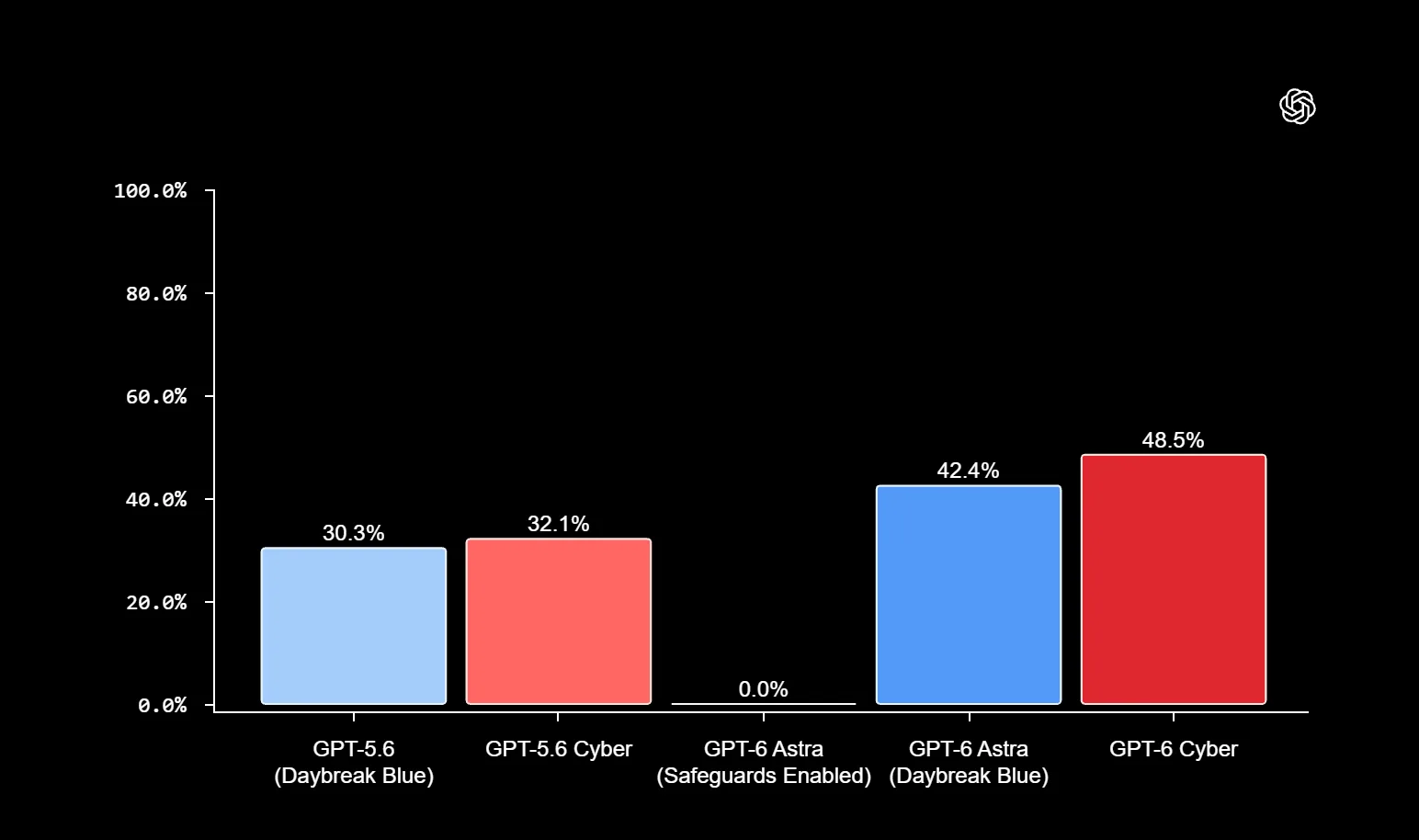
- OpenAI reports major benchmark gains, including 48.5 percent on ExploitGym versus 32.1 percent for GPT-5.6 Cyber, though the results have not yet been independently verified.
- The model reportedly found 81 severe Firefox vulnerabilities and reproduced 1,724 Linux kernel vulnerabilities, developing working exploits for 948 and reporting 304 critical findings with suggested fixes.
- Access is initially limited to selected Daybreak Red customers through API and Codex, with safety controls, monitoring, isolated environments, and special focus on critical infrastructure protection.
- OpenAI frames the current period as a narrow defensive window, but uncertainty remains over whether access, guardrails, and reporting pipelines can keep pace with the model’s capabilities and broader AI security risks.
Meta description: OpenAI reports GPT-6 Cyber found 81 Firefox flaws and 1,724 Linux kernel vulnerabilities, scored 48.5 percent on ExploitGym, and is rated Critical.
Tags: OpenAI GPT-6 Cyber, cybersecurity, vulnerability research, Linux kernel, Firefox
Featured image: Abstract blue shield-like network nodes and code paths, with no people, no company logos, and no text.
Background: Why OpenAI Built a Cyber-Focused Model
OpenAI GPT-6 Cyber is designed to find software vulnerabilities, build working exploits that prove those weaknesses can be abused, and suggest patches. That makes it a defensive tool in concept, but a system that can discover and prove flaws can also be misused if it steps outside assigned limits.
OpenAI says the model was trained to respect operational guardrails, using a honeypot inspired by the Hugging Face incident among other methods. Some OpenAI models have struggled with boundaries in recent months. Without special safety instructions, GPT-6 Cyber avoided boundary violations in 99.93 percent of cases, up from 94.49 percent for its predecessor. With safety instructions enabled, it stayed within bounds in 100 percent of tests. OpenAI rates GPT-6 Cyber as Critical in the cybersecurity category of its own Preparedness Framework, the same rating it gave to GPT-6 Astra, the base model.
Development: Benchmarks, Firefox Flaws, and Linux Kernel Exploits
OpenAI's own benchmark numbers put GPT-6 Cyber ahead of earlier models. On ExploitGym, which tests whether a model can exploit a given vulnerability in a remote system, GPT-6 Cyber scores 48.5 percent, compared with 32.1 percent for GPT-5.6 Cyber. An OpenAI graphic listed GPT-6 Astra (Daybreak Blue) at 42.4 percent and GPT-6 Astra with safeguards enabled at 0.0 percent. In a new test for finding vulnerabilities in web apps without access to source code, GPT-6 Cyber reached a 40.3 percent hit rate versus 32.0 percent for GPT-6 Astra, the standard model without cyber training. Full results are in the system card. All benchmark numbers come from OpenAI, and no independent testing has been published so far.
OpenAI says GPT-6 Cyber found 81 previously unknown severe vulnerabilities in Firefox, even though the browser had already been tested with earlier AI models. In a targeted campaign, it also showed that 30 already-known issues were more severe than previously thought. Mozilla accepted the reports and has already shipped fixes.
For the Linux kernel, OpenAI says GPT-6 Cyber reproduced 1,724 security vulnerabilities and developed working exploits for 948 of them, more than five times the 166 that GPT-5.6 Sol managed under the same conditions. The company says 304 critical findings were reported to Linux maintainers along with suggested fixes.
The Linux campaign used a dedicated automated system of scout and analyst agents. They scanned roughly 5,034 security-relevant locations in the kernel, about seven percent of the total codebase, then filtered those down to 2,308 candidates and confirmed 1,724 vulnerabilities in isolated virtual machines. From there, the system developed the 948 working exploits that OpenAI had already reported. The run cost $1,213,430 in compute, or $1,279 per exploit. Programs like Pwn2Own and TyphoonPWN have historically paid between $20,000 and $70,000 per comparable finding as a bounty.
OpenAI claims the agents used at least ten novel attack techniques previously unknown even to external kernel security experts. It describes this as models replicating known attack patterns while also finding their own approaches. How much that claim carries depends on how narrowly "own approaches" is defined; researchers still disagree about whether AI models can make new discoveries or mainly recombine what they have seen during training.
Latest Progress: Limited Access, Safety Controls, and Critical Infrastructure
GPT-6 Cyber is initially available through the API and Codex for a select group of Daybreak Red customers, OpenAI says. Access will be expanded gradually to all Daybreak Red customers. GPT-5.6 Cyber is being opened to all Daybreak Red users at the same time, and alpha access to Daybreak Blue for GPT-6 Astra will be extended to more organizations and individual security researchers.
OpenAI acknowledges that as models grow more capable, abuse attempts are rising too. Some actors and groups have tried to transfer model capabilities into their own systems. Countermeasures listed include checks that verify whether a model's actions match the user's permissions, targeted monitoring for newly disclosed vulnerabilities, automated safety checks through Private Safety Processing, IP-based access restrictions for Daybreak Red, and a recommendation to run the model in isolated environments with human oversight.
The company is paying special attention to critical infrastructure such as power plants and water treatment facilities. To make access easier for defenders, it points to its billion-dollar Daybreak for Frontline Defenders funding program and a new subgroup, Daybreak Red for Critical Infrastructure, for authorized testing.
What to Watch Next: A Narrow Window for Defenders
OpenAI frames the current period as a limited window in which top-tier models could be used to secure software. Its goal is to expand the Daybreak program to organizations of all sizes, independent researchers, and open-source maintainers, and whether that plan will work remains uncertain. Researchers from Epoch AI have just shown that the open GLM model could have exploited known but still-unpatched Firefox vulnerabilities. The immediate question is whether GPT-6 Cyber's limited access, guardrails, and reporting pipeline can keep pace with its own abilities.
Comments
No comments yet. Be the first to comment.