
Gemini 4 Carbon launches just in time to feel like old news in the fastest model cycle ever.
Gemini 4 Carbon launches amid fast AI cycles; Fable 5.2 leads, while Carbon wins coding benchmarks and offers agent swarm and API access.
Key Takeaways
- Gemini 4 Carbon is now generally available and complements Argon for complex multi-step coding, debugging, and scientific reasoning, though it may cost more overall because it uses more tokens despite the same per-token price.
- Anthropic’s Fable 5.2 currently leads Artificial Analysis, 62 to 60, but Carbon wins key benchmarks including CursorBench 4.0, Perplexity WANDR, and Zapier AutomationBench, often with strong cost-performance.
- Carbon showed notable cybersecurity results during early access, finding real zero-day vulnerabilities in under two hours and producing working proof-of-concept exploits, while improving open-source detection rates by more than 25% over Argon.
- Google reports strong safety performance, including a 92% internal honesty pass rate, 99% attack-path blocking in simulated cyberattacks, no universal jailbreak found in extensive testing, and a claimed zero prompt-injection success rate on Gray Swan.
- The launch highlights an unusually fast AI model cycle, with next watchpoints including a possible Gemini 4 Flash variant and whether Google’s new /swarm agent teams justify their complexity beyond demonstrations.
Meta description: Google Gemini 4 Carbon is now available after a two-week test, but Anthropic Fable 5.2 leads Artificial Analysis while Carbon keeps strong cost benchmarks.
Tags: Gemini 4 Carbon, Anthropic Fable 5.2, AI benchmarks, agent swarms, cybersecurity
Featured image: A glowing neural network grid over a timeline, abstract technology style, no people, no logos, no text.
About two weeks ago, Google appeared ready to reclaim the AI model lead with Gemini 4 Carbon, but the release took long enough that Anthropic’s Fable 5.2 now sits ahead on Artificial Analysis. The model cycle is spinning particularly fast right now. Carbon is now generally available after a two-week testing phase for selected security experts.
Background: a faster model cycle
Google says Carbon complements previously released Gemini 4 Argon rather than replacing it. Argon remains better for most software engineering and knowledge work, according to Google, while Carbon targets tasks that push model intelligence. That is surprising because both models have the same token price, yet Carbon scores higher on benchmarks. Google lists complex multi-step coding, debugging, and open-ended scientific research among Carbon’s strengths. Carbon uses more tokens than Argon to reason deeply and run longer verification loops, so the total bill is likely higher despite the same token price.
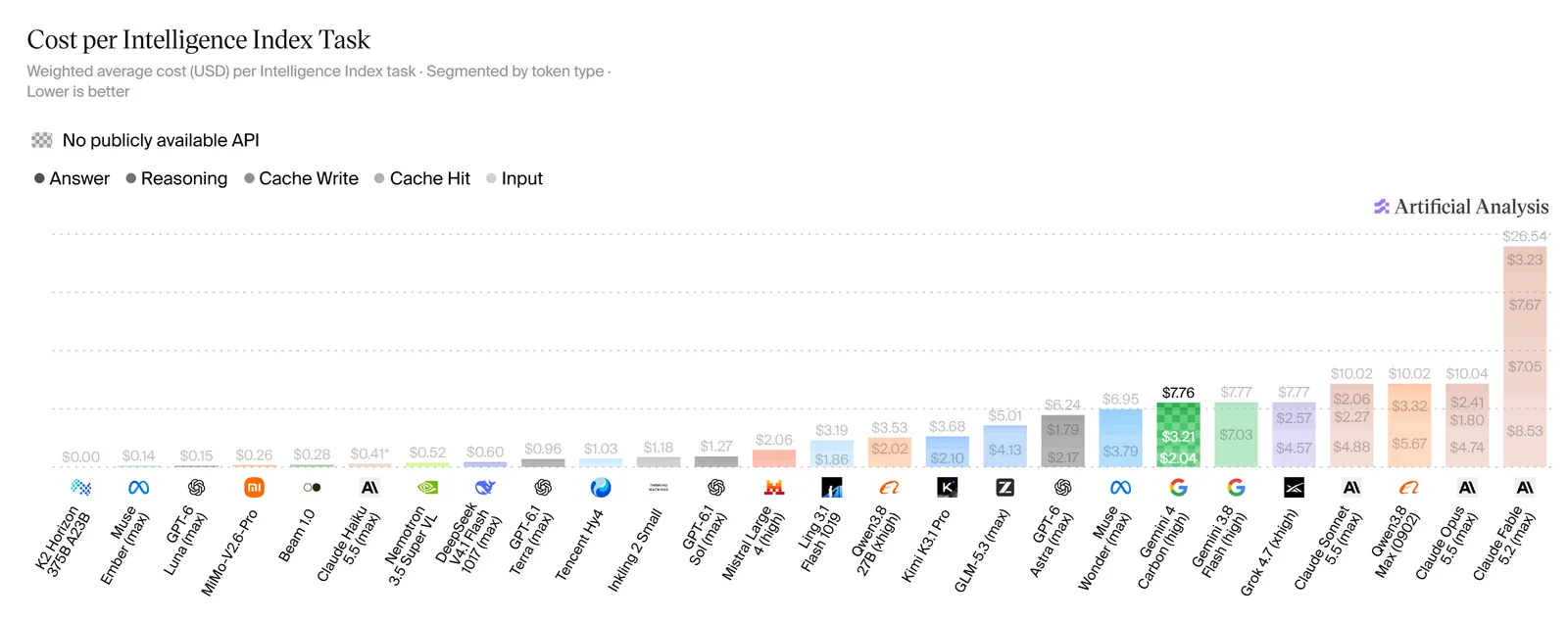
In the Artificial Analysis test published two weeks ago, Carbon cost $7.76 per solved task at the standard price of four dollars per million input tokens and 20 dollars per million output tokens. That makes Carbon cheaper than older budget model Flash 3.8 while delivering better performance. A Flash variant of Gemini 4 is likely to launch soon. In the same test, Opus 5.5 Max comes in at $10.04 and GPT-6 Astra Max at $6.25. Fable 5.2 maximum tier costs as much as $26.50; High tier costs about $9 per task but sits two points ahead of Carbon in the overall index, 62 versus 60. Paid developers and business customers can access Carbon through the Gemini API in Google AI Studio, Android Studio, or Gemini for Business. Introductory pricing stays at two dollars per million input tokens and ten dollars per million output tokens.
Development: agent swarms and benchmarks
Alongside the launch, Google previews /swarm in Google Antigravity, its counterpart to Claude Code. The feature turns one prompt into a coordinated team of agents tracked in real time. Carbon handles architecture design, coordination, and auditing, while faster, lighter models run in parallel isolated workspaces and as adversarial verifiers. Google demonstrates it with a three-dimensional game exploring Google’s Mountain View campus as a pelican on a GBike, an interactive three-dimensional reconstruction of the Eiffel Tower’s construction from historical photos, and a playable 18th-century fortepiano with seat-specific spatial acoustics. The cost-benefit ratio of such swarms is debated; OpenAI and Anthropic have sounded cautious, and researchers are skeptical. The main benefit appears to be speed through parallelization, but it is complex.
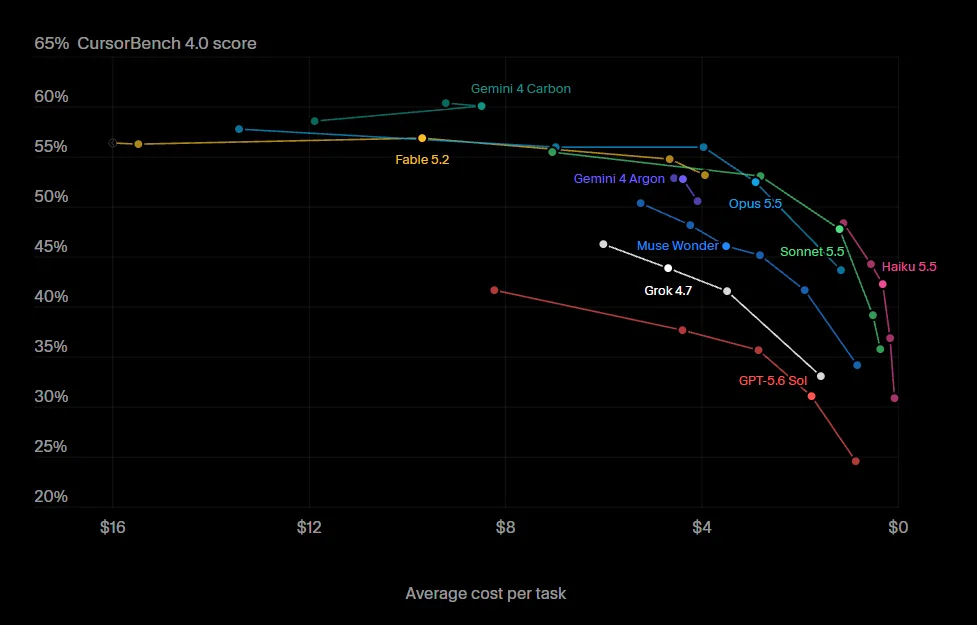
In addition to performance data known from late October, Google cites new results. Carbon takes first place on coding benchmark CursorBench 4.0, ahead of Fable 5.2, and on Perplexity’s WANDR and Zapier’s AutomationBench, at less than half the per-task cost of next-best Fable 5.2. In Google Deepmind’s CursorBench material, Gemini 4 Carbon leads CursorBench 4.0 with just under 60 percent, followed by Fable 5.2 and Gemini 4 Argon. Carbon achieves the highest score at average costs of roughly $8 to $10 per task, while more expensive configurations of other models like Fable 5.2 score lower at similar costs. GPT-5.6 Sol and Grok 4.7 trail well behind. For dense documents with charts, blueprints, and tables, Google partnered with Artificial Analysis to launch the Multimodal Knowledge Agent benchmark. Carbon finishes second, just behind Fable 5.2 and just ahead of Opus 5.5, but costs less than one-sixth of the top performer on average.
Latest progress: security and safety
Through the Fairwind Program’s two-week early-access phase, Google shares real-world cyberdefense results. Under Wiz’s Scan for Good program, Carbon found real zero-day vulnerabilities while scanning two large SaaS providers in under two hours. Google’s cloud security team also used it to write working proof-of-concept exploits for two known bugs in a popular open-source project. Only then could the bugs be proven critically exploitable, comparable to PHP2Shell. In Project Fortify, Carbon boosted detection rates on open-source codebases by more than 25 percent over Argon. Google says Carbon leads SEC-bench Pro for finding vulnerabilities, ExploitGym for exploiting vulnerabilities, and CWE-bench v1 for patching vulnerabilities, but only for the Fairwind version, and shares no specific numbers.
Google also published a safety report and model card. On an internal honesty test with 375 tasks, Carbon passes 92 percent, versus 70 percent for Argon, and refuses to fabricate missing experimental data in 98 percent of cases. In simulated cyberattacks, it blocked 99 percent of attack paths from adaptive red-teaming agents and cut breakthrough rate per attempt from 3.1 percent with Argon to 0.8 percent. Trajectory Labs testers did not find a single universal jailbreak in 132 hours and over 13,000 queries. On the Gray Swan prompt injection benchmark, Carbon achieved zero percent prompt injection success rate, Google says, not cracked even once. Google says this is the first model milestone, though prompt injection is not solved and the test may be saturated; some competitors remain more vulnerable.
Current stage
Gemini 4 Carbon is generally available, but Fable 5.2 has changed the Artificial Analysis top ranking. Next checkpoints are a possible Gemini 4 Flash variant and whether agent swarms justify their complexity beyond demos.
Comments
No comments yet. Be the first to comment.