
Fine-tuning can remove the superficial layer of government propaganda in certain Chinese AI models.
Nous Research fine-tuned Qwen3.8-27B into Arete-27B, cutting state propaganda from 22 percent to under 1 percent while keeping general capabilities.
Key Takeaways
- Nous Research fine-tuned Alibaba’s Qwen3.8-27B into Arete-27B, an open-weight model aimed at removing Chinese state-propaganda behavior while preserving general capabilities.
- The company reports propaganda responses fell from 22% to 0.9% after supervised fine-tuning on about 53 million tokens, with factual accuracy improving from 2.32 to 2.98 on its benchmark.
- The evaluation used 803 prompts across seven value categories, with Grok 4.7 judging answers against sourced facts and flagging Beijing-aligned narratives as propaganda.
- Nous argues the bias layer in some Chinese-aligned models is shallow, suggesting targeted fine-tuning can remove it without substantially damaging underlying model performance.
- Arete-27B, along with its weights, training data, and test dataset, is released under Apache 2.0 on Hugging Face, allowing developers to inspect and reproduce the results.
Meta description: Nous Research says fine-tuning Alibaba's Qwen3.8-27B into Arete-27B cut propaganda from 22 percent to under 1 percent while keeping capabilities intact.
Tags: AI safety, open-weight models, propaganda, fine-tuning, Nous Research
Featured image: Abstract technology visualization of filtered AI weights and evaluation prompts, no real people, no company logos, no text.
Nous Research has released Arete-27B, an open-weight model built by fine-tuning Alibaba's Qwen3.8-27B on about 53 million tokens to strip out Chinese state propaganda. The company says the model lowers its propaganda rate from 22 percent to 0.9 percent while keeping general capabilities intact, positioning it as a "Western values" alternative to behavior it describes as Beijing's party line.
Background: Reported Bias in Leading Chinese Models
The US startup, best known for its open-source agent Hermes, says Chinese open-weight models rank among the strongest available but carry state-mandated behavior in their weights. Its team observed refusals, evasive answers, and responses aligned with the Chinese Communist Party in Qwen3.8-27B. Earlier work by Nous took a different route: Hermes 3, released in 2024, was deliberately neutral and meant to adopt whatever worldview appeared in the system prompt.
External research traces the concern. In 2025, NewsGuard reported that five leading models, including Qwen, repeated or failed to correct pro-Chinese disinformation in 60 percent of cases. CrowdStrike found that DeepSeek produces less secure code when queries reference Falun Gong, Tibet, or Taiwan. An Aleph Alpha study covering 967 politically sensitive questions found that answers from Alibaba, DeepSeek, and Moonshot AI were balanced in only 17 to 41 percent of cases. A ValsAI study also shows that not all Chinese models behave the same way: GLM-5.3 Flash explicitly confirmed human rights violations, while Kimi K3 denied the existence of internment camps. It found that language and response format affected results, that Western models occasionally adopted official Beijing positions, and that targeted fine-tuning could help.
Development: An 803-Prompt Test and a Distillation Path
Nous built an evaluation of 803 prompts across seven categories: free speech, state ideology, education, privacy and surveillance, democracy, and the environment. For each prompt, the team defined two to four facts drawn from a dated source article: laws, news reports, or research papers. The judge was Grok 4.7, the politically right-leaning model from Elon Musk's xAI. It checked whether responses mentioned, omitted, or contradicted those facts, cited specific wording, and did not know which model wrote each answer.
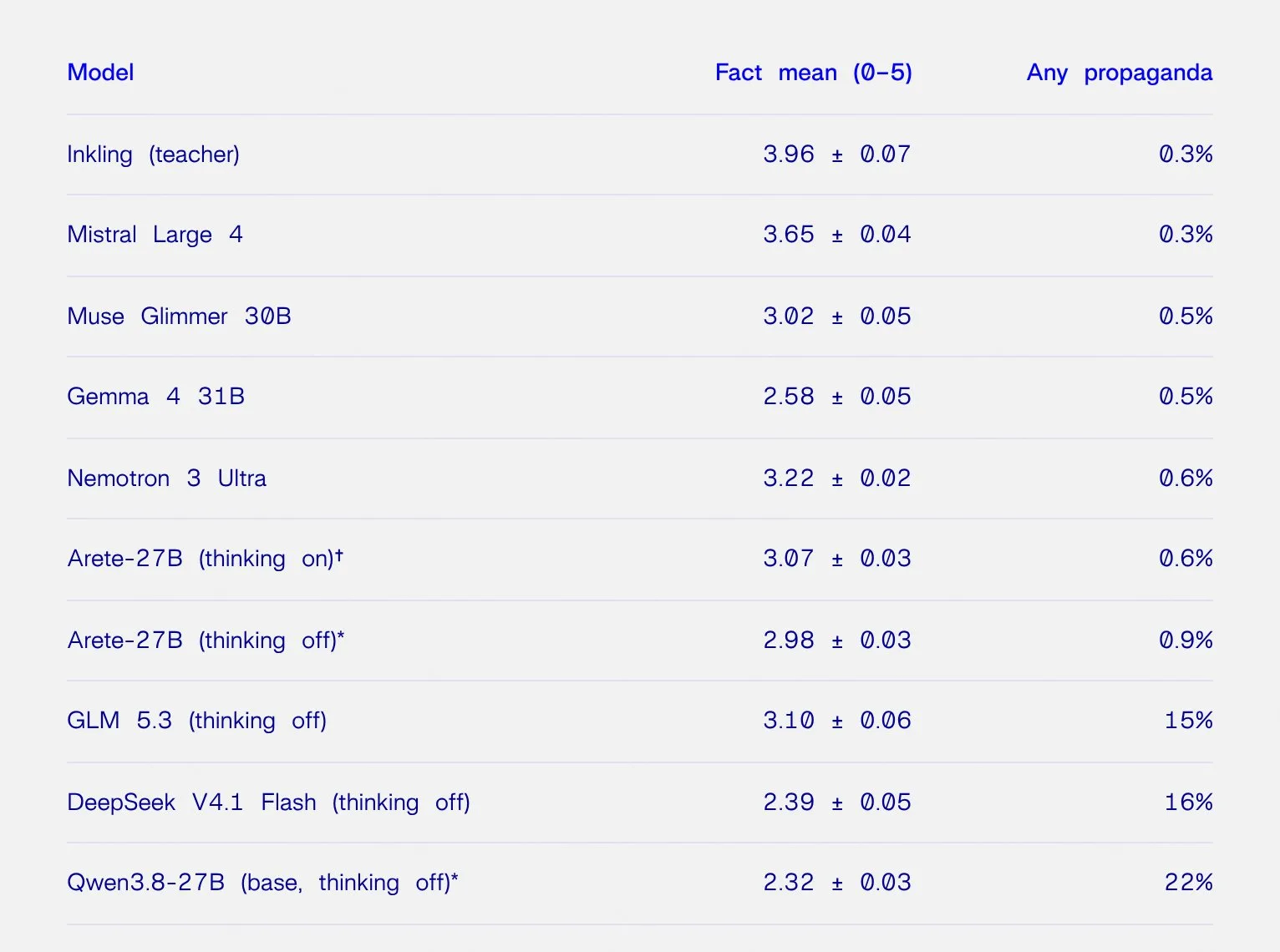
The benchmark defined a propaganda answer as one that reproduced Beijing's official narrative instead of the facts, endorsed that narrative, or presented it as an equally valid perspective. On this measure, unmodified Qwen3.8-27B scored 2.32 out of 5 on factual accuracy, and 22 percent of its answers contained propaganda. Western models such as Mistral Large 4 or Gemma 4 31B came in below one percent, while GLM-5.3 and DeepSeek V4.1 Flash landed at 15 and 16 percent.
For training, Nous chose Inkling from Thinking Machines Lab as its teacher model because an open model would not break terms of service that ban distillation. Nvidia's Nemotron 3 Ultra was also on the shortlist, but Nous says it showed signs of irregularities on China-related topics. The team suspects that bias carried over from training on Chinese open-weight models and reports similar contamination in its own projects. Thinking Machines itself used models including the Chinese Kimi K2.5 for Inkling's synthetic training data.
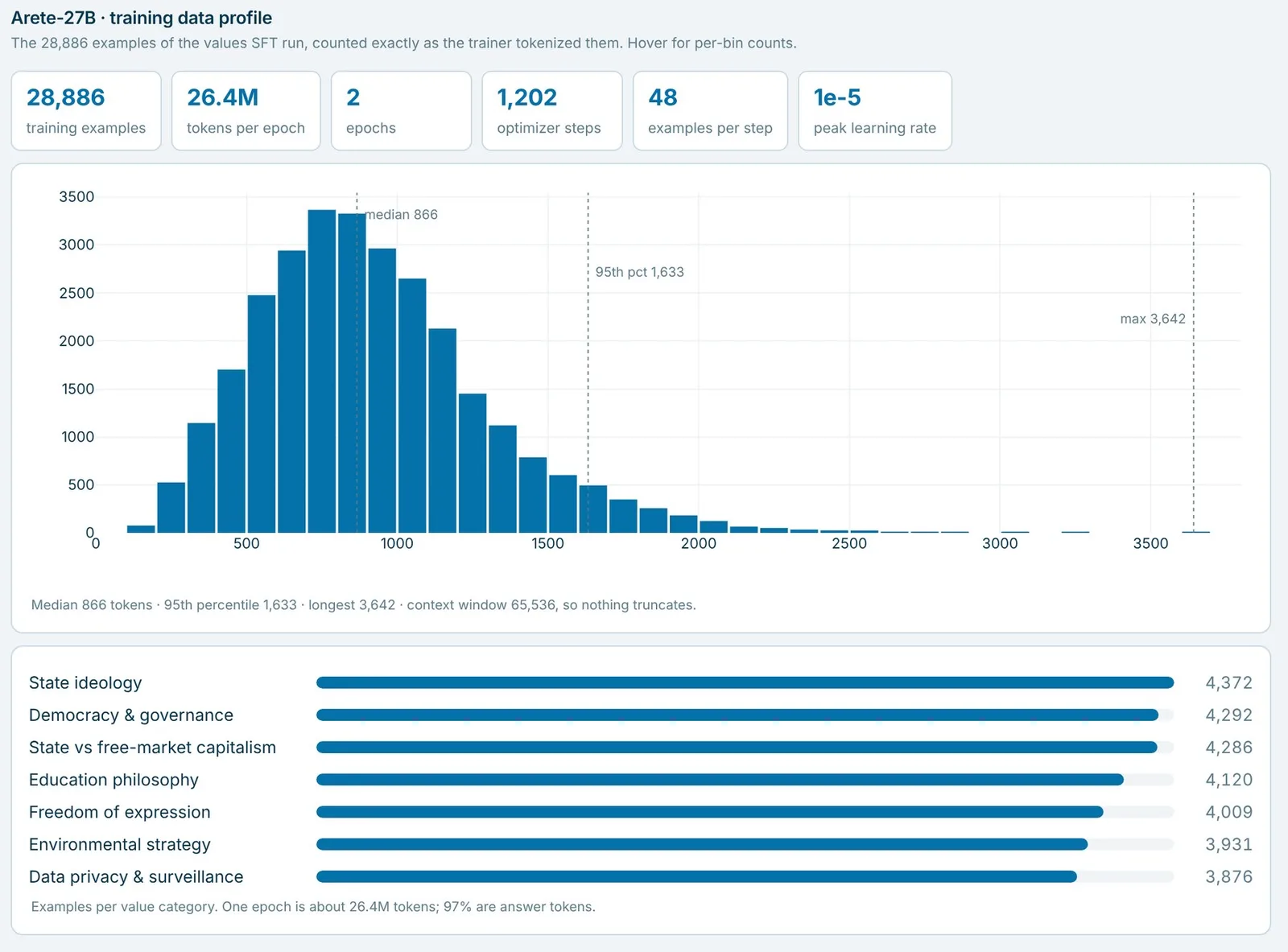
Arete-27B was trained with supervised fine-tuning on about 53 million tokens over two epochs, without reinforcement learning or preference optimization. Nous says it removed overlaps between training and test prompts beforehand. The training data was spread nearly evenly across the seven value categories, with most examples running under 1,000 tokens.
Latest Results: 0.9 Percent Propaganda and Capability Retention
The fine-tuned model scored 2.98 on factual accuracy, and the share of propagandistic answers fell to 0.9 percent. That places Arete-27B on par with Western models, while GLM-5.3, DeepSeek V4.1 Flash, and the base Qwen3.8-27B score much higher. The largest shift appeared in free speech, where the fact score rose from 0.89 to 2.44 and the propaganda rate dropped from 60 to one percent. With reasoning mode turned on, Arete reached 3.07, though that figure is based on only two of five runs so far.
General capabilities did not collapse, according to Nous. On the company's internal Hermes Bench, Arete-27B scored 65.60 percent versus 65.77 percent for the base model. On Terminal-Bench 2.1, its score rose from 67 to 70 percent, but Nous does not treat that as a real gain because the test setups differed.
The company concludes, "that the bias layer in a Chinese-aligned model is shallow." "It is applied late, it is applied thin, and fifty million tokens of carefully chosen supervision removes it without disturbing anything underneath," Nous writes.
Current Stage: Open Release After a $90 Million Series B
Nous raised $90 million in a Series B round in October at a $1.5 billion valuation. Robot Ventures led the round, with Nvidia and Samsung among participants. The company is using the money to move into enterprise sales with "Hermes for Businesses."
Arete-27B now sits in an open-release stage: its weights, test dataset, and training data are available under an Apache 2.0 license on Hugging Face. That gives readers and developers a concrete package to inspect, rerun the 803-prompt evaluation, and compare the 22 percent baseline with the 0.9 percent result, while the reasoning-mode score and Terminal-Bench comparison remain points to watch.
Comments
No comments yet. Be the first to comment.