
Video-Coder strengthens agentic coding for video generation
Video-Coder is a code-driven agent that writes and executes programs to build dynamic 3D draft videos. These draft videos provide structure and motion signals for downstream video models, addressing weaknesses in spatial coherence and controllable scene composition. The system uses curated SFT and RL datasets, a harness for coding, rendering, and feedback, and a training loop with execution and video rewards that anneal toward final quality. Reported gains include 7 points on PhyGenBench and 24 points on VBench-2.0 when improving Minimax-H3. Data, models, and code are open source.
Key Takeaways
- Video-Coder is a code-driven video generation agent that autonomously writes and executes code to build a 3D “Draft Video,” providing spatial structure and motion cues to downstream video models.
- It addresses limitations in current video generation systems by separating executable scene construction from final video synthesis, improving control over spatial layout, motion dynamics, and scene composition.
- The system uses curated datasets, a unified execution-and-rendering harness, supervised fine-tuning, and agentic reinforcement learning with dual rewards for code execution and video quality.
- A reward annealing strategy gradually shifts training focus from successful code execution toward stronger final video generation performance.
- Video-Coder improves Minimax-H3 by about 7 points on PhyGenBench and 24 points on VBench-2.0, with data, models, and code fully open-sourced.
Meta description: Video-Coder trains a code agent to build three-dimensional draft videos, lifting Minimax-H3 by 7 on PhyGenBench and 24 on VBench-2.0, open data, models, code.
Tags: Video-Coder, Minimax-H3, video generation, code-driven agents, VBench-2.0
Featured image: Abstract three-dimensional scene made of code paths, motion arrows, and translucent video frames in cool light, with no people, logos, or text.
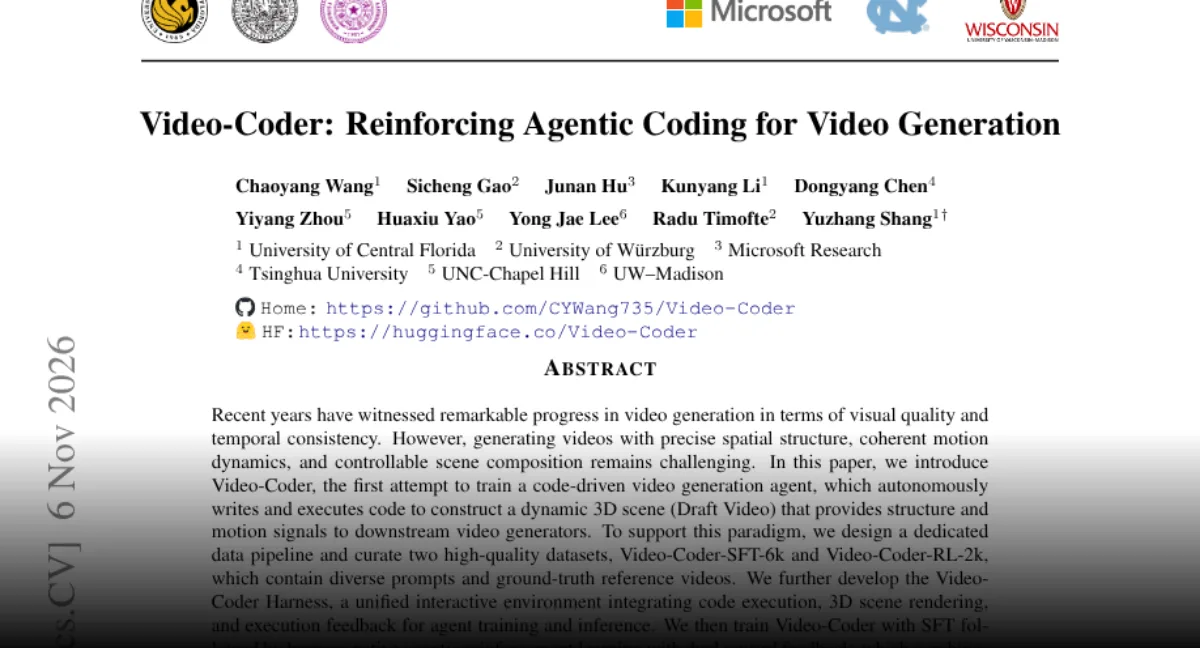
Video-Coder is a code-driven video generation agent presented as the first attempt to train a system that autonomously writes and executes code to construct a dynamic three-dimensional scene, called a Draft Video, and supplies structure and motion signals to downstream video generators. Its reported gains on PhyGenBench and VBench-2.0 show why adding executable scene structure may matter beyond visual quality and temporal consistency.
Background: The Gap Behind Better Videos
Video generation has advanced in visual quality and temporal consistency, but precise spatial structure, coherent motion dynamics, and controllable scene composition remain challenging. The paper introduces Video-Coder as a response to that gap. Instead of relying only on a final video model to infer scene behavior, the agent builds a three-dimensional Draft Video that can guide downstream video generators.
The Draft Video is created when Video-Coder autonomously writes and executes code. That code constructs a dynamic three-dimensional scene, and the scene provides structure and motion signals for later video generation. The approach places scene construction before final synthesis, giving the downstream video model a more explicit target for spatial and temporal organization.
Development: Data Pipeline, Harness, and Training Loop
To support the code-driven paradigm, the project designs a dedicated data pipeline and curates two high-quality datasets: Video-Coder-SFT-6k and Video-Coder-RL-2k. Both datasets contain diverse prompts and ground-truth reference videos, creating examples for the agent's training.
The second infrastructure component is the Video-Coder Harness, a unified interactive environment for agent training and inference. It integrates code execution, three-dimensional scene rendering, and execution feedback. This environment lets the agent write code, run it, render the resulting scene, and receive feedback from the execution process.
Training begins with supervised fine-tuning, followed by harness-native agentic reinforcement learning with dual reward feedback. The dual rewards combine execution-based rewards and video-based rewards. The execution reward reflects whether the code and scene construction work, while the video reward evaluates the generated video output.
A further annealing training strategy changes the reward balance over time. The execution reward is gradually reduced as training continues, allowing the model to rely more on the video reward in later training stages. The sequence moves the agent from code-based scene construction toward stronger final video quality.
Latest Progress: Benchmark Results and Open Release
Experiments report that Video-Coder achieves significant gains when improving Minimax-H3. The gains are approximately 7 points on PhyGenBench and 24 points on VBench-2.0. These benchmark numbers indicate that a code-built Draft Video can add measurable value to a downstream video generation pipeline.
The work is presented as an open foundation for coding agents in video generation. Its data, models, and code are fully open-source. For readers tracking this field, the notable shift is the use of autonomous code writing to construct three-dimensional scene structure before video synthesis.
Comments
No comments yet. Be the first to comment.