
Anthropic says it is maintaining momentum with Fable 5.2 rather than pausing its development.
Anthropic released Claude Fable 5.2 and Mythos 5.2, faster and cheaper upgrades to its top AI models, with Fable taking first place on Artificial Analysis' Intelligence Index. The launch follows Anthropic's argument for pacing frontier development rather than pausing. Mythos remains limited to vetted security and life sciences users, while Fable adds stronger cyber and biology guardrails. The release also highlights cost and capability tradeoffs, as Meta's Muse Ember and Google's upcoming Gemini 4 Carbon intensify competition. Anthropic says the new models lead benchmarks, but still price top-tier AI above Opus 5.5, pushing buyers to choose the intelligence level that justifies token costs.
Key Takeaways
- Anthropic released Claude Fable 5.2 and Mythos 5.2 as cheaper, faster upgrades, with Fable debuting at No. 1 on Artificial Analysis' Intelligence Index, showing that its “pace, not pause” strategy still keeps it at the frontier.
- Mythos is limited to vetted security and life sciences users, while Fable has stronger cyber and biology guardrails for broader use; it delivers major productivity gains but still costs twice as much as Opus 5.5 per token.
- The launch sharpens competition: Meta's low-cost Muse Ember matched Claude Haiku 5.5 on the Intelligence Index at a much lower per-task cost, while Google's upcoming TPU 8tx and 8i Max chips target secure AI workloads and long-context agent tasks.
- With Anthropic preparing for an IPO, Fable 5.2 strengthens its public-market story, while the next key tests are whether Google's Gemini 4 Carbon and OpenAI's upcoming model close the narrow intelligence gap and whether per-task cost becomes the main competitive battleground.
Anthropic has released Claude Fable 5.2 and Mythos 5.2, two cheaper and faster upgrades to its most powerful AI family, and Fable immediately took the No. 1 spot on Artificial Analysis' Intelligence Index leaderboard. The release arrived after a fall in which Anthropic spent months telling the AI industry to pace itself, and it shows what CEO Dario Amodei's call to "pace the frontier" looks like in practice: even in what the company frames as a slower lane, it still leads the field.

Background: A Fall Spent Arguing for Pacing
Anthropic entered the fall making the case that the industry should slow down. The release of Fable 5.2 and Mythos 5.2 is the company's first look at what that argument means in product terms. Exec Dianne Penn summarized the position on the development slowdown: "We called for pacing, not pausing."
The distinction matters because the new models are not a retreat. They are upgrades to the company's most powerful AI family, priced lower and running faster than their predecessors, and they arrive at the top of the leaderboards rather than behind the pack.

Development: Fable 5.2 and Mythos 5.2 Arrive
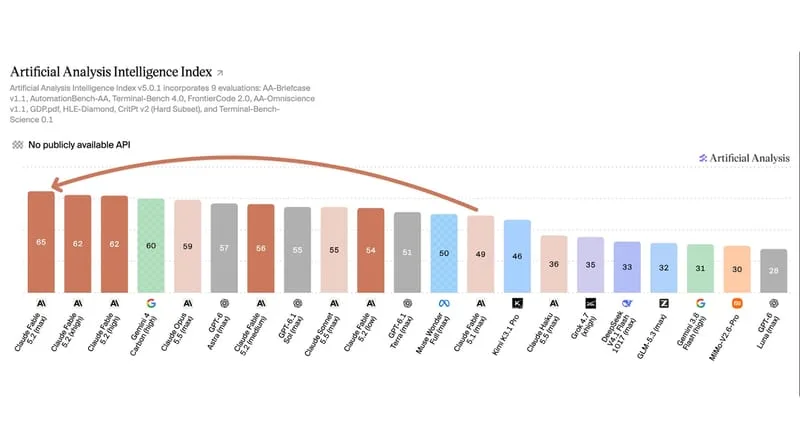
Fable debuted at No. 1 on Artificial Analysis' Intelligence Index leaderboard, edging out Google's still unreleased Gemini 4 Carbon model by 5 points. The result ended Google's run at the top of the leaderboard before Carbon was even released to the public.
The two model names serve different audiences. Mythos is limited to vetted security and life sciences groups. Fable is the same model with stronger cyber and biology guardrails, making it the version available more broadly.
The performance figures released alongside the launch cover both capability and cost:
- Teams of 1,000 Fable agents built an operating system in 8 days and formalized the full proof of a famous math problem in 30 hours, with Opus finishing just 26%.
- Fable was held near Opus level in certain skills that speed up development, a deliberate constraint tied to the pacing strategy.
- Version 5.2 is 20% cheaper and as much as 30% faster than 5.1.
- At $8 in and $40 out per million tokens, 5.2 still costs twice as much as Opus 5.5.
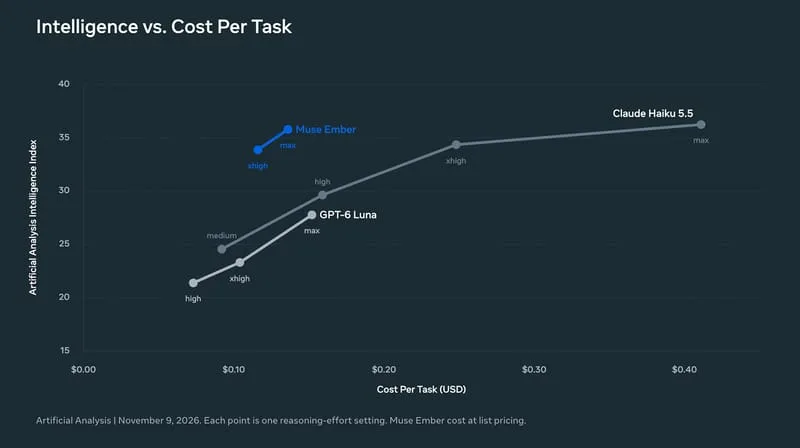
The benchmark comparison spans three companies. Meta's newly released Muse Ember tied Anthropic's budget Claude Haiku 5.5 at 36 on the same Intelligence Index, while OpenAI's comparable GPT-6 Luna scored 28.
What the Release Signals for the Competitive Field
Google's run at the top of the leaderboard ended before Carbon was released, and Anthropic's pacing does not feel like a slowdown for users who lack its internal super-models. With OpenAI also expected to release a new model, the bar has moved higher, and anything less will likely come as a disappointment.

The pricing detail is as telling as the benchmark score. Fable 5.2 undercuts the previous generation while still costing twice as much as Opus 5.5, which places the top of Anthropic's lineup well above its own mid-tier pricing. For buyers, the choice is no longer simply which model is smartest but which tier of intelligence justifies the per-token cost.

The Wider Context: Meta's Cost Play and Google's Chip Push
The same day's news shows the competition moving on two fronts at once. Meta released Muse Ember, the smallest AI model in its lineup, built to handle routine, high-volume steps inside AI agents. Meta says Ember matches Claude Haiku 5.5 at roughly one-third of the per-task cost. Ember tied Haiku 5.5 at 36 on the Intelligence Index and beat GPT-6 Luna by a wide margin. Meta AI chief Alexandr Wang described the pairing with the larger Muse Wonder: "wonder can plan, ember can handle the volume."

Ember's sticker price matches both rivals, with the savings coming from using fewer tokens per job: an average test task ran $0.14 on Ember and $0.41 on Haiku. Meta trained Ember using its larger Muse Wonder Full, the first model built that way, and said "even more efficient models" are in training. Meta shipped its first Muse model in April and now has answers for every tier Anthropic and OpenAI sell, from near-frontier down to the bargain bin.
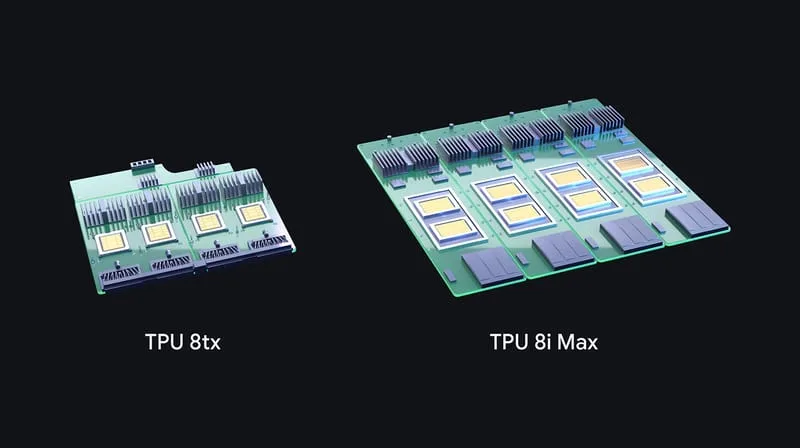
On the hardware side, Google announced the TPU 8tx and 8i Max, two specialized versions of its custom AI chips arriving next year. Google began selling TPUs to other companies this year and has nearly 100 customers, including Anthropic and Apple, with every available chip spoken for. The 8tx keeps data encrypted even while an AI model is working on it, a step where it normally sits exposed, with governments and regulated firms as targets. The 8i Max joins two chips as one unit to double processing power and memory speed, for AI agents that must keep an entire codebase or long video in view. "The future is going to be about specialization," said Amin Vahdat, who runs Google's chip work, expecting both to reach customers next year.
What to Watch Next
Anthropic is preparing to proceed with its IPO despite current fear in the AI sector, with shares likely launching for trading as soon as Thursday next week, The Wall Street Journal reports. That timing puts the Fable 5.2 launch in a different light: a leaderboard-topping, cost-reduced model is a stronger story to take to public markets than a paused one.
For readers, three things are worth tracking. First, whether Google's Gemini 4 Carbon closes the 5-point gap when it reaches the public. Second, whether OpenAI's expected new model resets the leaderboard again. Third, whether the per-task cost gap that Meta is advertising with Ember, $0.14 against $0.41, holds up as more agent workloads move into production. The current stage is one of compressed generations: cheaper and faster versions of top models arriving within months, with the leaderboard lead measured in single-digit points and the real contest shifting to what each task costs.
Comments
No comments yet. Be the first to comment.