
Google's Gemini 4 Hydrogen surpasses the larger Argon only four weeks after its launch.
Google Gemini 4 Hydrogen is a fast, low-cost AI model that beats larger Argon on key benchmarks and adds one-million-token context in the Gemini app.
Key Takeaways
- Google launched Gemini 4 Hydrogen, a fast and cost-efficient general-purpose AI model that surpasses the larger Gemini 4 Argon on a key intelligence benchmark despite being positioned for everyday tasks rather than deep reasoning.
- Hydrogen replaces the Flash-style tier in Google’s Gemini 4 family, offering four thinking levels, a one-million-token context window, and pricing of $1.50 per million input tokens and $7.50 per million output tokens.
- Google claims strong benchmark gains over Gemini 3.8 Flash, including faster task completion, better tool recovery, reduced hallucinations, and competitive scores on agent, legal, tax, and multimodal knowledge-work evaluations.
- Independent testing supports Hydrogen’s overall intelligence and price-performance strengths but identifies terminal and computer-use tasks as relative weaknesses compared with Claude Sonnet 5.5 and GPT-6.1 Sol.
- Hydrogen’s rapid release shortly after Argon’s launch may reshape Google’s model lineup by making the mid-tier Argon less necessary for routine developer and knowledge-work tasks.
Google has launched Gemini 4 Hydrogen, a general-purpose AI model built for speed and cost efficiency that, according to the company, outperforms its larger frontier sibling Gemini 4 Argon on a key intelligence benchmark. The release comes just two days after Google announced Gemini 4 Carbon, its newest frontier reasoning model, and less than four weeks after Argon itself debuted—a pace that is rapidly reshaping the company's model lineup.
Hydrogen is positioned as the successor to the earlier Flash series, designed for everyday tasks rather than the deep, long-horizon reasoning that Carbon and Argon target. But benchmark results suggest the distinction between "fast" and "frontier" is blurring.
Background: A Model Family in Flux
Google's Gemini 4 family now spans three tiers. Carbon and Argon were built for hard problems requiring sustained reasoning. Hydrogen, by contrast, was designed to handle routine work quickly and cheaply. When Google announced Carbon two days ago, it recommended that developers stick with Argon for daily coding tasks. Hydrogen appears to make that advice obsolete, leaving Argon superseded within a month of its release.
The model is available now in the Gemini app and supports four thinking levels: low, medium, high (the default), and a new xhigh tier. Argon offers only medium and high. Hydrogen carries a one-million-token context window for input and can output up to one million tokens. Pricing is set at $1.50 per million input tokens and $7.50 per million output tokens, with cache hits costing $0.075.
Development: Benchmark Gains Over the Flash Generation
Google describes Hydrogen as a standalone model and a substantial upgrade over Gemini 3.8 Flash. At the default thinking level, the company says it completes tasks 2.5 times faster. On Terminal-Bench 4.1, the score rises from 18.2 percent for Flash to 57 percent for Hydrogen. Google also reports that hallucinations dropped by a factor of five, and that the model recovers more effectively when a tool call fails or a search returns no results.
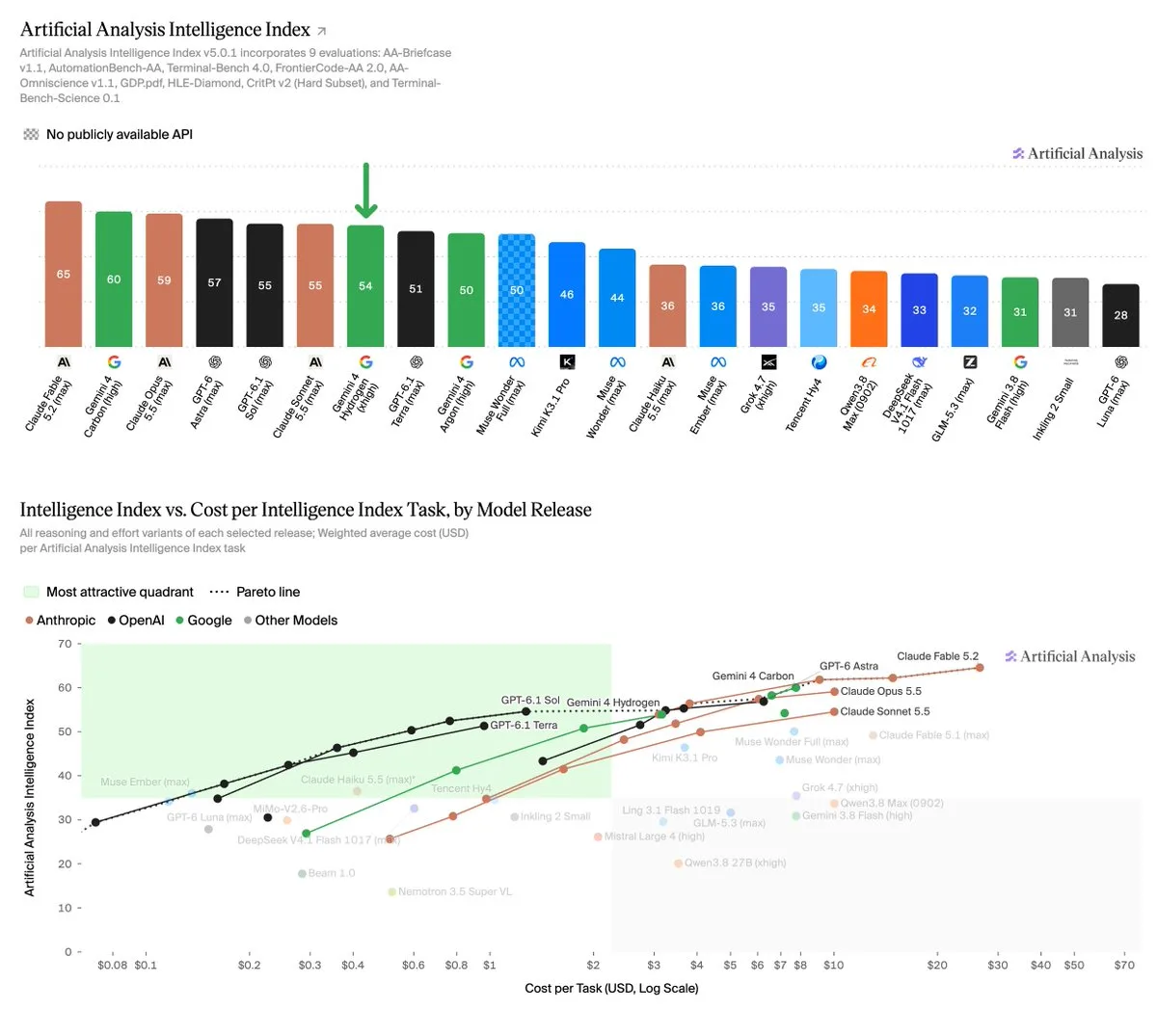
On the Artificial Analysis Intelligence Index, Hydrogen scores 51 at the default high thinking level, edging out Argon's 50, and reaches 54 at xhigh—just behind Claude Sonnet 5.5 and GPT-6.1 Sol, which each score 55 at their maximum thinking levels. Argon trails at 50.
For open-ended agent tasks such as research, data analysis, and code navigation, Hydrogen ranks fifth on the Agent Arena leaderboard. Google says it takes first place on the Vals Tax Agent Bench with 52.3 percent and ties for first on the Vals Legal Research Bench with 55.8 percent. On multimodal knowledge work—summarizing large PDFs, spreadsheets, or videos—it scores 53.4 percent on Google's new Multimodal Knowledge Agent Benchmark and 71.6 percent on Agents' Last Exam v1.1.
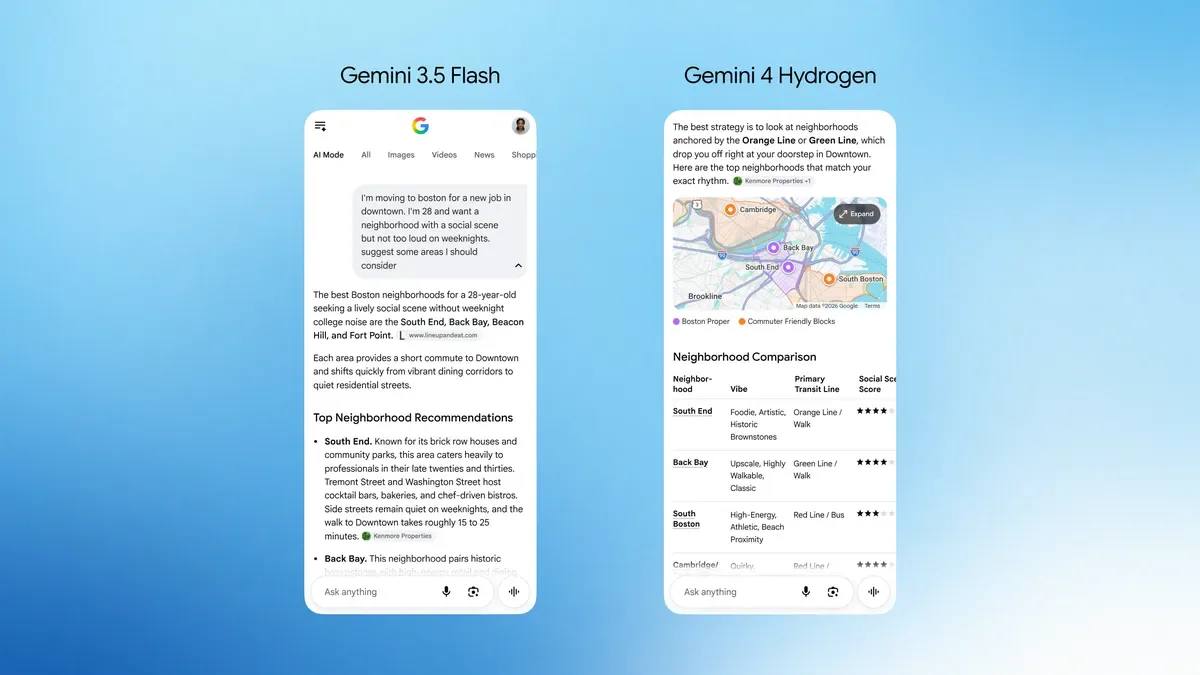
In the Gemini app, Google says the model adheres more closely to tone, format, and instructions over longer conversations, making drafts, summaries, and documents more often usable on the first attempt. Hydrogen can also draw context from Google apps including Gmail and Drive, as well as third-party apps such as Airtable and Dropbox. Google further claims a "significant upgrade" for Search, with better handling of typos, multi-part questions, and highly specific requests, more visual and scannable results, and an improved query fan-out technique that pulls in a wider range of relevant links.
In Antigravity, Google's coding tool, a new orchestrator switches dynamically between Carbon and Hydrogen within a session rather than committing to one model. On Terminal-Bench 4.0, Google says the orchestrator nearly matches Carbon's success rates while using 24 percent fewer resources and cutting processing time by 19 percent.
Latest: Independent Testing Reveals a Split Profile
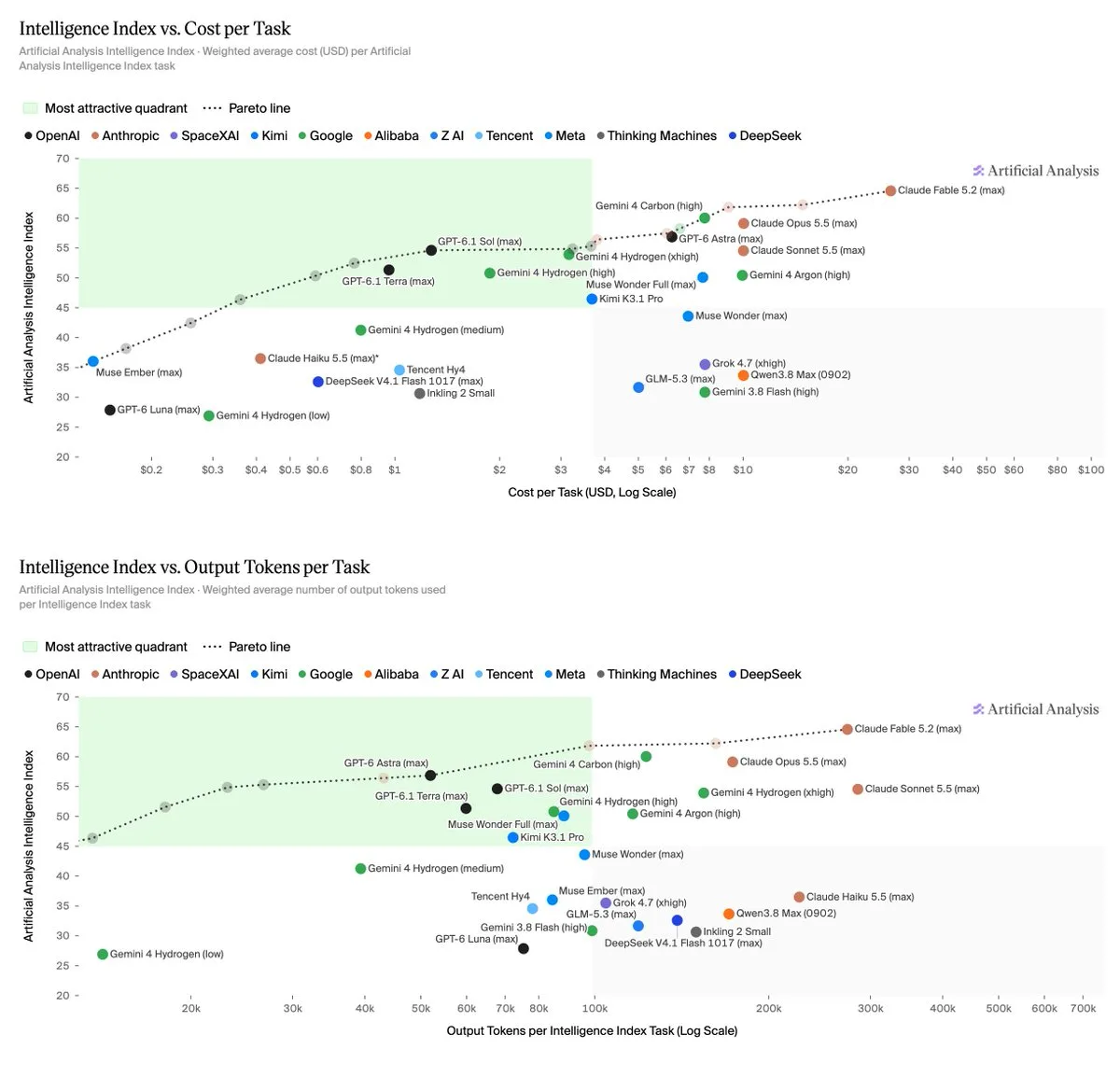
An independent evaluation by Artificial Analysis broadly corroborates Google's claims while exposing weaknesses. At its highest thinking level, Hydrogen lands roughly on par with Claude Sonnet 5.5. At the default high level, the score drops to 51, slightly behind GPT-6.1 Sol (xhigh, 52) and Claude Opus 5.5 (high, 52).
On the AA-Omniscience benchmark, Hydrogen fabricates information only 8 percent of the time, according to Artificial Analysis, and it beats other Gemini models including Carbon on presentation quality in AA-Briefcase, which evaluates agentic knowledge work.
Terminal work is the weak spot. Hydrogen scores 54 percent on Terminal-Bench 4.0 and just 50 percent on Terminal-Bench-Science 0.1. Claude Sonnet 5.5 (max) reaches 64 and 53 percent respectively, while GPT-6.1 Sol (max) scores 56 and 58 percent.
On price-performance, Artificial Analysis puts Hydrogen at about $3.16 per task at xhigh—roughly a third of what Claude Sonnet 5.5 (max) costs at nearly the same intelligence level, but about 2.5 times as much as GPT-6.1 Sol (max). The xhigh tier lifts the intelligence score from 51 to 54 but requires nearly twice as many output tokens as high, pushing average cost per task from $1.87 to $3.16. At high, costs fall to $1.87; at medium, $0.80; at low, $0.29. Intelligence scores fall sharply at lower tiers—medium reaches only 41 and low just 27 on the index. Artificial Analysis notes that at the high, medium, and low tiers, Hydrogen sits on the Pareto frontier, meaning no other model is both cheaper and smarter at those price points.
What to Watch Next
The practical question is how quickly Hydrogen displaces Argon in developer workflows. Google's own Antigravity orchestrator, which routes between Carbon and Hydrogen mid-session, hints at a future where the mid-tier Argon plays no role at all. Whether Google formally retires Argon or repositions it will signal how aggressively the company intends to consolidate its lineup. The other open question is terminal and computer-use performance: Hydrogen's deficits there against Claude Sonnet 5.5 and GPT-6.1 Sol leave room for competitors to hold ground in agentic coding and system-level automation, even as Google claims the price-performance frontier at lower intelligence tiers.
Comments
No comments yet. Be the first to comment.