
ElevenLabs Scribe v3 Live leverages conversational context to prevent voice agents from interrupting callers mid-sentence.
ElevenLabs Scribe v3 and v3 Live improve multilingual accuracy, real-time diarization, and voice-agent turn detection, with cost and speed trade-offs.
Key Points Summary
- ElevenLabs launched Scribe v3 for pre-recorded audio and Scribe v3 Live for real-time use, targeting noisy calls, overlapping speakers, and fast conversations, with claimed ~25% lower word errors across 102 languages and first-time real-time diarization.
- Independent benchmarks place Scribe v3 among the most accurate transcription models, but it is slower and more expensive than some competitors, making cheaper, faster options more practical for high-volume bulk transcription.
- Scribe v3 Live is designed for voice agents by using conversational context—not just silence timers—to determine when a caller has finished speaking, reducing unwanted interruptions.
- The models add developer and enterprise controls, including domain-specific term preloading, natural-language formatting rules, mid-sentence multilingual handling, EU isolated servers, and zero-retention options.
- ElevenLabs is also expanding its enterprise push through partnerships with Nvidia and McKinsey, plus a marketplace with ready-made voice agents, but real-world performance on interruptions and diarization still needs independent testing.
Elevenlabs has released Scribe v3 and Scribe v3 Live, two speech-to-text models aimed at difficult real-world audio: overlapping speakers in meetings, background noise on phone calls, and fast exchanges where timing matters. For developers building transcription and voice-agent products, the update shows that accuracy gains and real-time behavior are becoming important differentiators in speech recognition.
Before the Launch: Where the Problem Sat
Speech recognition for recordings has often been tested on clean audio, but practical applications face noisier conditions. Elevenlabs framed the new models as tools for those cases, with Scribe v3 handling pre-recorded files and Scribe v3 Live targeting low-latency real-time use. Both are available through the ElevenAPI developer interface and the ElevenAgents platform, putting them in the same developer stack for API access and agent-based voice systems.
The company says Scribe v3 reduces word errors by about 25 percent versus its predecessor across 102 languages. It also points to significantly better German accuracy and more reliable speaker diarization, the process of identifying who is speaking, in larger group conversations. For Scribe v3 Live, Elevenlabs says real-time diarization is available for the first time.
Independent Benchmarks: Accuracy Up, Speed and Cost Trade-offs
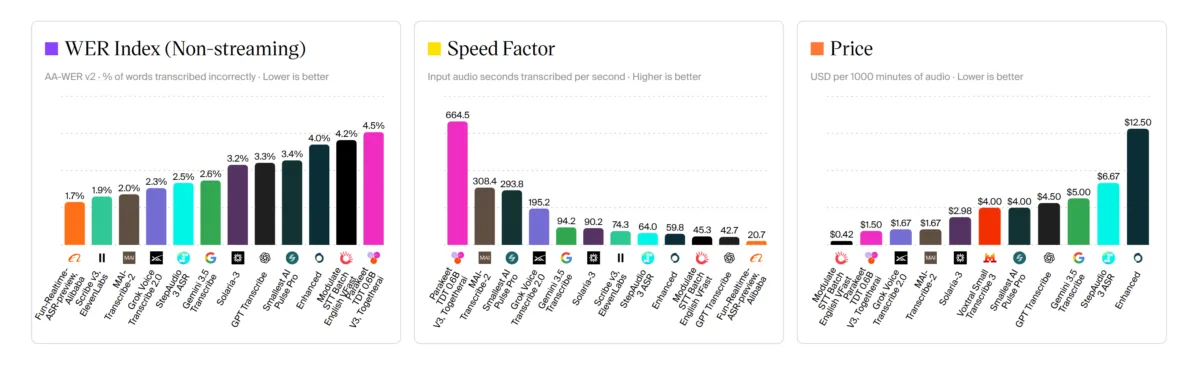
Artificial Analysis benchmark data places Scribe v3 among the most accurate transcription models tested, ahead of competitors from Microsoft, Mistral, xAI, Google, and OpenAI, but behind a preview model from Alibaba. The test measures word errors on recorded files, which explains why Elevenlabs can lead on accuracy while falling short on speed.
The trade-off is visible in speed and pricing. Scribe v3's benchmark price is $3.33 per 1,000 minutes. For teams that need to process large volumes of audio quickly and cheaply, other providers may be more practical. Elevenlabs sits mid-pack on speed and price, while models from Microsoft and xAI are described as running many times faster, with marginally higher error rates and roughly half the cost.
Those benchmark results do not capture the features Elevenlabs emphasizes beyond raw transcription accuracy: speaker separation, rare-language handling, and the real-time behavior of Scribe v3 Live. That gap matters for voice agents, where knowing when a caller has truly finished speaking is part of the user experience.
Real-Time Voice Agents and Enterprise Controls
Scribe v3 Live is designed to address a common failure in voice-agent systems: rigid pause timers that cut callers off when they pause to think or slowly read numbers. Instead of relying only on silence, the model analyzes conversational context alongside the audio signal to judge whether a speaker has completed a turn.
Developers get more control over the final transcript. The models can be preloaded with thousands of specialized terms, such as brand names or medication names, to reduce errors on domain-specific vocabulary. Formatting rules for numbers or dates can be set in natural language, and a multilingual mode handles switches between languages mid-sentence. For enterprise customers, Elevenlabs offers isolated servers in the EU and a zero-retention mode intended to delete data immediately after each request.
The model launch is paired with an enterprise push. Under an expanded partnership with Nvidia, Elevenlabs is integrating the open Nemotron 3.5 Super VL language model into ElevenAgents, securing additional compute capacity running on Nvidia, developing local voice control for robots, and running a phone agent for Poland's public health system. It also announced an alliance with consulting firm McKinsey, a broader partner program for system integrators, and a marketplace where companies such as Salesforce, IBM, and Zendesk offer ready-made voice agents.
What to Watch Next
The next step is to see how independent tests handle the limits of current benchmarks. Recorded-file word error rates do not show whether Scribe v3 Live reduces unwanted caller interruptions or whether diarization stays reliable in noisy meetings. For developers, the choice may come down to cheaper bulk transcription versus a more context-aware pipeline for interactive voice systems.
Comments
No comments yet. Be the first to comment.