
Google DeepMind uses AlphaGenome 2 to move genomics AI from bulk tissue prediction to single-cell type resolution.
AlphaGenome 2 predicts genetic variant effects in specific cell types, enabling better disease, immune, and vaccine research.
Key Takeaways
- AlphaGenome 2 shifts genomics AI from bulk tissue-level prediction to cell-type-specific modeling, using 107 million cell profiles across 68 tissues.
- The model pairs DNA sequences with specific biological states to predict gene effects, chromatin packaging, DNA methylation, and infer missing regulatory information.
- It outperforms earlier models on immune-cell benchmarks, identifying more causal variants and better predicting whether variants increase or decrease gene activity.
- It can reveal disease mechanisms hidden in bulk analyses, such as cell-state-specific effects of genetic variants in inflammatory bowel disease and COVID-19 vaccine responses.
- AlphaGenome 2 is available for noncommercial research via API and a commercial preview, but is not approved for clinical diagnostics and will be integrated into Google’s AI research workflows.
Meta description: Google Deepmind AlphaGenome 2 predicts cell-specific genetic variant effects, trained on 107 million cell profiles from 68 tissues for genomics research.
Tags: AlphaGenome 2, Google Deepmind, genomics AI, genetic variants, cell types
Featured image: Abstract DNA sequence network with cell-state nodes, technology style, no real people, no logos, no text.
Google Deepmind has moved from broad tissue-level variant prediction to cell-state-specific modeling with AlphaGenome 2, a genomics AI model that forecasts how genetic variants affect specific human cell types and identifies almost twice the number of relevant gene changes seen by the earlier model. The release matters because interpreting disease-associated variants requires knowing which cell type is reading a gene and how that gene is regulated.
Background: From One DNA Blueprint to Many Cell States
Human cells all share one DNA blueprint, but different cell types switch genes on or off in distinct ways. Heart muscle cells and immune cells read the same genome differently, and predicting those differences remains one of the biggest unsolved problems in genomics. The original AlphaGenome addressed part of the problem by taking a DNA sequence one million letters long and predicting its properties across thousands of experiments spanning many tissues at once. Google Deepmind treated that parallel design as a limitation: spreading capacity across many tissues made it difficult to capture subtle differences between closely related cell types.
Development: A Conditional Model for Individual Cell Profiles
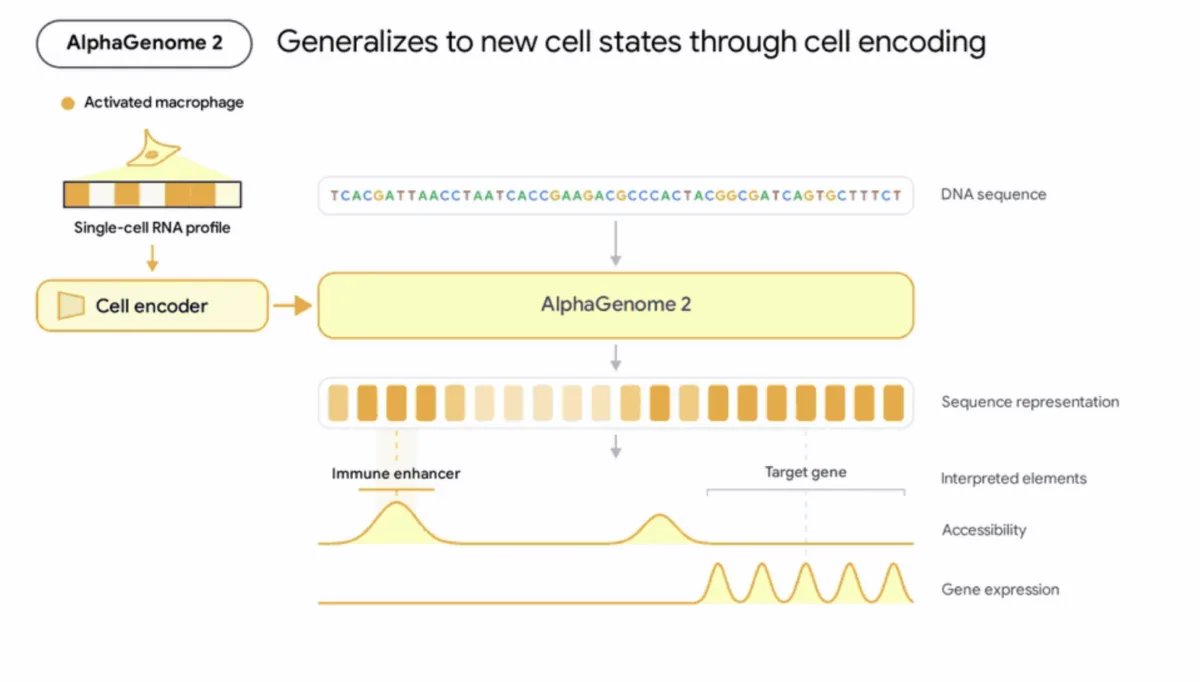
AlphaGenome 2 changes the framing. It is built as a conditional model, so the DNA sequence is paired with a specific biological state as an extra input, and the model calculates effects for that one cell type rather than a broad tissue mixture. The company says its training set included more than 107 million individual cell profiles from 68 tissues in humans and mice.
The model extends prediction beyond gene expression. It also estimates how DNA is physically packaged in the nucleus, indicating which genome stretches are accessible. It can predict DNA methylation, chemical tags that function as molecular switches to silence or activate genes. If researchers measure only one property, such as gene activity in a cell, the model can infer missing data, including how tightly or loosely certain DNA stretches are packaged. That helps researchers decide which lab experiments are worth running next.
Latest: Benchmarks, Disease Mechanisms, and Vaccine Responses
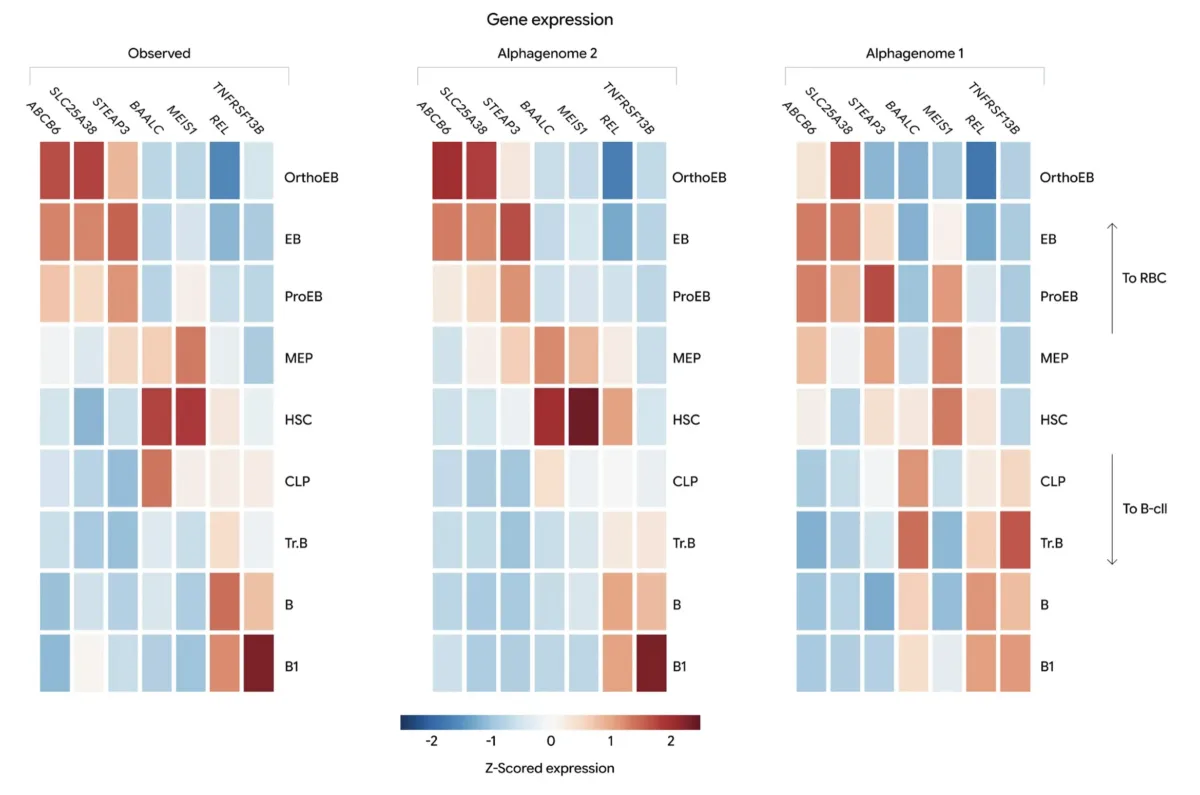
On the TenK10K benchmark dataset with 28 primary immune cell types, AlphaGenome 2 identified about 30 percent of causal variants and correctly predicted whether a variant upregulates or downregulates a gene in 43 percent of cases. A fine-tuned version of AlphaGenome 1 managed 16 percent and 23 percent on those measures. The system also models continuous changes, such as the maturation of blood stem cells into red blood cells, with considerably greater accuracy than the predecessor.
In a computational reproduction of an inflammatory bowel disease mechanism previously identified in a study, AlphaGenome 2 isolated the exact DNA variant in a regulatory switch far from the gene that selectively overactivates ETS2 in gut macrophages, while other cell types and genes remained largely unaffected.
Another advantage is adaptation without retraining. Researchers can provide gene activity data from just a few dozen cells, and the model calculates effects for that previously unseen cell state. Google Deepmind says it often beats specialized models trained directly on that data. Applied to data from a COVID-19 mRNA vaccine study, AlphaGenome 2 reliably distinguished vaccine-activated T cells from resting T cells and showed that a gene variant linked to severe COVID-19 cases disrupts cell activity mainly in the activated state. In resting cells, that effect would have remained invisible.
Current Stage: Research Access and Planned Workflow Integration
Google Deepmind has precomputed predictions for hundreds of cell and tissue conditions, partly to support AI-driven drug development. Those predictions also help interpret genome-wide association studies, which link broad DNA regions to traits such as height or type 2 diabetes but often locate signals only roughly. AlphaGenome 2 narrows the likely causal variants and identifies affected cell types, such as astrocytes in the brain or specific immune cells. When the model is confident enough, it also predicts whether a mutation upregulates or downregulates a gene, a capability important for drug development.
The model is available now for noncommercial research through an API, while commercial users receive access through a closed preview. It is not approved for clinical diagnostics. Google Deepmind plans to soon roll out dedicated AlphaGenome 2 features on its agentic development platform Google Antigravity, where the model is set to be combined with tools like Gemini 4 for automated research workflows.
AlphaGenome 2 is now positioned as a cell-state-specific interpretation layer: it connects genetic variants to individual biological contexts, but its commercial availability, benchmark performance, and integration with research workflows remain the points to watch.
Comments
No comments yet. Be the first to comment.