
Training AI tutors with simulated learners who err like real students speeds up learning
Microsoft researchers built StudentSim, a system that creates digital replicas of individual students who both make realistic mistakes and respond to tutoring. Using a two-stage training approach on Alibaba's Qwen3-4B model, it beat GPT-5.4 in simulating learners across chess, English, and math. Tutors trained with these replicas showed better factual accuracy, explanations, and personalization, addressing the key bottleneck in AI education.
Training an AI tutor with a large, diverse group of real students is "prohibitively expensive and time-consuming," the researchers write in their paper. Because of that, progress on tutoring systems has trailed behind the rapid gains in underlying AI models. Microsoft's answer is StudentSim, a system that creates a digital replica of each individual learner so tutors can be trained and evaluated without recruiting thousands of students. The work matters because personalization—not raw model capability—is shaping up as the key bottleneck in AI education.
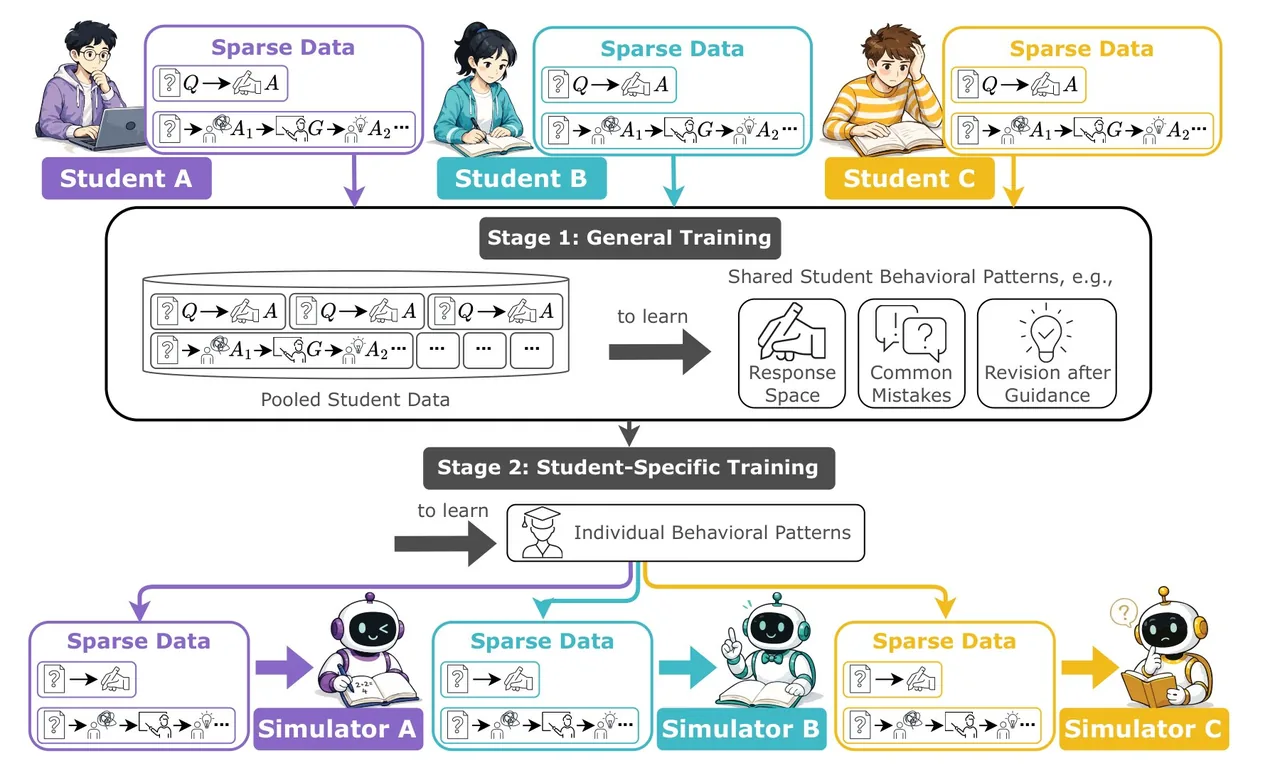
Student replicas must make mistakes and respond to teaching
According to the researchers, existing approaches cover only one of two essential skills. Models trained on real student data reproduce a learner's behavior faithfully but cannot make use of a tutor's explanations. Language models prompted to role-play as students, on the other hand, readily act on a tutor's hints yet fail to match the actual abilities of the person they are meant to imitate.
StudentSim turns both requirements into measurable objectives. The system scores how closely a replica matches a student's answers—including characteristic errors—and how willingly it revises those answers after receiving help. Both a realistic starting point and responsiveness to instruction are needed for meaningful tutor training.
Two-stage training makes scarce student data usable
The central challenge is data scarcity. In the English writing dataset, the median student has produced only three essays, and more than two-thirds have written five or fewer. Training a replica directly on so few samples fails, the team says, because the model overfits.
StudentSim solves this with two stages. First, a base model learns shared subject-level patterns from the pooled data of all students—common mistakes and how learners revise their work after a tutor's hint. The model is then adapted to each individual student using that person's limited records. Across all subjects, the system is built on Alibaba's Qwen3-4B-Instruct language model.
It outperforms GPT-5.4 in chess, English, and math
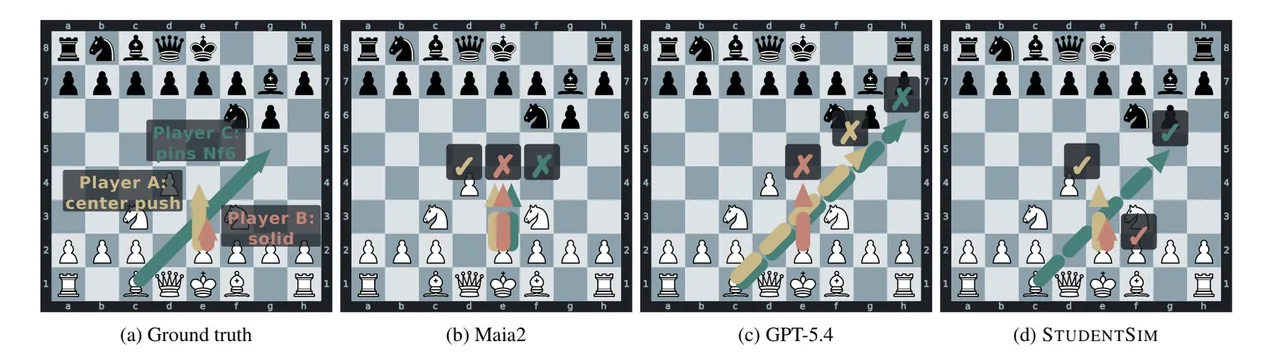
The team evaluated the method on 60 students across chess, English as a foreign language, and math, using public datasets of real learners. StudentSim beat the much larger GPT-5.4 in all three subjects when GPT-5.4 was prompted to play the role of a student. In chess, it correctly predicted a player's next move roughly twice as often and almost always followed corrective guidance; GPT-5.4 and specialized chess engines lagged behind.
Each rival method showed a distinct flaw. GPT-5.4 follows hints but doesn't recreate a specific student's mistakes. Chess models mirror a player's behavior but can't process verbal hints. In one position, three real players picked three different moves: StudentSim reproduced each choice, the chess model predicted the same most-likely move for all three, and GPT-5.4 got every one wrong.
Replica-trained tutors actually improve
As a further proof of concept, the researchers used replicas to train a chess tutor. Professional players rated three versions: one with no such training, one trained with GPT-5.4 as the student, and one trained with StudentSim. The StudentSim-trained tutor ranked highest on all three measures—fewest serious factual errors, best explanation quality, and strongest adaptation to the individual student. Notably, the GPT-5.4-trained tutor scored worse on factual accuracy than the untrained baseline.
The researchers stress this is a proof of concept, not a claim to have built the best tutor. Chess is a convenient test case because an engine can objectively evaluate any move; essay writing and open-ended math lack reliable scoring functions for free-form answers. Next, the team plans to model how students acquire, retain, and forget knowledge across many practice sessions. The code is available on GitHub.
Context: a crowded but incomplete field
Digital student replicas have drawn growing interest. In 2024, researchers used AI agents to replicate around 1,000 real people from two-hour interviews with each participant—though a separate study showed how error-prone such replicas can be, finding that nine open language models mimicking users on X, Bluesky, and Reddit produced less accurate content the more human they sounded.
Microsoft is also testing AI tutors with real students: in a pilot project in Nigeria, students worked with Copilot twice a week for six weeks and achieved test-score gains equivalent to nearly two additional years of learning. OpenAI and Google offer their own approaches through Study Mode and Guided Learning, which rely on system instructions and fine-tuned teaching models—but neither maintains a model of the individual learner. That gap matters: studies show users can perform worse after brief AI assistance than people who worked unaided from the start. Personalized learner models like StudentSim are one attempt to close it.
Meta description: Microsoft's StudentSim creates digital replicas of individual students to train AI tutors, outperforming GPT-5.4 in chess, English, and math tests.
Tags: Microsoft, StudentSim, AI tutoring, GPT-5.4, personalized learning
Featured image: Abstract illustration of overlapping digital human silhouettes rendered as data points and neural network lines on a soft gradient background.
Comments
No comments yet. Be the first to comment.