
AI inference leaves behind hidden storage costs that are often overlooked.
Generative AI budgets often focus on compute, but inference creates ongoing storage demand from logs, cached context, backups, and safety records. Video workloads can leave hundreds of times more back-end data than visible output, making storage a growing cost that may exceed compute budgets in 12 to 18 months.
Key Takeaways
- AI inference generates persistent hidden storage costs from logs, cached context, renders, backups, and safety records, often expanding faster than compute spending.
- A short AI-generated video example shows backend data can be more than 130 times larger than the user-visible file, highlighting how storage footprints compound rapidly.
- Most surveyed IT and business leaders report significant data growth from generative AI, and storage budgets may become material within 12 to 18 months if treated as a minor rounding error.
- Economically scalable AI infrastructure requires storage tiering, faster archive access, and lifecycle planning, since retained data increasingly supports future inference and retrieval-augmented workloads.
AI storage costs are becoming a less visible but growing part of AI infrastructure spending, according to a recent WD-sponsored global white paper from International Data Corporation that surveyed 763 information technology and business decision makers. The report points to a pattern that many executives miss: after a model answers a prompt, the data it leaves behind must be stored, and that retained footprint can expand faster than the compute line item that receives most attention.
Background: Training Runs End, Inference Data Accumulates
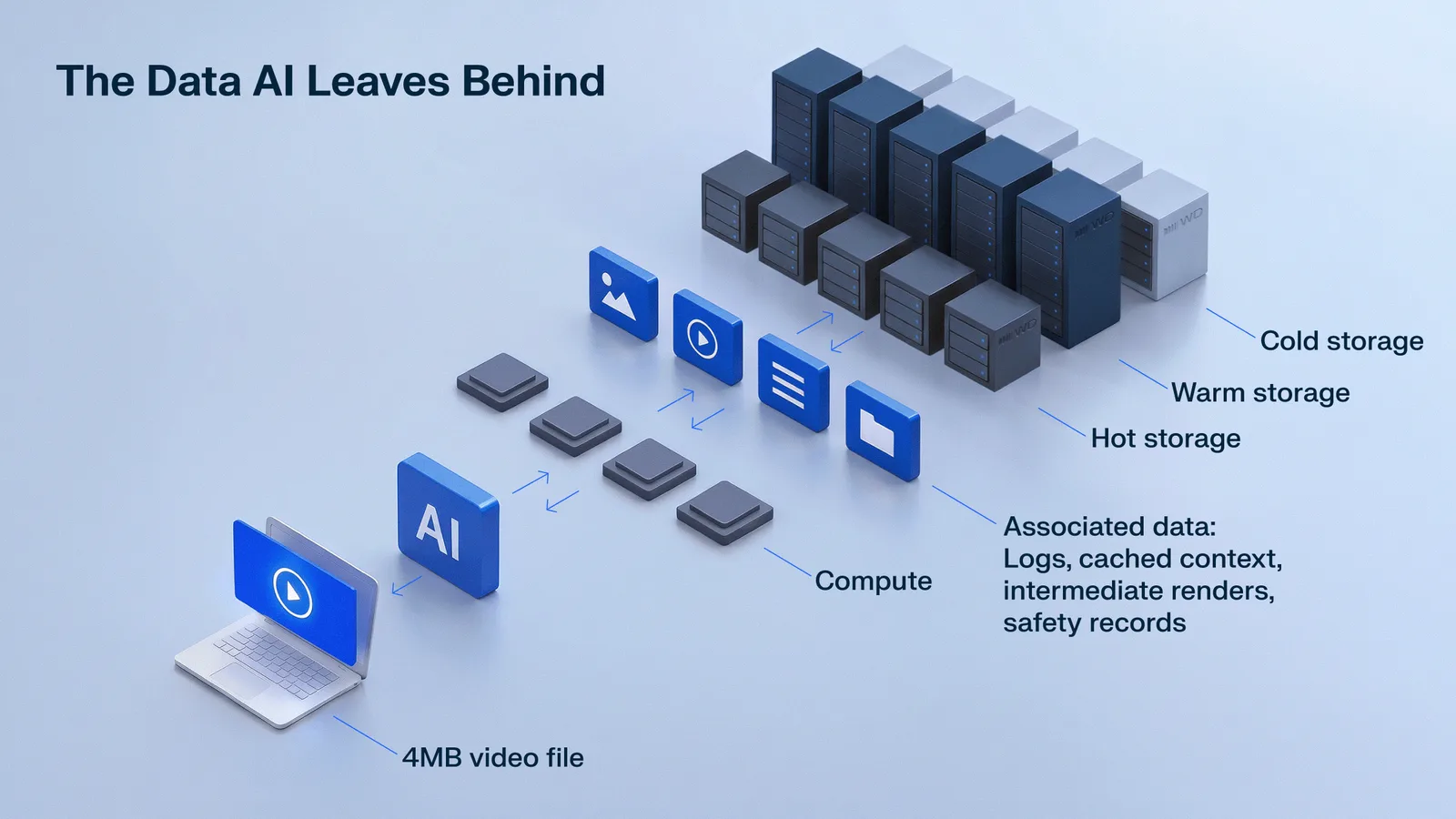
Traditional AI budgeting has focused on the compute-heavy training phase. A training run is finite: it starts, consumes accelerators, and ends. Inference is different. It runs continuously every time a model responds to a prompt, and each request can create logs, cached context, renders, backups, and safety records. From billions of daily prompts, images, and videos, the back-end data that remains can be much larger than the output shown to users. That makes data storage one of the harder infrastructure costs to plan for, especially when early AI infrastructure planning assumes compute is the main expense.
Development Process: Video Workloads Show the Compounding Footprint
WD’s internal measurements illustrate the gap. An 8-second AI-generated video clip returned to a user as a 3.97MB 720p file left more than 500MB of associated back-end data, including logs, cached context, immediate renders, backups, and safety records. That is a 130 times increase over the file size visible to the user. For enterprises generating longer, higher-resolution video, the back-end footprint can grow into the hundreds of gigabytes per clip.
The International Data Corporation survey found nearly 95% of respondents reported an increase in data volume due to generative AI over the past 12 months, and roughly 61% reported growth of 25% or more. A senior product manager at a hyperscale cloud service provider quoted in the report said storage can be viewed as an optimization to keep GPUs busy, because hours of idle GPU time become very expensive very quickly. The financial consequence is straightforward: if storage spend grows 25% year over year while compute budgets follow a more predictable cyclical pattern, storage can overtake the budget line that leadership tracks most closely.
Latest Progress: Budgets Surface the Gap in 12 to 18 Months
For chief financial officers and chief information officers, the risk is that “AI infrastructure spend” may be scoped too narrowly on compute. A model that sits idle while data loads can cost about as much as one waiting for a GPU, but the storage bottleneck may stay hidden until it appears as operating cost and retrieval delay, not as a capital expenditure line next to accelerators.
The source material gives practical examples. A retailer generating AI product videos for its catalog, or an insurer running claims documents through a retrieval-augmented generation pipeline for faster underwriting, can forecast compute per generation or per query. Storage is different because it compounds with every video generated and every claim processed, since the back-end data does not disappear after the task is finished. A team that budgets AI as compute plus a rounding error for storage may find, in 12 to 18 months, that the rounding error has become a significant fraction of total program cost, often around the time leadership decides whether to expand.
Current Stage: Economically Scalable Capacity Becomes the Next Priority
The timeline for this pressure is set by inference growth. McKinsey projects AI inference demand will grow at a 35% compound annual growth rate through 2030, versus 22% for training, and will make up more than 40% of total data center demand by the end of the decade. As retained data becomes an input for future workloads, storage must support both capacity and dynamic access. The survey found 96% of respondents anticipate needing faster archive retrieval to support inference or retrieval-augmented generation. For the vast volumes of data that must be retained and revisited, HDDs provide a cost-effective, high-capacity foundation, with a significant cost-per-terabyte advantage.
The underlying challenge is architectural. Storage strategy often prioritizes expensive, hot-tier performance for data accessed constantly, while most AI data accumulates in warm, cool, and cold tiers. Economically scalable capacity requires balancing performance, power, reliability, density, operational efficiency, and total cost of ownership across storage tiers, because the data does not stop accumulating when compute demand slows. Such infrastructure requires storage tiers in which power consumption, reliability, density, and operational efficiency determine whether the system remains economically sustainable as capacity scales.
The unresolved questions are what data retention policy exists for AI-generated content and who set it, whether storage procurement is tied to training-time performance needs or to the actual life cycle of the data being produced, and whether a doubling of AI usage next year would double storage cost or make it worse. Most organizations cannot answer all three with confidence. The next budget cycle will show whether organizations have moved from treating storage as a rounding error to planning for data that persists, compounds, and is reused.
Meta description: WD survey of 763 decision makers shows AI storage costs can outpace GPU budgets as inference data, retention, and archive access grow toward 2030.
Tags: AI storage costs, inference infrastructure, WD, International Data Corporation, data lifecycle
Featured image: abstract technology style, storage tiers and AI inference pipeline, no real people, no company logos, no text.
Comments
No comments yet. Be the first to comment.