
Decision-model controllers show good judgment but give bad advice, raising agent costs without improving success rates.
The Terminal-Bench 2.1 study tests agent controllers. Specialized decision models can improve offline judgment but add cost without raising success.
Key Takeaways
- The study tests whether a specialized decision-model controller, Jev 1.13, can improve AI agent efficiency by deciding when to stop, verify, or change strategy.
- Using the same agent loop across five controller strategies, the experiment isolates the controller’s effect on Terminal-Bench 2.1 over 315 trials and 21 held-out tasks.
- Jev 1.13 produced the best offline decision quality, with an AUROC of 0.78, outperforming deterministic rules and a small LLM.
- In end-to-end agent execution, it raised cost per attempt by 19% while task success remained unchanged at 73%, largely due to unnecessary verification and calibration issues.
- The core lesson is that better isolated decision signals do not necessarily improve overall agent performance; timing, calibration, and workflow overhead remain critical.
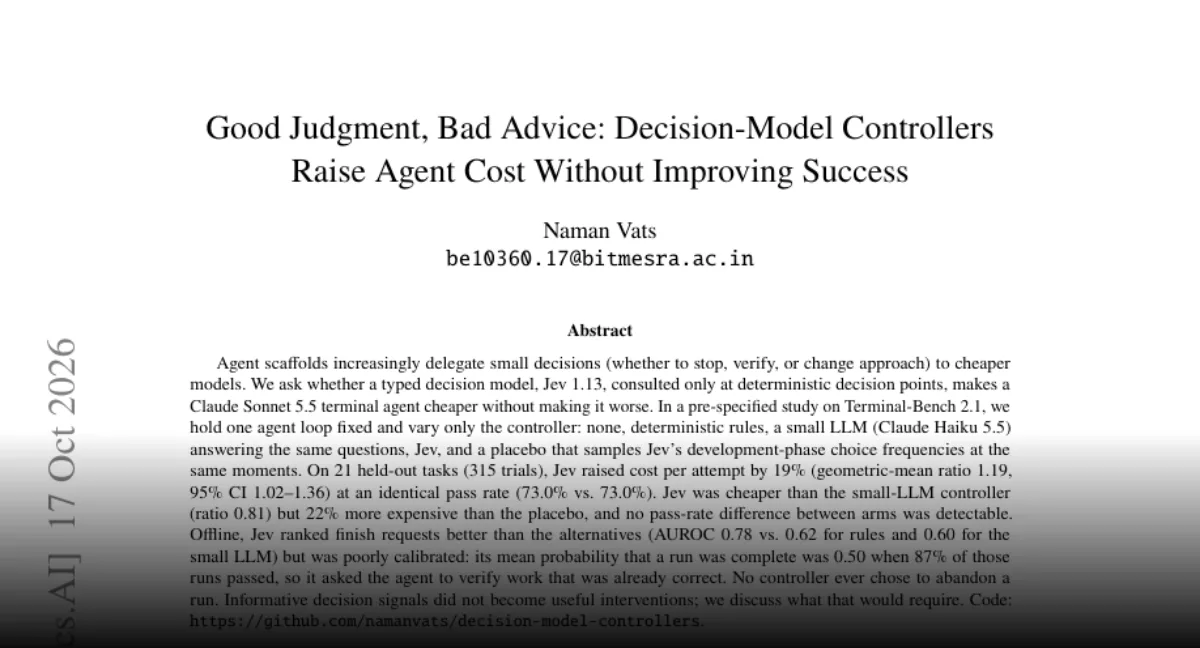
Can a specialized decision model make AI agents more efficient, or does it add overhead? The Terminal-Bench 2.1 study listed at https://arxiv.org/abs/2610.24649 answers that question by testing whether controllers that decide when to stop, verify, or change approach improve agent performance. The finding is uncomfortable: a controller can produce better isolated decision signals and still make the full agent workflow more expensive without raising success.
Background: Controllers Enter the Agent Loop
Agent systems repeatedly face control decisions: when to stop, when to verify an intermediate result, and when to change strategy. A deterministic rule can make those calls cheaply, but rules may miss subtle cases. A small LLM can add flexibility, but it may also add cost. Jev 1.13 represents the specialized decision-model approach, separating the control problem from task execution. The research question is whether that separation improves end-to-end performance or simply adds another layer.
Development: Five Controller Strategies on Terminal-Bench 2.1
The experiment keeps the same agent loop and changes only the controller. It compares five strategies: no controller, deterministic rules, a small LLM, Jev 1.13, and a placebo controller. The study covers 315 trials across 21 held-out tasks and releases code for reproducibility. This structure makes the comparison useful because any difference in cost or success can be attributed to the controller rather than to a different task-solving model.
Results: Better Offline Discrimination, Worse Cost-Per-Success
Jev 1.13 showed the strongest offline finish-decision discrimination among the tested options. Its area under the receiver operating characteristic curve score was 0.78, compared with 0.62 for deterministic rules and 0.60 for the small LLM.
In the agent loop, however, Jev 1.13 produced 19% higher cost per attempt while task success remained at 73% versus 73%. The study points to calibration challenges: the controller triggered unnecessary verification, adding overhead without turning better isolated judgments into better completed tasks.
Current Stage: Calibration and Intervention Timing Remain Open
The paper does not suggest that specialized decision models are worthless. It says better decision-making in isolation does not necessarily translate into better end-to-end agent performance. Controller calibration, intervention timing, and cost all matter. At this stage, Jev 1.13 improves signal quality in offline evaluation, but it does not yet deliver a reliable efficiency gain for agent workflows.
Comments
No comments yet. Be the first to comment.