
AdaTutoRank: Adaptive Tutoring Optimization for Document Set Reranking in RAG and Deep Research
AdaTutoRank improves RAG reranking with difficulty-matched hints and rubric rewards, reducing sparse credit in setwise evidence selection.
Key Takeaways
- AdaTutoRank is a setwise document reranker for RAG and deep research, treating evidence selection as composing a useful document set rather than ranking individual passages.
- It addresses the sparse supervision problem in setwise reranking, where one aggregate set score makes it hard to distinguish valuable documents from redundant or non-contributing ones.
- The method uses Adaptive Tutoring Optimization, built on nine rubric dimensions and three progressively more specific hint forms generated from a frozen policy snapshot.
- Each rollout receives tutoring guidance matched to its difficulty, making supervision denser while avoiding overly prescriptive hints for strong rollouts or overly vague hints for weak ones.
- AdaTutoRank’s practical value still depends on evaluation in real retrieval workloads, especially for downstream answer quality, evidence coverage, and redundancy control.
Meta description: AdaTutoRank reranker uses Adaptive Tutoring Optimization, three hint forms and nine rubric dimensions to reduce sparse supervision in setwise RAG reranking.
Tags: AdaTutoRank, RAG reranking, setwise retrieval, reinforcement learning, on-policy distillation

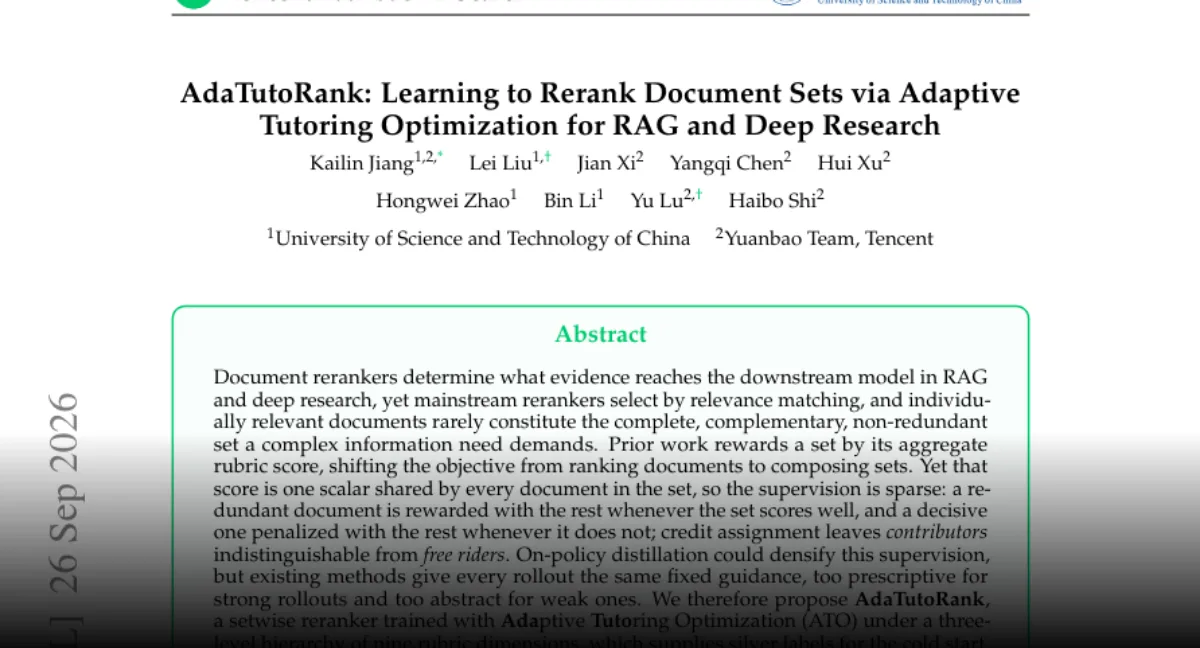
Document rerankers in retrieval-augmented generation (RAG) and deep research systems decide which retrieved passages reach the downstream model. AdaTutoRank is a proposed setwise reranker that aims to improve that decision by giving each generated candidate set more precise training feedback. Its core idea is to treat evidence selection as a set-composition problem rather than a simple list of relevant documents, a shift that could matter whenever a complex question needs several pieces of information to work together.
Background: RAG rerankers moved from relevance filters to evidence bundles
Commonly, mainstream rerankers operate as relevance filters. They score documents one by one and return the items that look most related to a query. That approach is efficient, but it can fail when a user needs a complete answer. A strong evidence set is not just a pile of matching passages. It should cover different facets, support the answer without contradiction, and avoid repeating the same point.
Individually relevant documents rarely form the whole, complementary, non-redundant package that a complex information demand requires. A RAG system that returns several highly relevant but overlapping paragraphs may still miss the missing step needed to answer the question.
Development: Set scores created sparse credit signals
Earlier setwise reranking methods moved the objective from ranking documents to composing sets. They judged the final collection with an aggregate rubric score. This was conceptually useful because it aligned the reward with the actual goal: a good answer needs a good bundle of evidence.
But that bundle-level score is a single number shared by every document in the set. The training signal therefore becomes sparse. If the set receives a high score, even a redundant document gets credit. If the set receives a low score, even a crucial document gets penalized. The result is a credit-assignment problem in which useful contributors and free riders are hard to separate.
On-policy distillation offered a way to make the supervision denser by guiding the model's own generated rollouts. The difficulty is that existing guidance often gives every rollout the same fixed instruction. For a strong rollout, that guidance can be overly prescriptive. For a weak rollout, it can be too abstract to act on.
Progress: AdaTutoRank matches tutoring hints to rollout difficulty
AdaTutoRank responds with Adaptive Tutoring Optimization (ATO), a training framework built around a three-level hierarchy of nine rubric dimensions. The rubric system is designed to serve three roles at once. It provides silver labels for the cold start, rewards for reinforcement learning, and hints for distillation.
The adaptive part comes from three hint forms with increasing specificity, all generated from a frozen snapshot of the policy. The first form uses the rubrics alone. The second asks a self-selector to build a sibling set under the same rubric structure. The third asks a self-reflector to compare the current rollout with that sibling set and produce a reflection.
Each rollout then receives the hint form matched to its difficulty. This is the central change: instead of one fixed teacher message for all attempts, AdaTutoRank selects a level of guidance that is concrete enough for weak attempts but not overly restrictive for strong ones.
What to watch: Evidence quality remains the next test
The proposal matters because rerankers sit at the boundary between retrieval and reasoning. If setwise training can separate contributors from free riders, RAG and deep research systems may become better at assembling evidence for multi-step questions, where missing one document can invalidate an otherwise relevant set.
For now, the main open question is how well this design translates into measurable evidence quality in practical retrieval workloads. The method's nine rubric dimensions, three hint levels, and rollout-matched tutoring need evaluation on real queries, downstream answer quality, and redundancy control. Independent testing will show whether AdaTutoRank's adaptive supervision changes the usual tradeoff between set-level scoring and per-document credit.
Comments
No comments yet. Be the first to comment.