
Accelerate Benchmark evaluates agents that optimize programs at the application level.
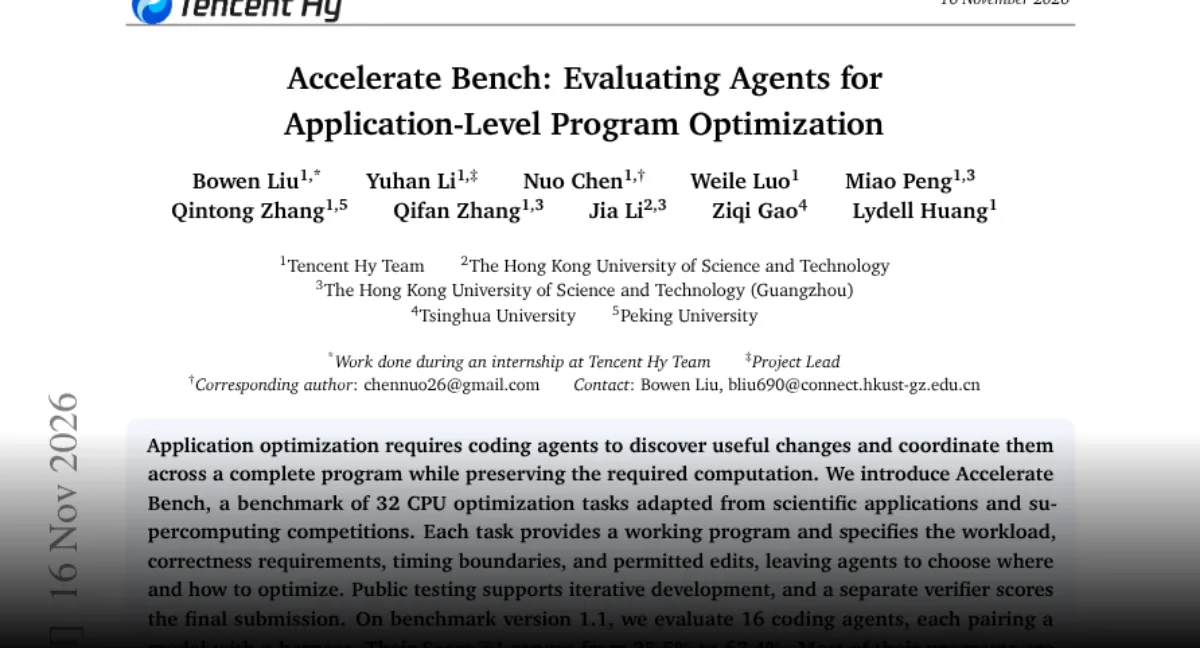
Accelerate Bench tests coding agents on 32 scientific CPU apps, requiring whole-program optimization within eight hours while preserving correctness.
Key Takeaways
- Accelerate Bench evaluates coding agents on whole-application CPU optimization across 32 scientific workloads in 8 application areas.
- Agents must improve complete programs within an 8-hour budget while preserving correctness, with final scoring based on hidden verifier rebuilds.
- Of 16 evaluated agents, two leading results achieve at least 2x speedups on 22 or more of the 32 tasks.
- The benchmark emphasizes that application-level coordination matters because build, runtime, and optimization choices interact.
- Tasks and results are available through Harbor Hub and Hugging Face, leaving the benchmark open for community validation.
Meta description: Accelerate Bench evaluates 16 coding agents on 32 scientific CPU workloads across 8 application areas to test application-level program optimization.
Tags: Accelerate Bench, coding agents, scientific computing, CPU optimization, Hugging Face
Featured image: abstract CPU optimization grid with no real people, no company logos, and no text.
The Hugging Face community has been introduced to Accelerate Bench, a benchmark for evaluating coding agents on application-level program optimization. The project matters because it moves beyond isolated code edits and asks an agent to improve a complete CPU application while keeping its result correct. For readers comparing agents, that changes the question from whether a model can write plausible code to whether it can coordinate build settings, runtime behavior, optimization choices, and correctness checks within a fixed budget.
Background: From Code Snippets to Whole Applications
The benchmark frames coding-agent progress as a whole-application problem. It covers 32 scientific workloads across 8 application areas. The named applications include GROMACS, OpenFOAM, and Quantum ESPRESSO. Each task gives an agent a working program, a fixed workload, correctness requirements, and a compute budget. The agent then has eight hours to decide where and how to optimize.
This setup separates useful optimization from simple code rewriting. A faster version that changes the scientific result fails the task, while an agent that only explores local source edits may miss gains that depend on build or runtime choices. The 32 workloads therefore test whether an agent can operate on an application as a system, not merely on a snippet.
Development: Public Tests, Hidden Inputs, and a Separate Verifier
The evaluation process has two layers. Public tests are provided to support iterative development, so an agent can revise its optimization plan while working. At the end, a separate verifier rebuilds the final submission, checks hidden inputs, and measures runtime against the original program. A speedup only counts if correctness survives. This design keeps the final score tied to a rebuilt, verified submission rather than to tests that an agent can see and tailor throughout the eight-hour window.
Latest Progress: 16 Agents Evaluated and Two Leading Results
16 coding agents have been evaluated on the benchmark. The two leading agents achieve at least 2× speedups on 22 or more of the 32 tasks. Controlled experiments are used to explain why application-level coordination matters. The same source code can perform very differently under different build and runtime settings. The benefit of one optimization can also depend strongly on another, so isolated improvements do not always add up.
The release is split across two access points. 31 tasks are available directly through Harbor Hub, while all 32 tasks are available through the full release on Hugging Face. The project site is https://acceleratebench.com/, the dataset is https://huggingface.co/datasets/AdAstraAbyssoque/accelerate-bench, and the Harbor Hub entry is https://hub.harborframework.com/datasets/accelerate-bench/accelerate-bench.
The project invites evaluations, reproductions, and discussion from the community. That leaves Accelerate Bench at an open validation stage: the benchmark, dataset, and agent results are available, but the wider community can still test whether the leading 2× speedups on 22 or more tasks are reproducible across the 32 scientific workloads.
Comments
No comments yet. Be the first to comment.