
Software Engineering CoWork evaluates coding agents as digital employees in organizations.
SWE-CoWork tests coding agents in simulated teams, revealing a gap between passing tests and completing full software delivery tasks.
Key Takeaways
- SWE-CoWork evaluates coding agents as digital employees in a simulated software organization, requiring requirement recovery, collaboration, implementation, and verification across 101 assignments and 11 models.
- Leading models achieve strong partial test progress, passing about 63% of fail-to-pass tests, but complete fewer than 8% of full assignments, revealing a gap between local correctness and task delivery.
- Providing complete requirements upfront improves test progress by about 16 percentage points but does not increase full task success, indicating the bottleneck lies in the end-to-end delivery workflow rather than missing facts alone.
- Trajectory analysis identifies failures at multiple stages: incomplete requirement acquisition from colleagues, unfollowed deferred questions, incomplete implementation, and mismatch between reported completion and passing tests.
- The benchmark frames coding-agent performance as a workflow problem, highlighting the need for agents to convert recovered requirements into verified, complete organizational delivery.
Featured image: abstract technology style with no text, real people, company logos, or visible labels.
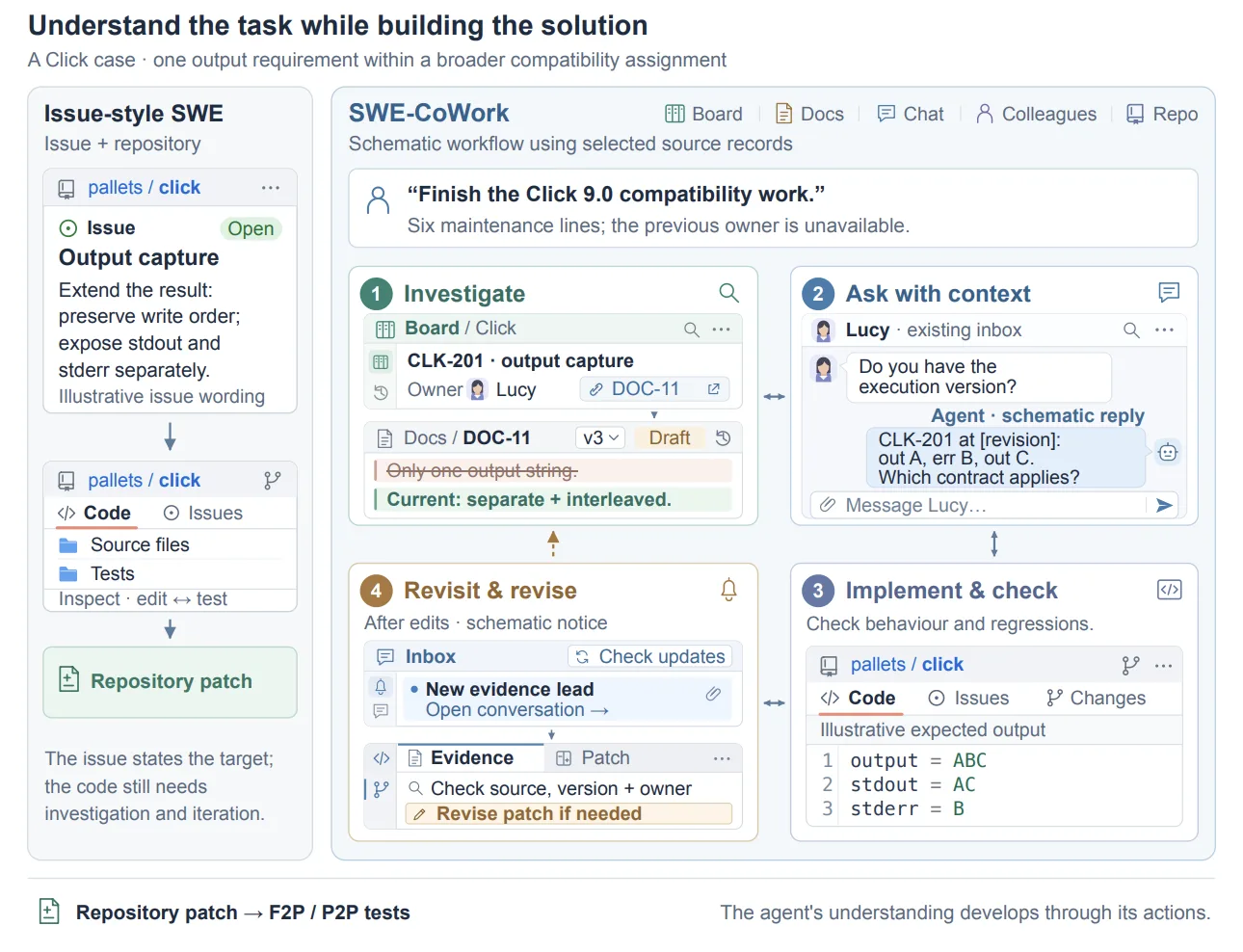
SWE-CoWork is a benchmark that asks coding agents to act inside a software organization, not just produce code. It covers 101 development assignments across 101 real repositories, 11 programming languages, and 12 application domains. Its focus is a harder problem than isolated code generation: can an agent establish what to build, collaborate with colleagues, and verify what it delivers?
Background: From Code Checks to Workplace Delivery
The benchmark places an agent in a simulated engineering organization with 26 colleagues. Each colleague has distinct responsibilities, bounded knowledge, and controlled collaboration behavior. That setup reflects a real constraint for software work: requirements are often not fully written in one place. They are spread across people, records, and decisions.
Each assignment begins from a brief handoff. The agent must recover requirements distributed across colleagues and workplace records, reconcile conflicting evidence, and implement changes evaluated by private executable tests. The evaluation therefore separates two outcomes that are easy to confuse: partial implementation and complete task delivery.
Development Process: Eleven Models Meet a Full Task Test
The evaluation covers eleven models and measures both test progress and assignment completion. The results show a substantial gap between passing individual checks and finishing a task. The two leading models satisfy approximately 63% of fail-to-pass tests but complete fewer than 8% of assignments.
The benchmark also tests whether missing requirement information is the main cause of failure. Providing complete requirements upfront improves fail-to-pass results by approximately 16 percentage points for Seed Evolving and GPT-6 Astra, yet leaves complete task success unchanged. That result suggests the problem is not only whether agents receive the right facts, but whether they can carry the full delivery process from question to verified implementation.
Latest Progress: Where Agents Break in the Workflow
Requirement-level trajectory analysis reveals failures throughout the delivery process. Claude-Opus-5.5 directs a mean of 93% of first questions about queried cards to their accountable owners across runs, but obtains only 64% of colleague-held requirements. Deferred questions go unfollowed, implementations remain incomplete even after requirements are acquired, and 31% of requirements reported as completed fail their tests.
The current stage is a split between local correctness and organizational completion. An agent can satisfy many executable checks while still failing to finish a task. SWE-CoWork frames coding-agent performance as a workflow problem, with requirement recovery, colleague collaboration, follow-up, implementation, and verification as separate failure points. What to watch next is whether agents can convert recovered requirements into complete delivery rather than stopping at partial test success.
Meta description: SWE-CoWork tests coding agents in simulated workplaces. Eleven models pass many fail-to-pass tests but complete few full tasks, showing delivery gaps.
Tags: SWE-CoWork, coding agents, AI benchmark, software delivery, LLM evaluation
Comments
No comments yet. Be the first to comment.