
SPILLWAY defends tool-using agents against prompt injection by separating target admission from sanitization.
SPILLWAY 1.0.0 blocks prompt injection by checking AI agent tool calls, reporting zero in-scope attack successes and 48.9% utility under attack.
Key Takeaways
- SPILLWAY 1.0.0 protects tool-using AI agents from prompt injection by separating target admission from sanitization and checking each tool call before it reaches a tool.
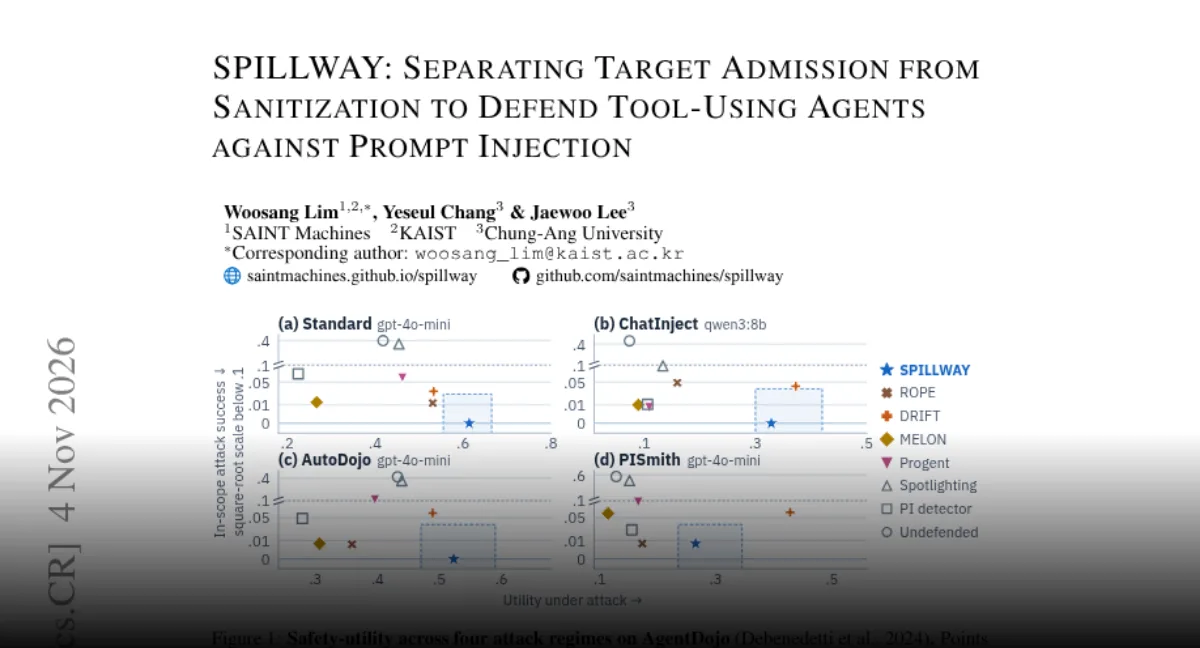
- In AgentDojo evaluation, it reports 0 in-scope attack successes across all 12 backbone-by-suite cells while retaining 48.9% mean utility under attack, better than the next-best compared defense.
- Its core policy is deterministic and lightweight: addresses, accounts, or URLs are admitted only if they appear in the user request or typed read-only tool fields, and free-text-only targets are refused unless explicitly delegated.
- The optional local judge adds low cost—0.19–0.39 model calls per episode and at most about 500 ms task overhead—without rerunning the backbone agent, and the release includes integration recipes for common agent frameworks.
- Stronger attack tests also show near-zero leakage, except a 0.5% mean in-scope success against the PISmith RL attacker, indicating the guard is not simply refusing most legitimate tasks.
!Abstract technology style AI agent safety guard filtering tool calls
Meta description: SPILLWAY 1.0.0 reports zero in-scope attack success across 12 AgentDojo cells and 48.9% mean utility under attack, using real-time tool-call checks.
Tags: SPILLWAY, AI agent security, prompt injection, AgentDojo, tool-call safety
SPILLWAY 1.0.0 is a real-time safety guard for AI agents, and its release record puts it at the top of the AgentDojo comparison for prompt-injection defense: 0 in-scope attack successes across all 12 backbone-by-suite cells, with 48.9% mean utility under attack. The next best utility under attack in that comparison is 45.3%. The practical point for readers evaluating agent tooling is that the guard tries to stop an action before it reaches a tool, instead of filtering only the prompt text.
Background: Hidden Instructions Turn Agent Tools Into Risky Actions
AgentDojo tests defenses for agents that can call tools. A malicious instruction can arrive through an email, a web page, or another content source that the agent reads. If the agent treats that instruction as a task, it may be pushed to move files, send money, or contact an attacker-controlled account or URL. SPILLWAY targets that path by checking every tool call before it runs.
The guard admits a recipient, account, or URL when the value appears in the user's request or in a typed field returned by a read-only tool, such as the sender field of an email. If an address appears only in free text, such as the body of an email, SPILLWAY refuses it unless the user request delegates that address. The core check is a set lookup without a model call. An optional local judge can restore a refused call, but not one whose target came from injected text that the sanitizer removed.
Development: 0 of 2,847 Successes and the Utility Gap
The standard attack test covers 3 backbones across 4 suites with the judge on. In that setup, SPILLWAY reports 0 of 2,847 in-scope attack successes. The other six defenses in the seven-defense comparison leak somewhere in the 12 cells: ROPE leaks in 3, DRIFT in 7, MELON in 10, PI detector in 10, Progent in 11, and Spotlighting in 12.
Utility separates SPILLWAY from the field. Without attack, mean utility is 53.9%. Under attack, it remains 48.9%, while DRIFT falls to 45.3%, ROPE to 34.5%, and MELON to 31.4%. That pattern suggests the guard is not protecting only by refusing most tasks.
Stronger attack cases also appear in the release records. Against ChatInject's forged chat template, SPILLWAY reports 0 of 665 successes. Against AutoDojo, it reports 0 of 389. Against an attacker who sends the injected email, it reports 0 of 126. The PISmith released reinforcement-learning attacker is the exception in the summary: with gpt-4o-mini across four suites and attack success rate at 1, it produced 0.5% mean in-scope attack success, or 4 of 949, at 25.7% utility.
Latest Progress: Frontier Router, Cost, and 1.0.0 Artifacts
The latest 1.0.0 material also compares SPILLWAY against a frontier router. On 7 suites from AgentDojo and AgentDyn, using a gpt-4o-mini agent, SPILLWAY keeps zero in-scope attack success and more utility than ROPE on every suite. ROPE routes through its authors' Claude Opus 4.8 and leaks on 3 suites.
Cost is another part of the story. The optional judge is a local 4-bit Gemma 4 31B that checks selected calls. On benign qwen3:8b Workspace and Slack episodes, SPILLWAY adds 0.19 to 0.39 model calls per episode, including the judge, which is 13 to 50 times fewer than MELON, Progent, and DRIFT. The average task-time addition is at most 500 milliseconds compared with the undefended agent, while those three defenses add 1,600 to 10,500 milliseconds. No defense step re-runs the backbone.
The AgentDojo results use code released as spillway-guard 1.0.0. The comparison defenses, the AgentDyn portion of the router comparison, and the cost study retain their original measurements. The repository includes recipes for LangChain and LangGraph, the OpenAI Agents SDK, any MCP host, and Claude Code hooks. On the project page, a recorded Slack episode shows SPILLWAY as the only one of eight runs that posts the reply the user asked for without sending the injected link.
The paper is at https://arxiv.org/abs/2611.07222, per-cell records are at https://github.com/saintmachines/spillway, and the project page is at https://saintmachines.github.io/spillway/. The package installs with pip install -U spillway-guard. The current stage is the 1.0.0 release itself: it presents the standard AgentDojo grid, the stronger attack cases, the frontier-router comparison, the cost study, and the integration recipes as the published record.
Comments
No comments yet. Be the first to comment.