
Moving Beyond Timestamps: On-Policy Distillation Aligned with Decisions for Long-Horizon Agents
AlignOPSD moves distillation from timestamps to functional decision spans, using credit assignment to improve long-horizon agent training.
Key Takeaways
- AlignOPSD improves on-policy distillation for long-horizon agents by aligning supervision with functional decisions rather than isolated timestamps.
- Step-level or timestamp-based supervision can miss the real decision because agent behavior often spans multiple observations, actions, and environment responses.
- The framework introduces hierarchical credit assignment over decision spans to identify which earlier actions deserve responsibility for later outcomes.
- It showed consistent gains on interactive agent benchmarks, though further details on span identification, implementation, and broader validation are still needed.
Meta description: AlignOPSD improves on-policy distillation for long-horizon agents by aligning supervision with functional decisions and credit assignment over decision spans.
Tags: AlignOPSD, on-policy distillation, long-horizon agents, agent supervision, AI training

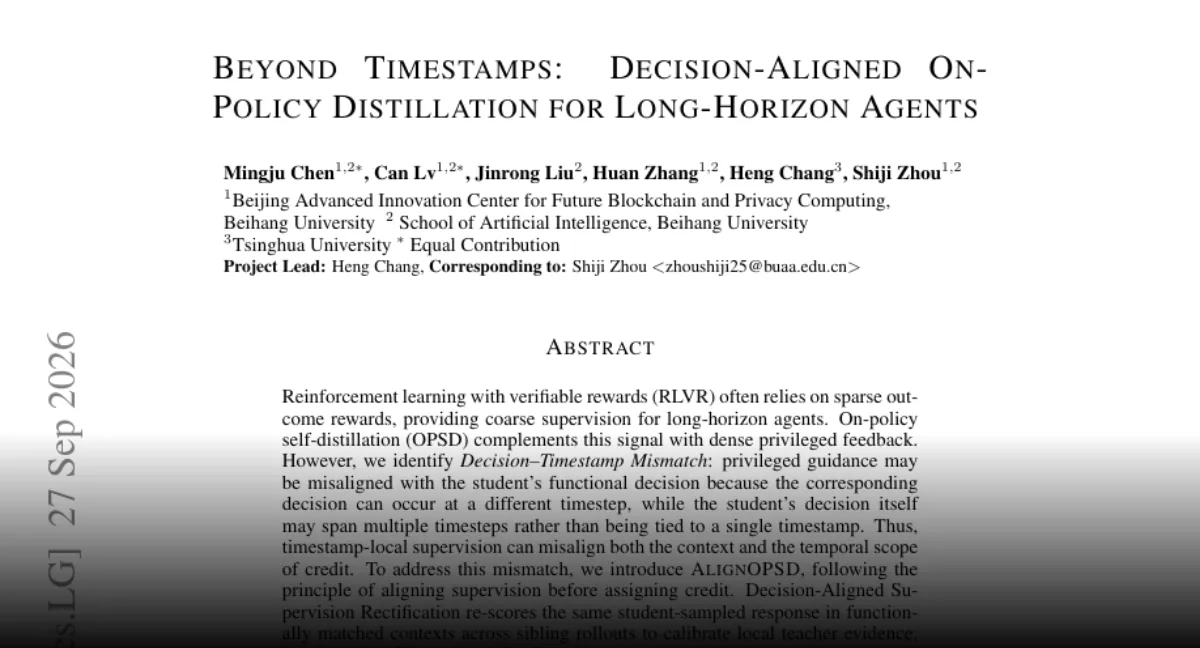
AlignOPSD is a framework introduced to improve on-policy distillation for long-horizon agents. The proposal matters because agent training is usually measured step by step, while many agent behaviors only become meaningful across a chain of observations, actions, and environment responses. In that setting, a timeline can be aligned while the underlying decision is not.
Background: Why Step-Level Supervision Can Miss The Real Decision
Long-horizon agents operate over extended tasks. They may read information, plan, call tools, wait for feedback, revise a choice, and continue until a goal is completed. In this setting, a single timestamp may be too small a unit for learning. A model might be rewarded or penalized at the wrong moment because the useful part of its behavior spans several consecutive steps.
On-policy distillation is a training pattern in which one model learns from another while following the states it itself visits. The teacher provides guidance on the student's own trajectory, which can make the training signal more relevant than offline imitation. But the gap identified in the new framework is that assigning supervision based on timestamps does not guarantee that the supervision falls on the decision that actually mattered.
Development Process: From Timestamps To Functional Decision Spans
AlignOPSD addresses that mismatch by changing the unit of supervision. Instead of treating every step as an isolated learning target, it first aligns supervision with functional decisions. A functional decision is the part of the trajectory where the agent's behavior has a meaningful effect, not merely the clock position where a token or action appears.
The framework then applies hierarchical credit assignment over decision spans. Credit assignment is the process of deciding which earlier actions deserve responsibility for a later outcome. In long-horizon tasks, that process can be complicated because one successful result may depend on several actions at different levels: a broad plan, a subgoal, and a specific tool call.
By moving beyond timestamp-level alignment, AlignOPSD aims to create more reliable training signals. The goal is to place learning pressure where the agent's choices have functional impact, rather than where the trajectory happens to be recorded.
Latest Progress: Tested On Interactive Agent Benchmarks
The framework was evaluated on several interactive agent benchmarks and showed consistent improvements over existing baselines. The benchmarks described in the source are not named, but they are associated with agents that act through multiple turns or environment interactions rather than single-response generation.
That evaluation matters because it places the method in the same setting that motivated it: interactive tasks with delayed consequences. If a distillation method only helps on short prompts, it may not improve agent behavior when outcomes depend on a longer chain of steps. The reported consistent gains suggest that aligning supervision with functional decisions and assigning credit across spans can improve training outcomes in those settings.
Current Stage: A Method Shift, Not Yet A Fully Detailed Training Recipe
At present, AlignOPSD is best understood as a framework for restructuring how supervision is distributed during on-policy distillation. It does not introduce a new benchmark, a named model family, or a product in the source material. Its contribution is conceptual and procedural: first define where functional decisions occur, then assign credit across those spans.
The next useful signal for this line of work will be more public detail about how functional decision spans are identified, how the hierarchical credit assignment is implemented, and whether the gains hold across different agent tasks and model sizes. Until those details are available, the main takeaway is narrower: timestamp-based supervision can be a useful starting point, but it is not automatically decision-based supervision.
Comments
No comments yet. Be the first to comment.