
Cable Dynamics Prediction via Physical Attention Bias
Physical attention biases help learned cable simulators: arc length captures elasticity, Euclidean captures contact, and split heads improve results.
Key Takeaways
- In learned cable simulators, the distance metric used to bias global attention strongly affects prediction accuracy.
- Arc-length along the cable better captures elastic forces and generalizes more effectively to unseen cables.
- Using arc-length bias reduces prediction error by 15% and more than halves segment-length drift in a constrained setting.
- Splitting arc-length and Euclidean distance biases across attention heads gives best or near-best performance.
- The key design principle is to match the physical distance signal to the force being modeled, rather than relying on a single global metric.
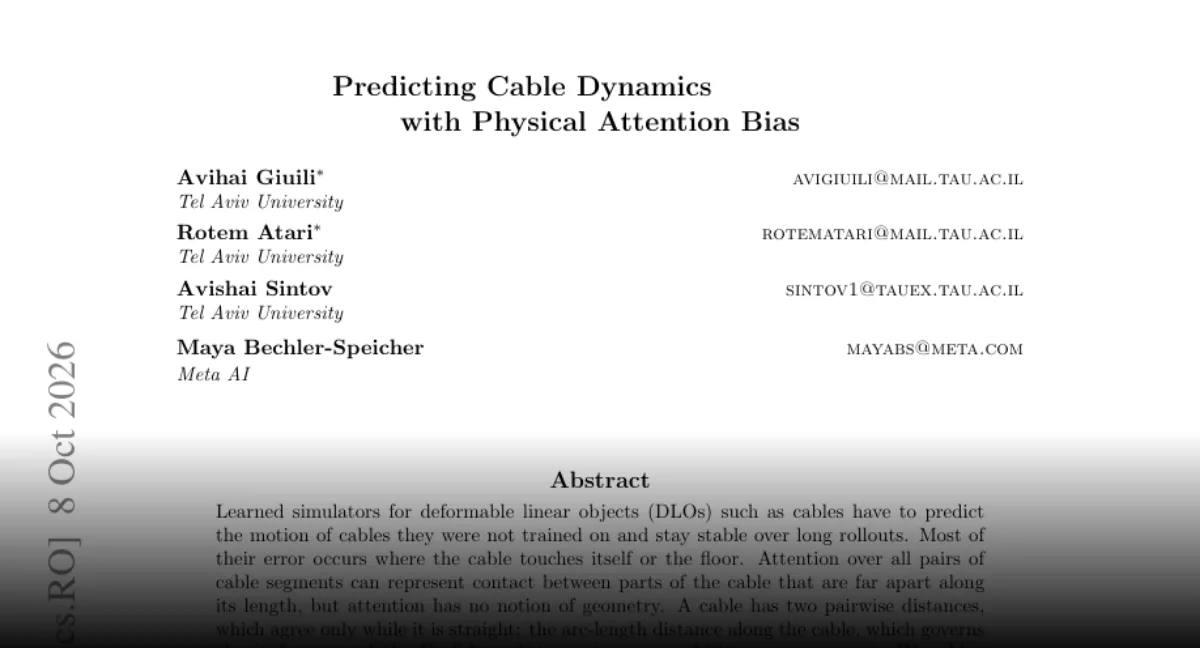
A research study on learned cable simulators has found that the choice of distance metric used to bias global attention significantly affects prediction accuracy. The work compares two candidates: arc-length along the cable, which governs elastic forces, and Euclidean distance in space, which governs contact. The findings show that a physically grounded attention bias generalizes better to cables the model has never seen during training.
Background: Why Distance Metrics Matter in Learned Simulators
Learned simulators for deformable objects like cables must capture two distinct physical phenomena. Elastic forces propagate along the cable's own length, following its curved path through space. Contact forces depend on straight-line proximity between points that may be far apart along the cable but close in space. A global attention mechanism needs a distance signal to decide which segments influence each other. The study tests whether that signal should reflect the cable's intrinsic geometry or the surrounding spatial geometry.
Key Results: Arc-Length Bias Reduces Error and Drift
The most striking result appears in a constrained setting where attention is the only path connecting distant segments. Under that condition, the arc-length bias cuts prediction error by 15% and more than halves segment-length drift. Splitting both distance types across attention heads performs best or near-best on every evaluated metric, suggesting that neither distance alone captures the full physics. The study reports these outcomes as improvements on unseen cables, indicating the benefit is not tied to memorization of training configurations.
What to Watch Next
The code and per-run records are available at https://github.com/avihaig/dlogps. The dataset and checkpoints are described as coming to the Hub. For researchers building learned simulators for ropes, sutures, or tethered systems, the result points to a design principle: encode the physical distance that matches the force being modeled, and consider distributing competing distance signals across attention heads rather than choosing one globally.
Comments
No comments yet. Be the first to comment.