
Language Models Exhibit Self-Preservation Behavior.
Qwen study shows Task Banks and generated replay can reduce forgetting beyond listed tasks in continual tuning, but fixed budgets limit gains.
Key Takeaways
- Continual learning can still cause models to forget unlisted capabilities, so the study explores whether Qwen models can help preserve their own knowledge using Task Banks and generated replay.
- Forgetting is shaped by both the new task and the learning rate, and average accuracy can hide losses in specific prior skills.
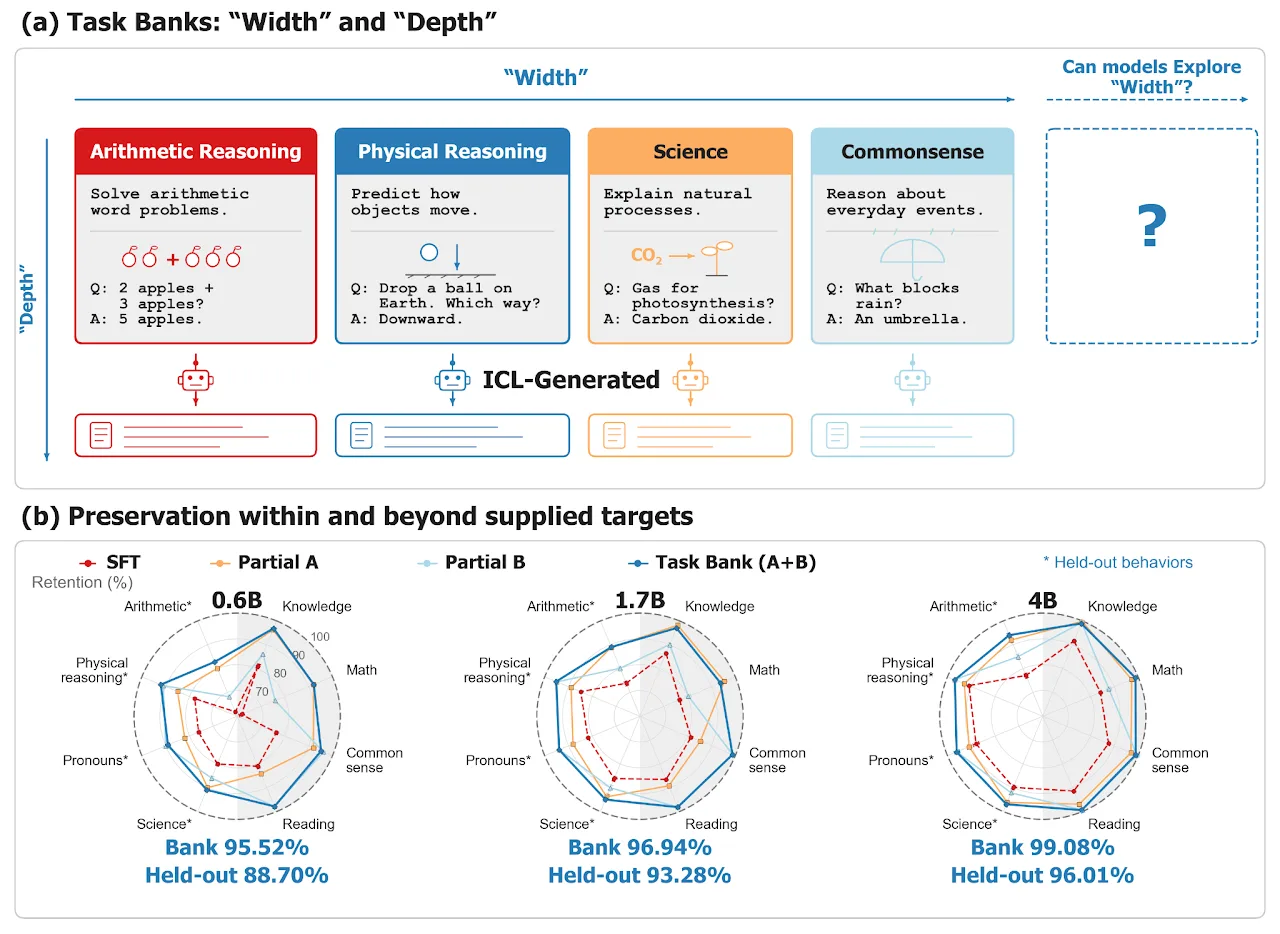
- Generated replay reduces forgetting beyond the selected Task Bank, and combining partial banks improves mean retention across different Qwen model sizes.
- Task-informed target selection can improve held-out preservation at 4B without hurting new-task performance, but fixed example budgets create a trade-off between preserving old skills and learning new ones.
- The work does not solve continual learning, but it establishes a measurable path where frozen Qwen models can generate useful replay to support broader self-preservation.
Title: Qwen Continual Learning Study Shows Task Banks Can Aid Model Self-Preservation
Meta description: A Qwen study examines continual instruction tuning with Task Banks, showing generated replay can reduce forgetting and guide preservation targets.
Tags: Continual Learning, Qwen, Task Banks, Replay Generation, Model Preservation
Featured image: Abstract technology style showing a network of task cards and a model preserving earlier capabilities; no real people, no company logos, no text.
Background: The Preservation Gap in Continual Learning
Continual learning seeks to adapt pretrained models while preserving prior capabilities. In practice, a fine-tuning job is often given a small set of preservation tasks, but those tasks cover only part of what the model already knows. A model can therefore forget skills outside the supplied list, even when it appears to retain the tasks used during training. This gap makes the problem larger than simply passing a short checklist of old tasks.
Recent work created a new opening for this problem. Language models can produce replay material, synthetic examples that stand in for earlier tasks, without needing access to their original training data. That raises a self-preservation question: can the model help choose the targets whose replay will protect its broader capabilities?
Development: Task Banks and Frozen Qwen Models
The study turns this question into an experiment. It organizes task descriptions and examples into Task Banks. Each entry in a Task Bank can be selected and combined to guide replay generation by a frozen model. The frozen model is not retrained to invent the bank; instead, it uses the selected entries as prompts to create replay for preservation.
The researchers then apply continual instruction tuning to Qwen models of varying sizes. The setup compares how much new learning causes prior capability loss, how different preservation targets affect forgetting, and whether generated replay can reduce damage beyond the tasks explicitly included in the bank.
Latest Findings: Three Signals From Instruction Tuning
The first finding concerns the shape of forgetting. The new task and the learning rate together determine which prior capabilities degrade. Average accuracy alone can miss that pattern. Tracking previously correct answers reveals losses that the overall score can conceal, because a model may still perform well on broad measures while dropping specific skills it used to pass.
The second finding supports replay as a practical mitigation. Generated replay reduces forgetting on tasks outside the Task Bank. This matters because it suggests the preservation effect is not limited to the examples selected for replay. Combining partial banks also improves mean retention over using either bank alone, and that improvement appears across the tested Qwen sizes.
The third finding addresses the self-preservation question more directly. The model can help choose preservation targets that protect its own capabilities more broadly. When selection is informed by the new task, mean held-out retention improves over random selection at 4B, while the model still achieves similar new-task gains. Under a fixed example budget, however, replacing new-task examples with replay reduces the new-task gain, showing that preservation choices carry trade-offs.
Current Stage: A Measured Path Toward Broader Preservation
At this stage, the work does not claim that Task Banks solve continual learning. It establishes a measurable route: frozen Qwen models can generate useful replay, partial bank combinations can improve mean retention, and task-informed selection can improve held-out preservation at 4B without giving up comparable new-task performance. The remaining tension is budget: more replay can protect older capabilities, but under fixed example limits it may reduce the benefit of new learning.
Comments
No comments yet. Be the first to comment.