
The agent harness is self-evolving.
Harness-RSI explains self-evolving agent systems that turn feedback into persistent changes, with selection, activation, attribution, improvement.
Key Points
- Harness-RSI studies how AI agents improve from experience by modifying the harness (instructions, memory, tools, workflows, and runtime logic) around a fixed base model, turning execution feedback into persistent changes rather than one-off results.
- It separates update targets into two types: interpreted components (instructions, memory, workflow specs) and executable components (tools, runtime logic), and analyzes them through evolutionary algorithms and PAC learning theory for continual learning.
- The evaluation framework distinguishes four claims behind any reported gain: selection (whether the estimate accounts for search effects), activation (whether the update actually operated in scored runs), attribution (whether it caused the difference under controlled conditions), and improvement (whether gains hold beyond the originating tasks).
- Harness-RSI covers applications across five domains—personal assistance, enterprise automation, scientific discovery, robotics, and public services—and identifies five effect areas: productivity, economic distribution, innovation and public services, privacy and security, and institutional governance.
- Future work focuses on update algorithms, supporting infrastructure, evaluation methods, and responsible deployment, aiming to make self-evolution measurable, reliable, and governed rather than merely demonstrable.
Meta description: Harness-RSI explains self-evolving AI agent harnesses by turning execution feedback into changes, with selection, activation, attribution, and improvement.
Tags: Harness-RSI, self-evolving AI agents, harness evolution, execution feedback, continual learning
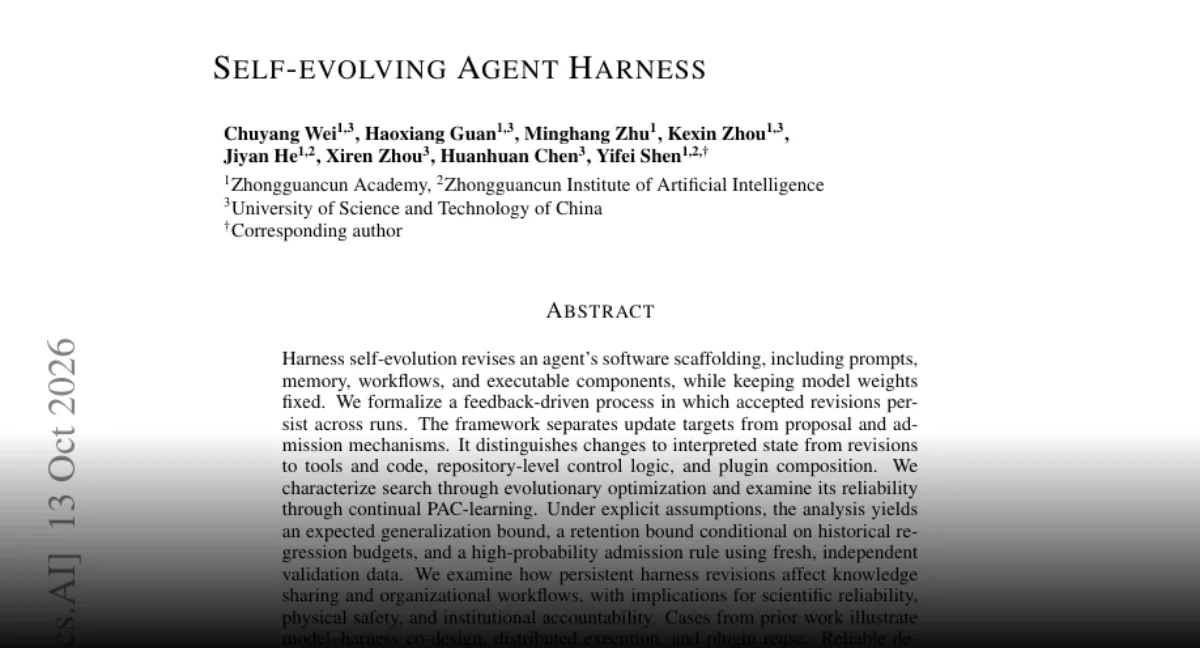
Featured Image: Abstract technology style, no real people, no company logos, no text, showing feedback loops around a fixed base model.
Harness-RSI describes a unified way to study how artificial intelligence agents improve from experience by changing the surrounding system around a fixed base model. Building agents that learn from experience is a central goal of artificial intelligence, and harness self-evolution offers a path toward that goal. The framework matters because it turns execution feedback into persistent harness changes, not just one-off task results.
Starting point: experience needs a changing harness
The starting point is the gap between a fixed base model and agents that must learn from experience. Harness self-evolution addresses that gap by adapting the system around the fixed base model. In this view, the harness is the structure that carries instructions, memory, workflow specifications, executable tools, and runtime logic. Harness-RSI organizes these elements as the update targets of self-evolving agent systems.
Development process: feedback becomes persistent change
The development stage asks how execution feedback produces persistent harness changes. The framework separates two kinds of update targets. The first includes instructions, memory, and workflow specifications interpreted by fixed components. The second includes executable tools and runtime logic. The comparison focuses on how algorithms propose changes and admit changes. A proposal may edit the text that a fixed component reads, or it may change the tools and runtime logic used by the agent system.
The theoretical analysis places harness evolution within evolutionary algorithms and draws on PAC learning theory for continual learning. Those lenses give design insights: harness updates can be viewed as variation and selection over components, while PAC learning theory for continual learning informs algorithm design.
Evaluation stage: four claims behind a reported gain
The evaluation stage separates four claims hidden inside a reported gain. Selection asks whether the estimate is independent of the search or accounts for selection. Activation asks whether the accepted update operated in the scored runs. Attribution asks whether it caused the difference under controlled evaluation conditions. Improvement asks whether the difference holds beyond the tasks that produced it.
The reviewed protocols show that held-out performance, component use, and retained gains require different evidence. A gain on held-out tasks may show improvement, but it does not automatically show activation. A component may be used in a run, but that does not prove it caused the observed difference. A search process may find a strong candidate, yet the estimate can reflect selection effects if it does not account for selection.
Applications and effects across five domains
Harness-RSI covers applications in personal assistance, enterprise automation, scientific discovery, robotics, and public services. These five domains show why persistent harness changes matter beyond isolated tasks. The framework also brings five broad effect areas into view: productivity and skills, economic distribution and market structure, innovation and public services, privacy and security, and institutional governance.
These effects connect to how updates are proposed, admitted, and evaluated. When a system can change instructions, memory, workflows, tools, or runtime logic, the practical question is not only whether it performs better. It is also whether the change is active, attributable, and durable beyond the tasks that produced it.
Current stage: separating promising changes from durable gains
The future directions identified in Harness-RSI are update algorithms, supporting infrastructure, evaluation, and responsible deployment. Those four areas point to the next stage of work: making self-evolution measurable, reliable, and governed rather than merely demonstrable. The project repository is available at https://github.com/zgcagi/Harness-RSI.
For now, Harness-RSI frames harness self-evolution as a structured approach to learning from experience. The field remains at a stage where evidence must distinguish selection from activation, attribution from improvement, and retained gains from task-specific differences.
Comments
No comments yet. Be the first to comment.