
AI agents discover better solutions after their chat history is cleared.
AI agents can get stuck refining weak solution zones in long tasks. Fork-and-Flush forks workspaces and clears chat history, raising scores to 0.78.
Key Takeaways
- During long-running tasks, AI agents using GPT-5.6-terra and GPT-5.5 can become trapped in narrow “idea basins,” spending compute to refine weak solutions instead of exploring stronger paths.
- The proposed Fork-and-Flush method creates parallel branches that inherit the workspace and generated files but clear the chat history, allowing agents to start fresh conversations while preserving prior work.
- Across 13 long-running tasks, Fork-and-Flush raised the min-max-normalized average score to 0.78, compared with 0.47 for single runs and 0.54 for best-of-4, while also reducing score variance.
- Tests with Qwen3.5 models show that performance variation is highest on tasks near the edge of a model’s ability, suggesting that context resets may remain useful even as stronger models emerge.
Meta description: Cai, Ziakas et al. (2026) test Fork-and-Flush on GPT-5.6-terra and GPT-5.5, lifting scores to 0.78 across 13 long-running tasks, with Qwen3.5 model tests too.
Tags: GPT-5.6-terra, GPT-5.5, Fork-and-Flush, Qwen3.5, GitHub Copilot CLI
Featured image: Abstract blue network map of clustered solution regions and branching search paths, in technology style, no real people, no company logos, no text.
A 2026 study by Cai, Ziakas et al. reports that agents running on GPT-5.6-terra and GPT-5.5 can become trapped in narrow zones of a problem’s solution space during long tasks. Their Fork-and-Flush method raises the min-max-normalized average score, scaled between observed extremes, to 0.78 across 13 long-running tasks. The result matters because long-running agents may burn compute polishing a limited approach while other runs have already found stronger paths.
Background: Agents cluster around idea basins
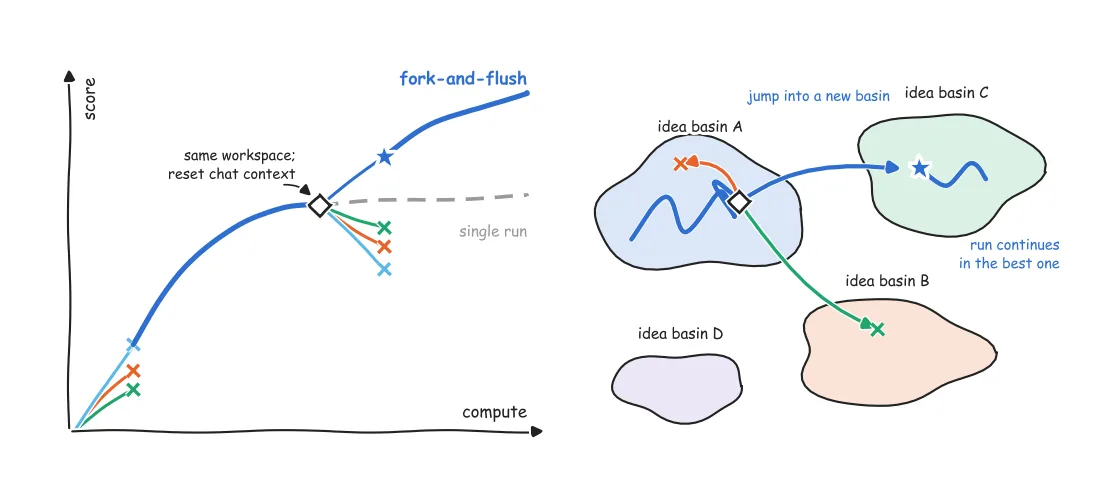
To visualize search behavior, the team projected solutions from every run onto a two-dimensional map, with nearby points representing similar results. Single-run solutions rarely spread far; they clustered in small zones the paper names idea basins. Instead of moving toward stronger approaches seen in other runs, the agents often used most of their remaining compute to refine work inside a low-yield zone. Periodically shrinking the conversation history did not stop the clustering.
Development: Fork workspaces, flush chat history
Fork-and-Flush adds two moves. Forking creates K parallel branches, where K is the number of branches, and each branch inherits the previous workspace and all generated files. Flushing removes the full chat context from each branch while keeping the workspace intact, so the branch can start a fresh conversation and continue from earlier work.
A branch that keeps the parent process’s chat context tends to drift back into the same idea basin because earlier reasoning steers its next steps. Fresh context restores diversity in the search. The conversation history is lost, but the code, files, and saved results remain in the workspace. In the study’s comparison, a single run, shown as a gray dashed line, keeps refining inside one basin. Fork-and-Flush starts parallel branches with fresh chat contexts, keeps the best branch, and discards the rest. One branch with fresh context moves into a different idea basin and achieves a higher score.
Latest progress: Higher scores and less variance
The method was tested on 13 long-running tasks, including polyomino packing, job-shop scheduling, and cryptanalysis. The tasks also included compressing a CIFAR classifier and optimizing a very long instruction word kernel. Individual runs lasted from several hours to over 100 hours. The agents used GPT-5.6-terra and GPT-5.5 through GitHub Copilot CLI.
On the same compute budget, Fork-and-Flush achieved a min-max-normalized average score of 0.78, compared with 0.47 for single runs and 0.54 for best-of-4. The paper reports relative gains of 66.0 and 44.4 percent, respectively. The method achieved the highest mean score on 12 of the 13 tasks. It also produced more consistent results, with normalized standard deviation falling to 0.16 from 0.26 for single runs. Simply clearing the chat context without branching improved results by 22 percent.
Current stage: Resets may stay useful as models improve
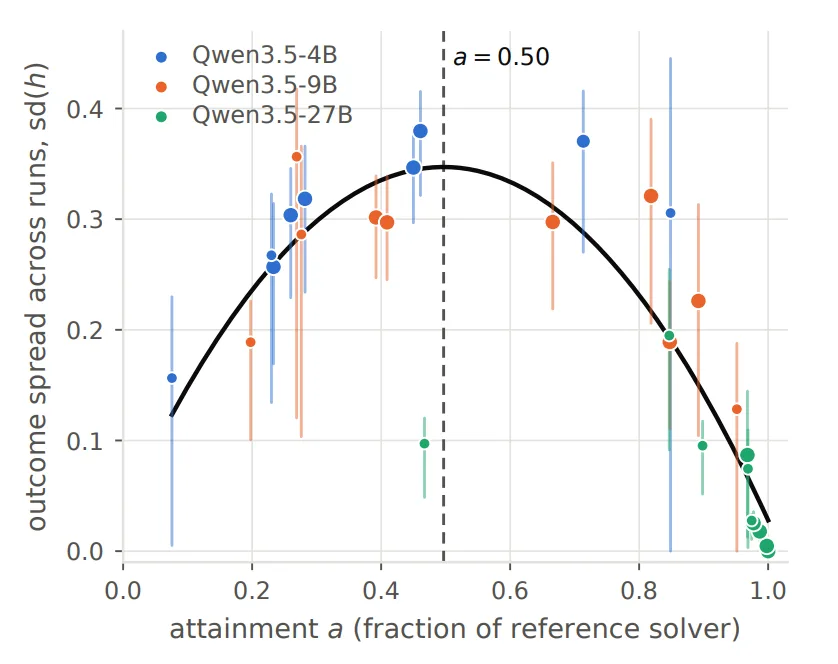
The team also examined whether stronger models avoid the clustering, using maximum 3-satisfiability (MAX-3-SAT) tasks across three model sizes: Qwen3.5-4B, 9B, and 27B. Variance between runs followed an inverted U-shaped curve, peaking on tasks at the edge of a model’s abilities, roughly halfway between random-guessing performance and the reference solver’s performance. Results vary most at the edge, with some runs succeeding and others falling well short. Models almost always succeed on very easy tasks and fail on very hard ones. This pattern held across all three model sizes tested.
The authors argue that open research problems sit, by definition, at the limits of models’ abilities. They expect the variation that Fork-and-Flush exploits to persist as models improve, with the boundary shifting toward harder problems. The results suggest that regular context resets could remain useful even for frontier research agents.
Comments
No comments yet. Be the first to comment.