
This Technical Report Covers Fish Audio Drama 3
Fish Audio Drama 3 offers open weights, voice cloning, text direction, revision, dubbing, editing, and streaming speech synthesis in one large model.
Key Takeaways
- Fish Audio Drama 3 is an open-source speech generation model that turns text into directed audio performances, combining voice cloning, natural-language direction, take-by-take revision, multi-character scenes, scene dubbing, infilling-based speech editing, long-form synthesis, and streaming audio in one model.
- It uses a 35B-parameter mixture-of-experts backbone with 3B active parameters per token, yet reports faster single-stream inference than Fish Audio S2: 271 frames per second on one H200 compared with 177 frames per second.
- The architecture pairs a hybrid linear-attention backbone with a codebook multi-token-prediction audio decoder, designed to support long audio contexts, coordinated frame-level prediction, revisions, and streaming output.
- Training includes a three-stage pre-training recipe, instruction fine-tuning, and large-batch reinforcement learning, using a single learned human-preference reward focused on perceived output quality.
- Weights and inference tools are publicly available through GitHub, Hugging Face, and SGLang-Omni, enabling local study, modification, and practical testing rather than closed black-box use.
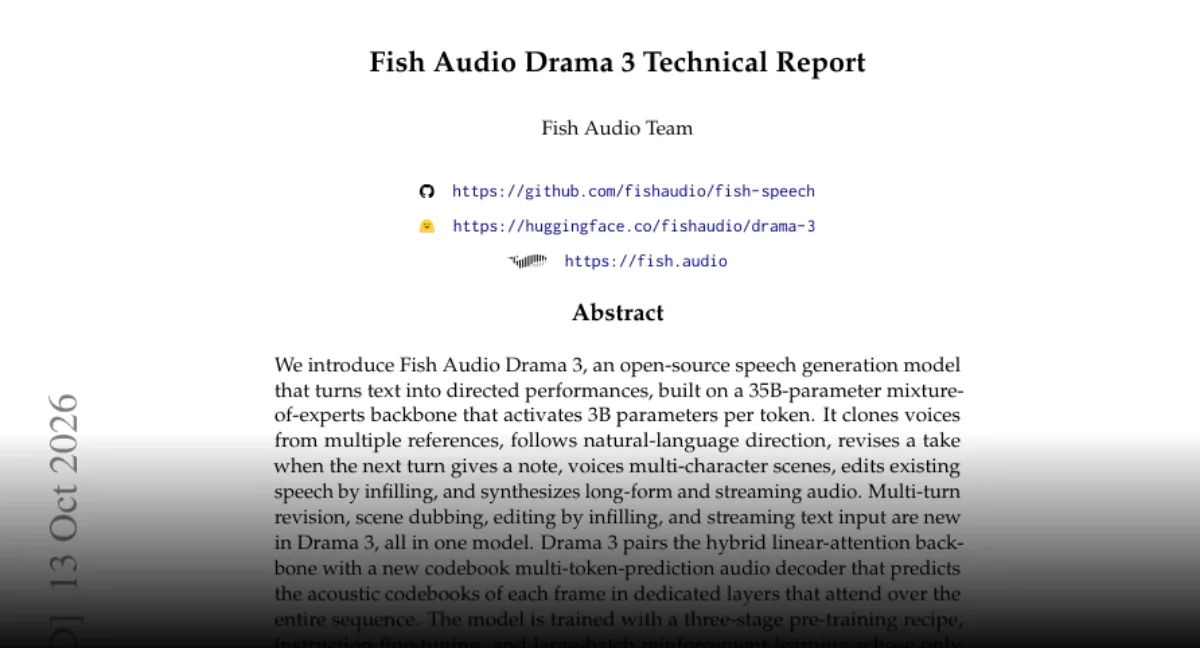
Fish Audio has introduced Fish Audio Drama 3, an open-source speech generation model that turns written text into directed performances. The model is built on a 35B-parameter mixture-of-experts backbone and activates 3B parameters per token. It brings together voice cloning from multiple references, natural-language direction, take-by-take revision, multi-character scene voicing, scene dubbing, speech editing by infilling, long-form synthesis, and streaming audio generation in one model. The release matters for readers who need speech systems that can be studied, modified, and run locally rather than treated as closed black boxes.
Background: A larger open speech model with a known speed reference
Fish Audio Drama 3 is presented as an open model from Fish Audio, and its inference speed is compared with Fish Audio S2. The comparison gives a concrete speed anchor: Fish Audio S2 decodes a single stream at 177 frames per second, while Fish Audio Drama 3 reaches 271 frames per second on one H200. That result is notable because Fish Audio Drama 3 has more than seven times as many parameters as the compared reference.
The model also expands the workflow it supports. Instead of focusing only on producing a single audio clip from text, it is designed to accept direction, revise earlier attempts, handle several characters, and edit existing speech. These capabilities are described as new in Drama 3 and are combined in one model.
Development: One model for direction, revision, dubbing, editing, and streaming
The core idea is a directed performance pipeline. Fish Audio Drama 3 clones voices from multiple references and follows natural-language direction. If a user provides a note in the next turn, the model can revise the previous take. It can voice multi-character scenes, support scene dubbing, and edit existing speech by infilling, meaning it can reconstruct missing or replaced portions while preserving the surrounding audio. It also synthesizes long-form and streaming audio, allowing streaming text input to be processed as it arrives rather than requiring a complete prompt before output begins.
The architecture pairs a hybrid linear-attention backbone with a new codebook multi-token-prediction audio decoder. The decoder predicts the acoustic codebooks of each frame in dedicated layers that attend over the entire sequence. This design is meant to support long audio contexts and coordinated frame-level prediction, which is useful for scenes, revisions, and streaming output.
Training is described as a three-stage pre-training recipe, followed by instruction fine-tuning and large-batch reinforcement learning. The reinforcement learning stage uses a single learned model of human preference as its only reward. This keeps the objective focused on perceived output quality rather than a mix of separate reward signals.
Latest progress: Open weights, SGLang-Omni inference, and self-directed testing
The model weights are available on GitHub at https://github.com/fishaudio/fish-speech and on Hugging Face at https://huggingface.co/fishaudio/drama-3. Inference is available through SGLang-Omni at https://github.com/sgl-project/sglang-omni. The release also points users to https://fish.audio to direct their own performances.
The speed result gives readers a clear current benchmark: 271 frames per second for a single stream on one H200, compared with 177 frames per second for Fish Audio S2. Because the model is open, those numbers can be checked against local hardware and integration needs. The main practical questions are whether the multi-turn revision workflow, scene dubbing, infilling editing, and streaming input behave consistently in real production tasks, and whether users can direct performances without losing voice cloning quality or long-form stability.
Fish Audio Drama 3 is currently at the stage of an open model release with downloadable weights, an inference path through SGLang-Omni, and a public testing site. It offers a larger 35B-parameter mixture-of-experts architecture while reporting faster single-stream decoding than Fish Audio S2.
Meta Description: Fish Audio Drama 3 is an open-source 35B-parameter mixture-of-experts speech model with 3B active, 271 frames per second on H200, and public weights.
Tags: Fish Audio Drama 3, open-source speech, 35B-parameter model, SGLang-Omni, H200 inference
Featured Image: An abstract technology scene of glowing speech waveforms, branching neural pathways, and translucent audio frames, with no people, logos, or text.
Comments
No comments yet. Be the first to comment.