
A World-State-Centric Framework Enables Agentic Video Generation at Any Time and in Any Space
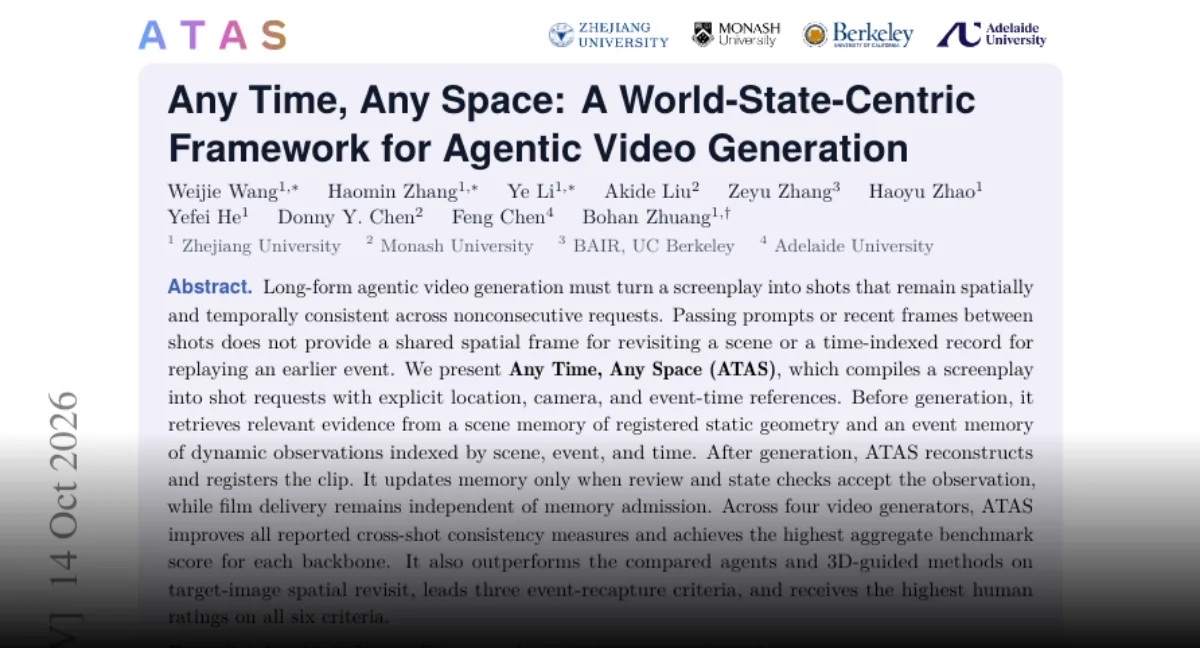
ATAS gives video agents shared scene and event memory, improving cross-shot consistency, spatial revisits, and human preference.
Key Takeaways
- ATAS introduces a world-state-centric framework that gives video agents a shared spatial and temporal reference to reduce drift across generated shots.
- It uses two memories: scene memory for stable static geometry and event memory for time-indexed dynamic observations, enabling consistent revisits and replays.
- The framework supports “different cameras, one event” continuity, helping agents maintain the same layout, event, and timing across viewpoints.
- Tested on four video generators, ATAS improved cross-shot consistency measures, spatial revisits, event recapture, and human preference results.
- Its core contribution is shifting agentic video generation from strong isolated clips toward reliable multi-shot storytelling.
Meta Description: ATAS, a world-state framework, gives video agents shared spatial and temporal memory to improve cross-shot consistency across four video generators.
Tags: ATAS, video generation, world state, camera consistency, AI video
Featured Image: Abstract technology image showing connected point clouds, camera trajectories, and linked video frames; no real people, no company logos, no text.
A framework introduced as ATAS gives video agents a shared spatial and temporal reference, addressing a persistent weakness in generative video: individual shots can look strong, while a sequence drifts. ATAS, whose name stands for Any Time, Any Space, is meant to keep a room’s layout stable when revisited and help different cameras capture the same event at the same point in time.
Background: A Strong Shot Does Not Make a Strong Story
Generative video tools can already render impressive isolated clips. The harder problem appears when those clips need to belong to one story. A room may change layout when the camera returns to it, and two viewpoints may disagree about the same moment in an event. For video agents, this means the system needs more than a prompt for each shot. It needs a shared reference for where the scene is and when the action happens.
Development: ATAS Builds a Persistent World State
ATAS is presented as a world-state-centric framework. Its core idea is to give agents a common spatial and temporal reference instead of generating each shot from scratch.
The framework uses two complementary memories. Scene memory stores registered static geometry, which helps preserve fixed parts of an environment, such as walls, furniture, and spatial relationships. Event memory stores time-indexed dynamic observations, which records changing happenings along a timeline. When a new shot is produced, the system retrieves the evidence it needs from these memories.
This design supports the “different cameras, one event” goal. An agent can revisit an earlier location or replay a past event from a new viewpoint while querying the same evolving world state. The result is a more persistent sense of continuity across shots.
Latest Progress: Testing Across Four Video Generators
ATAS was evaluated across four video generators. In those tests, it improved the reported cross-shot consistency measures. The evaluation also covered spatial revisits, event recapture, and human preferences.
Alongside the method, the project provides a project page and interactive demo, code, and a promo video. The demo lets users explore point clouds, which are 3D point sets that represent scene geometry, and camera poses, which describe each shot’s position and orientation. Linked videos show how the same world state can support multiple generated viewpoints.
Current Stage: From Shot Generation to Sequence Reliability
The current stage of the project is the transition from single-shot quality to sequence-level reliability. ATAS provides a shared reference that helps video agents keep layouts, events, and viewpoints aligned. The next signal to watch is how far such memory structures can be applied within the four evaluated video generators, especially as users test the interactive demo, review the code, and compare the reported consistency gains.
Comments
No comments yet. Be the first to comment.