
SwarmRSI Achieves Recursive Self-Improvement through an Evolving Swarm of Scientific Agents
SwarmRSI boosts AI scientist swarms by evolving shared hypotheses, programs, and feedback, reaching 76.2 on OpenProblems across 118 tasks.
Key Takeaways
- SwarmRSI argues that AI scientist agents improve less from running more agents in parallel and more from sharing what each agent learns through an evolving graph of hypotheses, programs, evidence, and open needs.
- Its core mechanisms let the swarm repair or revise work based on feedback, rebase promising hypotheses onto other programs, merge complementary components, and feed every outcome back into the shared research state.
- Across 118 scientific coding and ML engineering tasks, it reports a 76.2 average on OpenProblems single-cell, surpassing human experts at 57.2 and TusoAI at 67.1.
- On NatureBench, SwarmRSI matches published state-of-the-art results on 44.4% of tasks, and about 77% of its best final programs come from rebase, crossover, or feedback-triggered updates.
- The paper suggests the next path for AI scientists may depend less on scaling models or adding agents and more on making each agent’s results change where the next one starts.
Meta description: SwarmRSI paper reports 76.2 average on OpenProblems across 118 tasks by evolving shared hypotheses, programs, feedback, and recombinations now.
Tags: SwarmRSI, AI scientist agents, OpenProblems, NatureBench, MLE-Bench Lite
Featured image: An abstract technology-style network of evolving research states, with nodes for hypotheses, programs, feedback, and recombined components; no people, logos, or text.
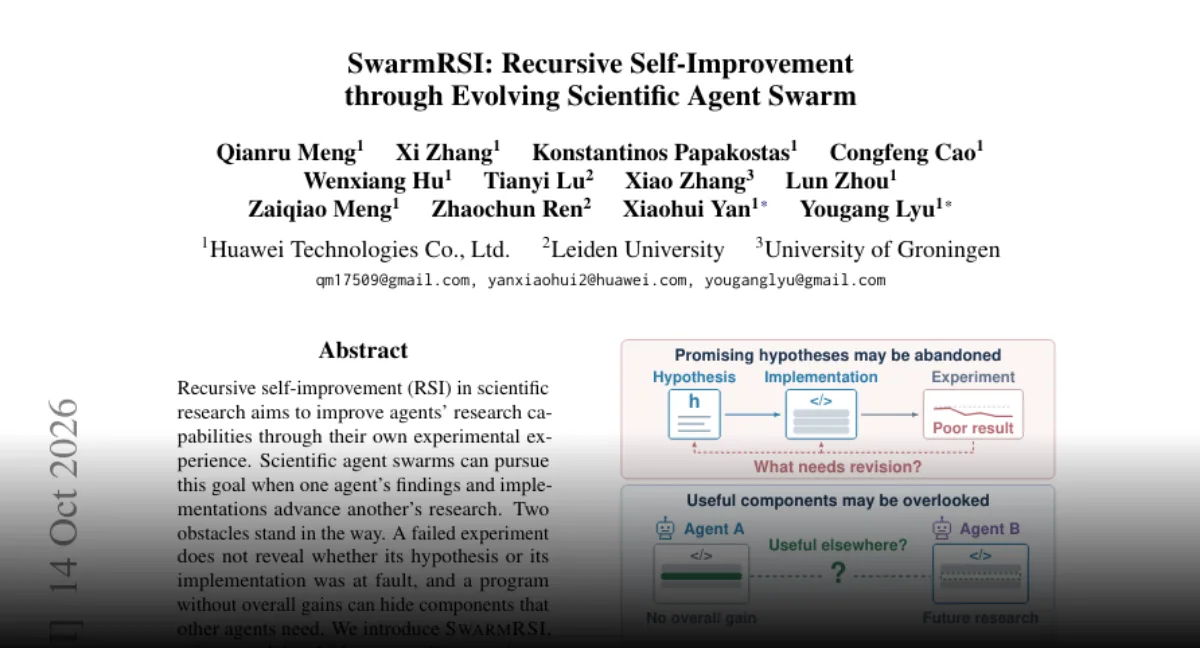
The new paper SwarmRSI: Recursive Self-Improvement through Evolving Scientific Agent Swarm argues that AI scientist agents do not become better just because more of them run in parallel. It says many swarms waste work when each agent keeps only its own best score. On 118 scientific coding and ML engineering tasks, the paper reports a 76.2 average on OpenProblems single-cell, compared with 57.2 for human experts and 67.1 for TusoAI.
Background: Parallel agents can hide useful results
The problem begins with two blind spots in agent swarms. First, a failed experiment does not show whether the hypothesis was wrong or the program code failed. Second, a program that produces no overall gain may still contain a piece that another agent needs. In the paper’s lab analogy, one student’s promising idea may be crossed off because implementation breaks, while another student’s discarded project may hold the trick that would have made it work. The result is that good ideas are abandoned and useful components are buried.
Development: A shared graph turns every outcome into inheritance
SwarmRSI changes the unit of improvement. Instead of letting each agent keep only its own best score, the swarm evolves what agents inherit. A shared graph records each research state, including hypotheses, programs, experimental evidence, and open needs.
Three mechanisms shape that graph. Feedback-Guided Swarm Mutation uses feedback from other agents to decide whether to revise the hypothesis or repair the program. Complementary Swarm Recombination does two things: it re-tests kept hypotheses on other agents’ programs, called rebase, and it merges components that complement each other, called crossover. Recursive Swarm Evolution sends every outcome back into the graph, whether it succeeded, failed, or made no gain, so each result changes where the next agent starts.
Latest Progress: Benchmark matches and follow-up biology use
The paper evaluates the method on 118 scientific coding and ML engineering tasks. For OpenProblems single-cell, it reports 76.2 average against 57.2 for human experts and 67.1 for TusoAI. On NatureBench’s 90 tasks, it says SwarmRSI matches published state-of-the-art results on 44.4% of tasks, the highest among compared methods, while the best Claude Code setup reaches 35.6%. On MLE-Bench Lite competitions, it reports medals on 81.8%, above Arbor and MLEvolve.
The reuse analysis is central to the timeline. About 77% of final best NatureBench programs come from a rebase, a crossover, or a feedback-triggered update. That suggests the value is not only in the first agent that writes a program, but in the shared graph that keeps later agents from starting from zero.
The paper also notes that biologists reproduced two of its programs and used them in follow-up studies of intestinal and splenic immunity. The paper is listed at https://arxiv.org/abs/2610.20431.
The next progress, as framed by the paper, may come less from adding more agents or scaling models, and more from making sure what one agent learns changes where the next one begins.
Comments
No comments yet. Be the first to comment.