
A new essay has divided researchers over whether AI interpretability is close to a breakthrough
Chris Cammarata says polysemantic neurons may show shared shapes or generalization, not superposition, reshaping AI safety interpretability.
Key Takeaways
- Chris Cammarata argues that famous polysemantic neurons may reflect shared shapes or ordinary generalization, not proof that AI networks arbitrarily pack unrelated concepts together.
- He proposes “recursive generalization” as an alternative explanation, suggesting neurons can expand or refine concepts in more interpretable ways.
- Preliminary language-model analysis indicates most neurons have one or two related functions, with only a small fraction remaining unexplained.
- If his interpretation is correct, it could significantly improve AI safety by making model deception and internal errors easier to inspect and correct.
- Some researchers see the work as potentially transformative, but others remain skeptical and believe superposition and interpretability challenges still persist.
A former OpenAI researcher who helped establish the mainstream view of how neural networks pack multiple concepts into single neurons now says the field's most famous evidence was misread. In a new essay, Chris Cammarata argues that what researchers long called polysemanticity—neurons firing on seemingly unrelated inputs—is often a shared-shape detector or ordinary generalization, not proof that networks arbitrarily cram unrelated concepts together. The claim matters because mechanistic interpretability underpins much of the work on AI safety: if researchers cannot reliably read a model's internal circuits, they have few ways to tell whether it is deceiving users or behaving dangerously.
Background: The Superposition Story
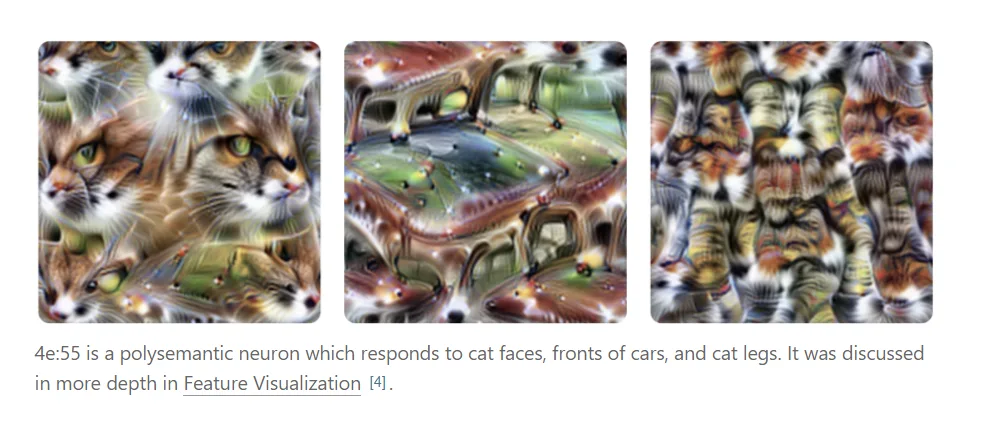
Mechanistic interpretability aims to trace how a model reaches its answers internally, not just observe its outputs. The ideal is that each of a model's millions of artificial neurons stands for a recognizable concept. In practice, many neurons appeared to fire on unrelated things. A famous early example was a neuron in the image model InceptionV1 that responded to both cat faces and the fronts of cars; Cammarata used it in his own early research.
The standard explanation was superposition: when a network runs out of neurons, it packs unrelated concepts into the same ones because they rarely interfere. The result looks like a knot, so many labs train a second model, such as a sparse autoencoder, to pull the concepts apart and study that model instead. Cammarata helped shape this view. With Chris Olah, he co-wrote the paper "Zoom In," which introduced the first superposition circuit. In 2023 he started an automated interpretability project at OpenAI, when only about 1.7 percent of neurons counted as understandable even by the most generous measure.
What Cammarata Now Says
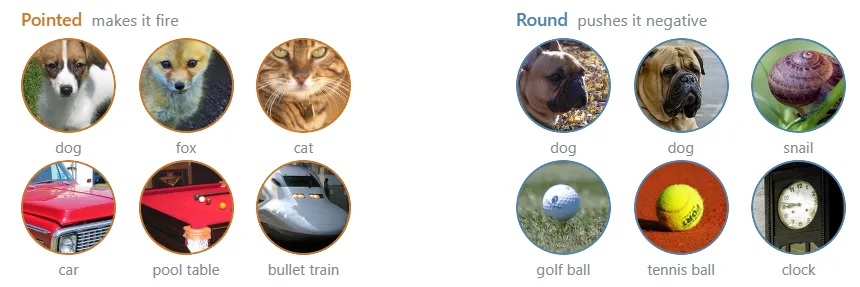
Cammarata now reads the cat-car neuron as a V-shape detector. Pointed shapes such as fox snouts or flames activate it, while round shapes such as the letter O push its activation negative. Because it responds to a shared shape rather than two unrelated concepts, he argues it is not an example of superposition.
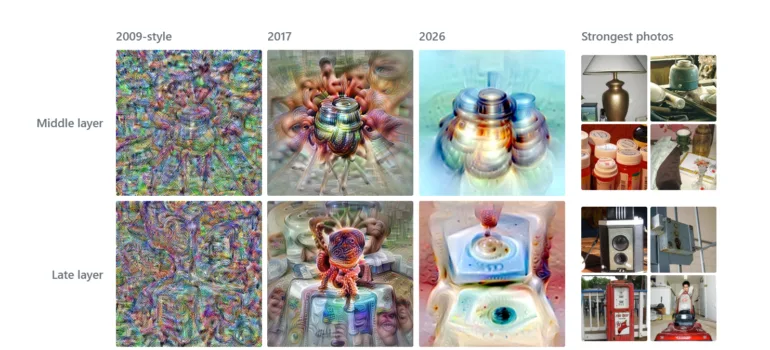
He applies the same re-reading to the superposition circuit from "Zoom In," where a car seemed to hide among dog neurons. In his view it is ordinary generalization: the circuit groups cars and dogs by which way they face the camera. He attributes the mess in InceptionV1's late layers to an outdated architecture and weak analysis tools, and says better analysis methods make response patterns and linked photos much easier to see—a reason to revisit older findings about how hard networks are to understand.
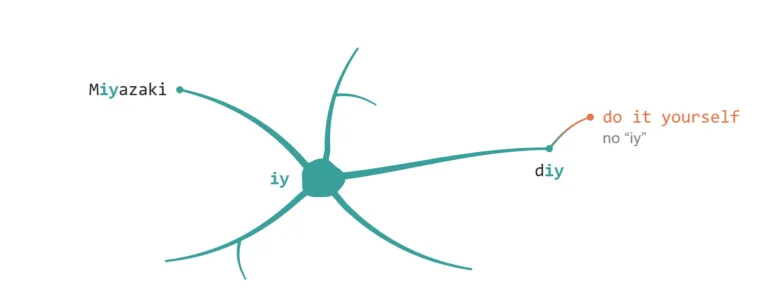
For the remaining ambiguity, Cammarata proposes "recursive generalization." A neuron grows like a branch that sprouts side shoots: one that recognized the letter sequence "iy" later responded to "diy" and eventually to "do it yourself," which contains no "iy" at all. Unlike superposition, he says, these groupings teach you something about the network.
He offers preliminary numbers for language models. In Qwen3-32B, about 90 percent of neuron poles have one main job and about 7 percent have two related ones; only 2 to 4 percent remain unexplained. Goodfire says it sees similar results in models with up to trillions of parameters. AI agents analyzing neurons in bulk did most of the work. Cammarata borrows from Rich Sutton's "Bitter Lesson" to conclude that in interpretability, too, simple investigation at massive scale beats clever decomposition methods. He does not introduce a fundamentally new method; he returns to studying neurons directly, with better tools, larger models and automated agents.
The Safety Stakes and the Pushback
If Cammarata is right, the implications for AI safety would be significant. Apart from monitoring chains of thought that keep getting less reliable, there are few ways to tell whether a model is deceiving people or behaving dangerously. Cammarata doubts alignment—steering AI toward human goals—can be solved without interpretability, because otherwise we do not know what we are building. Deception has no reason to hide from the model's own circuits, he writes; if humans become just another reader of the network, they can see the deception too, and errors might be fixed in a targeted way.
Roon, an OpenAI employee who posts under that pseudonym on X and is an influential voice in AI circles, called the work potentially "a major moment in scientific history." He said the news is so good that Eliezer Yudkowsky, one of the most prominent voices warning of an AI catastrophe, will have to lower his estimated odds of doom, and that alignment could become a "normal science." Even Roon has reservations: others still need to confirm the results, and he suspects interpretability breakthroughs will push capabilities forward—and that they are coming from outside the big labs, OpenAI included.
Neel Nanda, a founding figure of mechanistic interpretability who leads the interpretability team at Google DeepMind after stints at Anthropic and as an independent researcher, is far more measured. He says his views have shifted since mid-2024 toward pragmatic approaches, and his team deprioritized sparse autoencoder research—not because the technique was useless, but because it did not seem worth the field's effort. Cammarata's work is interesting but does not change the big picture, Nanda writes. Neuron-based analysis could help with practical questions, such as why a model did something questionable, and is easier to apply to frontier models, but he does not buy that interpretability is close to being fully cracked, and expects the approach to have serious flaws and miss a lot.
Nanda still thinks superposition is real: language models store far more facts than they have neurons, and weak activations in particular likely hold much of that information. He doubts findings from small image models carry over, and thinks the essay defines monosemanticity too loosely, though he credits Cammarata for checking old work with modern tools. Part of the dispute is definitional: Cammarata has no problem with models representing more concepts than they have dimensions, and Nanda sees him as agreeing on that point. What Cammarata disputes is that networks arbitrarily pack completely unrelated things together.
What to Watch
The technical companion paper has not been released, and Goodfire, as an interpretability company, has an obvious stake in the thesis. If Cammarata's reading holds up, he thinks automated researchers could do in months what took humans nearly a decade with image models—and he writes that there may not be much time left for that. The immediate test is independent confirmation of the neuron-level results, particularly whether the pattern in Qwen3-32B and larger models survives scrutiny beyond Goodfire's own analysis.
Comments
No comments yet. Be the first to comment.