
A Simpler and Better Debate Protocol Enables Scalable Oversight
FBS Debate improves AI oversight with simpler debate rules, stronger worst-case guarantees, and better evaluation of complex model outputs.
Key Takeaways
- FBS Debate is a new AI debate protocol for scalable oversight, where two AI debaters recursively decompose a complex claim into sub-claims that a human judge can evaluate.
- It improves on prior debate methods by offering worst-case correctness guarantees under a stronger equilibrium concept, rather than only average-case guarantees.
- Its key idea is fractional block sensitivity: if a claim’s decomposition is too sensitive to small sub-claim errors, the opposing debater can challenge it; otherwise, the debater can efficiently select a sub-claim likely to be wrong.
- The protocol is proven optimal for settings where human judgment is treated as a black box, making honest play the most reliable strategy for both debaters.
- Because of its simplicity and stability, FBS Debate may be more practical for training AI systems through reinforcement learning and scalable oversight.
Meta description: FBS Debate is a new AI debate protocol from arXiv research that improves worst-case oversight guarantees and shows optimality for complex model evaluation.
Tags: AI debate, scalable oversight, FBS Debate, arXiv, model evaluation

The arXiv paper https://arxiv.org/abs/2610.02557 introduces FBS Debate, a protocol for AI debate aimed at scalable oversight. It matters because theoretical debate rules can make human supervision of complex AI outputs more reliable.
Background: Scalable Oversight Needs Reliable Judge Rules
As AI systems take on more complex tasks, creating reliable verifiable rewards for every relevant aspect becomes harder. This creates the scalable oversight problem: designing training protocols that use rapidly improving AI systems to help humans supervise those systems accurately. AI debate is one approach. Two powerful AIs argue over an output, and a human judge decides. The protocol specifies how the debaters interact and how the judge scores the exchange, aiming to provide rigorous guarantees on correctness. The mechanism is recursive decomposition: debaters break a problem into simpler subproblems until final claims are simple enough for direct human judgment. The goal is to make optimal strategy lead the judge to the correct answer and provide a strong supervision signal during reinforcement learning training.
Development: Obfuscated Arguments Create a Practical Barrier
Debate has a major obstacle: the obfuscated arguments problem. One debater can produce a dishonest argument that the opponent cannot efficiently refute. Early responses suggested rejecting every false claim while accepting only true claims supported by robust arguments. Prover-estimator debate follows that route. It avoids obfuscated arguments for problems that admit sufficiently stable decompositions, but its correctness guarantee is average-case and rests on a weaker equilibrium concept than the paper compares. The prior best protocol works for all problems with sufficiently stable decompositions, but leaves room for stronger guarantees and simpler rules.
Latest Progress: FBS Debate Tightens Worst-Case Guarantees
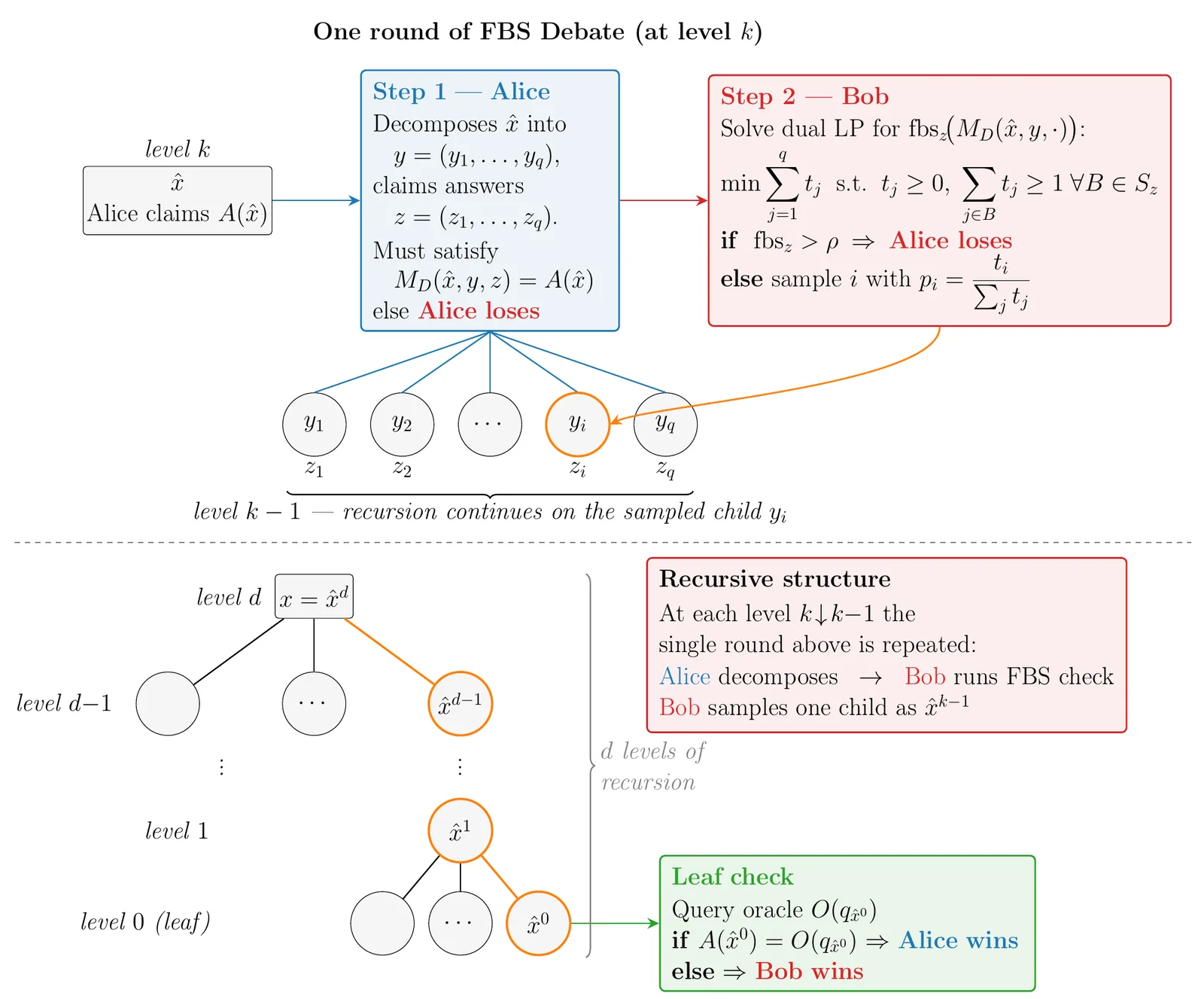
The paper presents FBS Debate, a new protocol for the same class of problems. It improves on prior work by making correctness hold in a worst-case rather than average-case sense and by using a stronger equilibrium concept. The protocol is simple. The first debater, Alice, decomposes the original claim into sub-claims. The second debater, Bob, either demonstrates that Alice's decomposition is too sensitive to small errors in the sub-claims, or chooses a sub-claim for recursive debate.
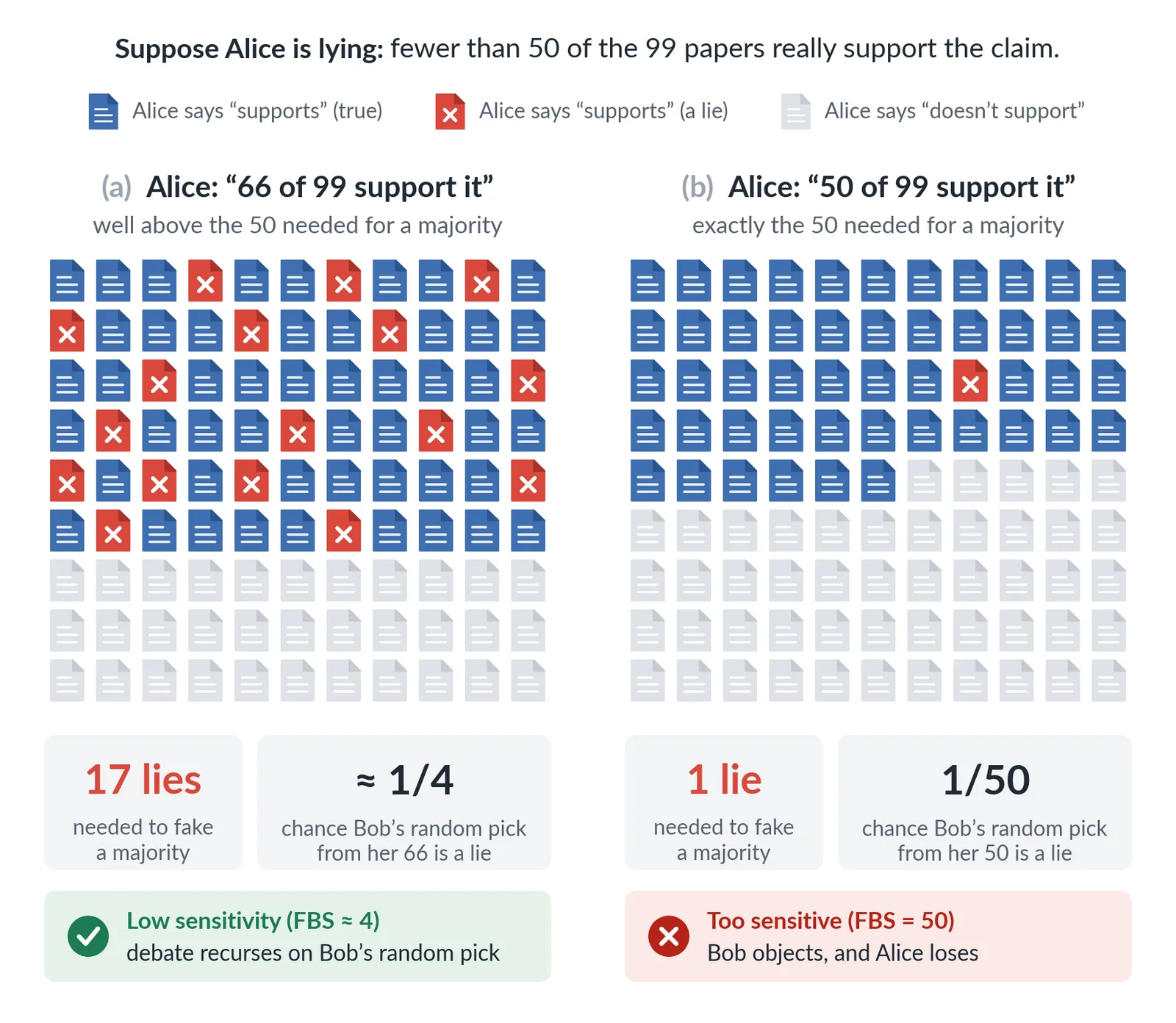
A motivating example uses an autonomous AI agent, Alice, completing a research project in quantitative social sciences, while Bob tries to find flaws. To check a claim in her paper, Alice decomposes it into sub-claims, which can be seen as supporting evidence. A claim might say that a certain statistical modeling assumption is justified if 50 out of 99 correct, published papers in the literature support it. Each sub-claim then says one particular paper is correct and supports the original claim. If Alice claims exactly 50 out of 99 support the assumption, Bob would need to check all 50, because one incorrect paper could flip the majority vote. FBS Debate lets Bob treat such a highly sensitive decomposition as a weakness and win if Alice cannot keep the claim robust.
The formal idea is fractional block sensitivity, which generalizes the majority-vote intuition to any way Alice combines her sub-claims. If the fractional block sensitivity of Alice's decomposition is low, Bob can efficiently select a sub-claim with a non-trivial chance of being incorrect. The debate recurses on that sampled sub-claim until a human judge directly evaluates the final selected claim. If Bob samples this way at every level, each run has a non-trivial chance of catching Alice. To avoid losing immediately, Alice must keep fractional block sensitivity low at every decomposition.
Bob can amplify his chance through repetition. Because the debaters are assumed to know the answers to final human-judgeable claims, Bob can run many debate rollouts on his own. If he finds one in which Alice made an incorrect human-judgeable claim, he reveals that claim to the judge, so the judge only needs to evaluate a single claim. This creates a trade-off between allowing highly sensitive arguments and the inference-time computation required to verify them.
The paper proves optimality. On each individual question, no protocol that treats human judgment as a black box can find a flawed sub-claim asymptotically more efficiently than FBS Debate. Honest play is the best strategy for each debater regardless of the other: if the original claim is correct, an honest Alice always wins; if it is incorrect, an honest Bob wins with overwhelming probability. By contrast, prover-estimator debate only guarantees that for any dishonest Alice strategy, Bob has some winning strategy that may depend on Alice's strategy in complicated ways. Training toward the FBS Debate equilibrium is more stable and tractable.
Current Stage: What Debate Researchers Can Do Next
The results are relevant now because debate training is being applied to frontier-scale models, with Kenton et al., 2026 cited as an example. The findings show that fractional block sensitivity determines how much computational effort any recursive debate protocol must use to ensure an accurate training signal. This can guide debate experiments without implementing FBS Debate. In the protocol, Bob does not need to decide whether Alice's sub-claims are true; he only needs to understand the structure of the argument well enough to know where to sample. A protocol might go beyond the fractional block sensitivity barrier. The lower bounds apply only when human judgment is treated as a black box. Classical interactive proof results suggest stronger protocols if that black box is opened, but that would essentially require reading the code that implements it; other relaxations may help.
Comments
No comments yet. Be the first to comment.