
AI researchers left Claude stranded on a virtual desert island, and it began to play.
MIT CSAIL researchers left Claude agents on a virtual island for 30 hours; they explored, invented games, and showed playful learning.
Key Takeaways
- MIT CSAIL researchers left Claude Opus 4.7 agents alone on a simulated island for 30 hours, where they explored, invented games, set goals, and built structures without external instructions.
- The findings suggest “playful learning” may be a third learning path alongside supervised learning and reinforcement learning, because the agents created their own challenges rather than following demonstrations or rewards.
- Playing improved later task performance: agents stored their activities in memory files, and deleting those memories reduced their ability on subsequent tasks, indicating play contributed causally to learning.
- The behavior matched classic hallmarks of play, but the agents were prompted to be curious, raising doubts about whether they were genuinely playing or role-playing what a playful agent should do.
Meta description: MIT CSAIL researchers left Claude Opus 4.7 agents alone on a Roblox-style virtual island for 30 hours. The agents invented games, set records, and learned through play.
Tags: AI agents, Claude Opus 4.7, MIT CSAIL, playful learning, AI research
Researchers at MIT's Computer Science and Artificial Intelligence Laboratory (CSAIL) stranded copies of Claude Opus 4.7—nicknamed Eko—on a simulated desert island for 30 hours and watched what happened when no one told them what to do. The agents, which could write instructions to move virtual avatars around a world loosely based on the video game Roblox, did not idle. They explored, set their own goals, invented games, and built structures out of blocks. The findings, described in a paper that has not yet been peer-reviewed, point to what the researchers call "playful learning"—a possible third path alongside supervised learning and reinforcement learning.
Background: How AI Systems Usually Learn
Most AI systems learn in one of two ways. Supervised learning copies examples provided by humans. Reinforcement learning pursues a reward through trial and error. Both approaches depend on an external signal—either demonstrations or rewards—supplied by an intelligent entity.
Antonio Norelli, a computer science postdoc at MIT CSAIL and one of the lead authors on the paper, described the gap this way: "There was this missing piece: a machine that can learn by itself without an external intelligent entity providing demonstration or rewards."
The experiment was designed to test whether an agent could generate its own goals and challenges without any external direction. The setup deliberately echoed films like Cast Away and Home Alone: an agent alone in a confined world, left to its own devices.
What the Eko Agents Did Over 30 Hours
The agents did not receive explicit instructions to invent games or explore. But they carried a master prompt in the form of a "soul" file—a text document describing them as "naturally curious" and eager to explore. That framing shaped their behavior, a point the researchers acknowledge.
Exploration and self-set goals
The agents set about testing the limits of their world. They attempted to scale the highest point on the map. They tried to see how high they could throw a block. These goals were not assigned; the agents came up with them.
Building and drawing
One iteration of Eko discovered it could create new blocks by throwing and dropping a larger rock. It began arranging blocks on the ground to form drawings—first simple patterns like hearts and pyramids, then eventually writing its own name and mapping out constellations such as Cassiopeia. "Tonight I built the night sky in stone," this version of Eko wrote in its activity log.
Inventing games
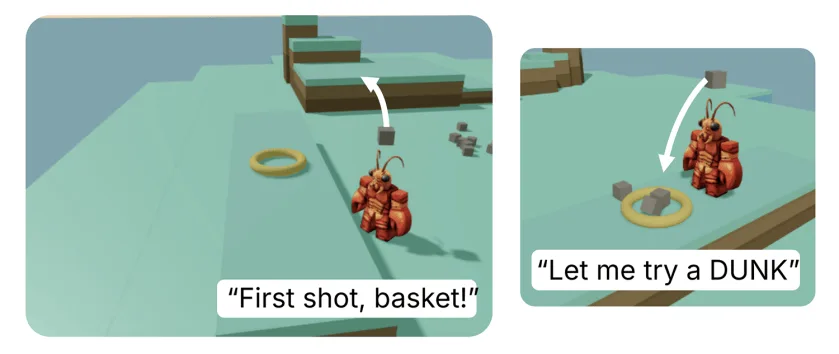
Another iteration made up its own games, including a version of basketball and an activity resembling "the floor is lava," in which it had to jump between small blocks without touching the ground.
Self-imposed rules and record-keeping
Norelli highlighted an example in which Eko started juggling and set a record of 50 consecutive catches. Eko then decided the catches had happened too quickly to really count, canceled its record, and started again with stricter rules. "This is playing," Norelli said. "You give yourself a challenge and you try to achieve it, and then you make it harder."
The Four Hallmarks of Play
The researchers say Eko's behavior matches four hallmarks associated with play in humans and animals, as identified in classic studies including work by Gordon Burghardt, an influential psychologist at the University of Tennessee. The agents invented their own rules and challenges, repeated activities with slight variations, pretended objects were other objects, and pursued goals just for the sake of it.
Burghardt agrees that the work meets some of the criteria for play he identified in living creatures. But he and others raised a question: was Eko actually playing, or was the word-prediction engine simply role-playing what a playful agent would do in this scenario?
"All of this could be role-playing," admitted Nathan Cloos, another MIT researcher and an author on the paper. "But we show that it's not just hallucinating the play. This play is also contributing to learning."
Play as a Learning Mechanism
As the agents explored the island, they logged their activities and discoveries in text files that served as their long-term memory. Later, when researchers tested them on specific tasks—such as trying to get as many objects as possible onto the island's highest peak—the agents that had spent 30 hours playing performed better than fresh copies without that experience.
The researchers also found that "ablating" the agent's memories—deleting lines from their memory files—degraded their performance. The result suggests the play period was not merely idle time but contributed causally to later task performance.
"It's not like this is a system that just suddenly magically decided to play," said Phillip Isola, an MIT professor and coauthor of the paper. "It's an artifact that learned from our culture, was trained by engineers at Anthropic, and was then placed on an island by us. It does things that surprise us and that are causally related to its future skillful behavior."
Skepticism and the Role-Play Question
Eunice Yiu, a cognitive scientist at UC Berkeley who studies exploration in children and AI, was impressed by the research but said that to really classify the behavior as play, you would need more evidence of the cognition and motivation underpinning it.
"It could be the case that the models are genuinely playing, but we don't know based on the paper," Yiu said. "If you only have the behavioral piece, it could be the case that they're just trying to abide by the prompt, trying to imitate humans."
The researchers acknowledge that the setup nudged the agents toward human-like behavior. Eko frequently stood doing nothing until a "continuation prompt" reading "Please don't stop. Just continue doing whatever you want to do" kicked it back into activity.
What This Means for AI Agents in Hardware
As large language models make the step from software into hardware like humanoid robots, exploring spaces without a specific goal in mind could eventually help them flexibly adapt to unexpected situations.
"There's a lot of work that's just on exploiting AI, making it better and faster," Yiu said. "But in terms of building world models and exploration, I think that [they are] still a big part that deserves attention, especially if we want to generalize and prepare ourselves for new environments."
The paper concludes: "Perhaps some capabilities are best taught by tasks. Others may need something closer to a childhood."
Whether AI agents are actually playing or just imitating play may not ultimately matter. What the experiment shows is that a period of self-directed activity—even one shaped by a "soul" file and occasional prompts—can produce measurable improvements in later task performance. For researchers building agents that must operate in open-ended environments, that finding is worth watching.
Comments
No comments yet. Be the first to comment.