
SoloQ Enables Calibration-Free Quantization for Diffusion Language Models
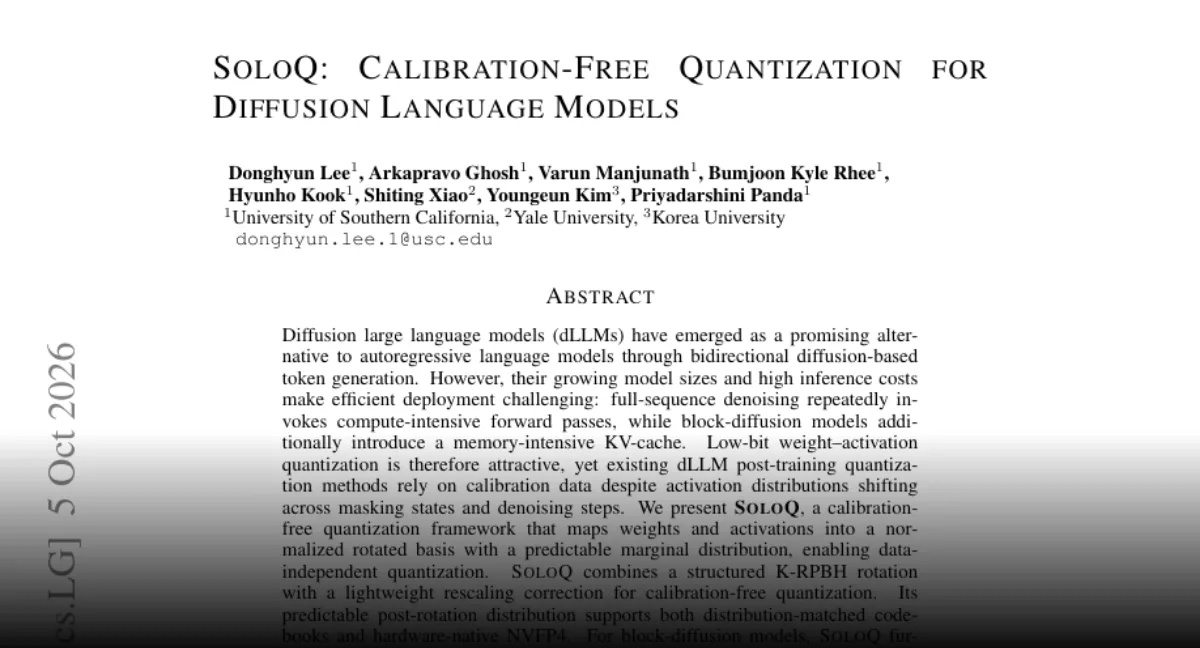
SoloQ enables calibration-free 4-bit quantization for diffusion LLMs, cutting peak memory by 2.61X and speeding inference by 2.24X.
Key Takeaways
- SoloQ is a calibration-free quantization framework for diffusion large language models, targeting lower deployment costs caused by repeated denoising and memory-heavy inference.
- It compresses weights, activations, and persistent cache states into low-bit formats without relying on calibration data, avoiding issues from unstable activation distributions during diffusion generation.
- The method uses rotated normalized representations, structured K-RPBH rotation, and lightweight weight rescaling to enable predictable distributions suitable for quantization.
- For block-diffusion models, SoloQ introduces commit-time key-value cache quantization, reducing cache pressure without disturbing the actively denoised block.
- In reported tests, SoloQ maintains 4-bit accuracy across diffusion models and outperforms calibration-based baselines, while NVFP4 support cuts peak memory by up to 2.61X and speeds inference by up to 2.24X.
Meta description: SoloQ's calibration-free 4-bit quantization for diffusion large language models cuts peak memory by up to 2.61X and speeds end-to-end inference by up to 2.24X.
Tags: SoloQ, Diffusion LLMs, Quantization, NVFP4, AI inference
Featured image: Abstract neural network diffusion lattice with compressed low-bit blocks, cool gradients, no real people, no company logos, no text.
SoloQ, a calibration-free quantization framework, is designed to make diffusion large language models easier to deploy by reducing the cost of repeated denoising. These models have emerged as a promising alternative to autoregressive language models because they generate tokens through bidirectional diffusion-based token generation. The practical question is whether they can be served without large memory footprints and expensive inference passes. SoloQ addresses that question by compressing weights, activations, and persistent cache states into low-bit formats without relying on calibration data.
Background: Diffusion Models Move From Capability to Cost
The first phase of this story is architectural. Diffusion large language models use bidirectional diffusion-based token generation, which contrasts with autoregressive language models that generate tokens step by step in one direction. That design can be attractive, but growing model sizes and high inference costs make efficient deployment challenging.
Two technical bottlenecks appear in the serving path. Full-sequence denoising repeatedly invokes compute-intensive forward passes, so each generated sequence requires many model evaluations. Block-diffusion models introduce an additional burden: a memory-intensive key-value cache, which stores persistent state and increases pressure on serving hardware.
Development: Quantization Becomes the Next Bottleneck
Low-bit weight-activation quantization is a natural response because it reduces the storage and compute footprint of model weights and activations. Yet existing post-training quantization methods for diffusion large language models rely on calibration data. That reliance becomes fragile in this setting.
Activation distributions do not remain stable. They shift across masking states and denoising steps. A calibration snapshot that captures one stage of the diffusion process may not represent another, which means quantization can distort the distributions that change most during generation.
Latest Progress: SoloQ Removes the Calibration Requirement
SoloQ is presented as a calibration-free quantization framework. It maps weights and activations into a normalized rotated basis with a predictable marginal distribution, enabling data-independent quantization. The method combines structured K-RPBH rotation with a lightweight weight rescaling correction for calibration-free quantization.
The predictable post-rotation distributions support two practical paths: distribution-matched codebooks and hardware-native NVFP4. For block-diffusion models, SoloQ also applies commit-time key-value cache quantization. This compresses persistent states without perturbing the actively denoised block, so cache reduction does not directly disturb the block being processed during generation.
Current Stage: 4-Bit Accuracy and Hardware Gains
The reported results cover two classes of models. Across full-sequence diffusion large language models LLaDA and Dream, and block-diffusion models Fast-dLLM v2 and Nemotron-Labs-Diffusion, SoloQ retains accuracy under 4-bit quantization. It also outperforms calibration-based baselines on knowledge- and reasoning-intensive benchmarks.
With NVFP4, the framework reduces peak memory by up to 2.61X and accelerates end-to-end inference by up to 2.24X.
For readers following diffusion-based generation, the current stage is a shift from architecture debate to deployment feasibility. SoloQ shows that calibration-free quantization can address the memory and compute pressure created by repeated denoising and persistent cache state. The next question is how far these gains extend beyond the reported 4-bit settings and NVFP4-enabled hardware.
Comments
No comments yet. Be the first to comment.